
PA11 Yarn Moisture Conditioning and Package Dyeing Notes
PA11 is a bio-based polyamide 11 filament that mills increasingly specify for swimwear, sportswear and outdoor fabrics. It dyes well, but the results depend heavily on two process steps that buyers rarely discuss at the negotiating table: moisture conditioning before dyeing and package density control on the dye carrier. Get either one wrong and you will see uneven shade, ring dyeing, or package-to-package variation that no after-treatment can fix. This note explains what happens inside a PA11 package during conditioning and dyeing, and how to write realistic acceptance criteria into your purchase contract.
Why Moisture Content Matters Before Dyeing
Polyamide absorbs water from the atmosphere, and PA11 sits between nylon 6 and nylon 66 in equilibrium moisture uptake. When yarn is wound into a package, the outer layers equilibrate faster than the core. If incoming packages arrive at different moisture levels, one shift, one factory, or one season versus another, the dye uptake during the first minutes of the exhaust cycle will differ. The core of a dry package wetts out more slowly than the core of a conditioned one, and the dye molecules race ahead on the wetter zones. The result is a classic core-to-surface shade difference that only shows up after the package is wound into fabric.
Practical mills therefore pre-condition packages before dyeing rather than loading them straight from storage. The standard approach is to rest the packages in a controlled room or to run a slow pre-wet cycle at low temperature so the whole package reaches a uniform moisture level before the dye liquor arrives. The exact conditioning time depends on package weight, wind density and ambient humidity, so treat any published number as a starting point and verify on your own packages.
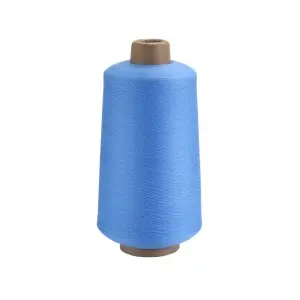
Package Density and Liquor Flow
Dye liquor in a package dyeing machine is forced through the package under pressure. If the winding density is too high, the liquor channels along the least resistant path and the center of the package stays under-dyed. If it is too low, the package distorts, filaments migrate and the dyeing becomes irregular in a different way. For PA11 filament, most dyehouses work within a moderate density window and check every package on a hardness tester before loading. A soft or over-dense package should be rewound, not dyed as-is.
Buyers should ask their yarn supplier two questions at the sampling stage. First, what is the recommended winding density range for the package form you will receive, cheese or cone. Second, has the yarn been lubricated and intermingled so it unwinds cleanly on your rewinding line without filament breakage. Both answers affect dye penetration more than any dyeing recipe adjustment later.
Dye Bath Behavior of PA11
PA11 takes acid dyes well because the polyamide chain offers the same dye sites as conventional nylons, but the fiber has a slightly different glass transition and thermal history. Mills moving from PA6 or PA66 recipes to PA11 usually need to slow the initial temperature ramp and hold a longer absorption plateau so the dye levels out before fixation. Rapid ramping produces the same defects as poor conditioning: a darker surface and a pale core.
- Run a lab dip on packages wound to your production density, not on loose skeins, because liquor flow through a skein is not representative of a compressed package.
- Record the lot number and conditioning state of every package set in the lab trial so the production recipe can be traced back to a consistent starting point.
- Agree on a color tolerance with your customer before bulk dyeing, and specify whether assessment is done under a single light source or multiple ones.
- Check the shade stability across the package cross-section by re-winding sections of a test package after dyeing, since surface inspection alone will not reveal a pale core.
Writing Acceptance Criteria into the Contract
A moisture and dyeing clause does not need to be complicated, but it must be measurable. Reasonable items include the following.
- Specify the delivery moisture range for packages, and state that packages outside the range are subject to re-conditioning before use at the supplier’s cost if the deviation causes shade defects.
- Require a lab dip report per lot, with the package density, dye bath recipe summary and light source conditions stated on the report.
- Define the shade acceptance method: gray scale rating, instrumental color difference values, or both, and who performs the assessment.
- Agree on a re-dye policy for packages found off-shade at incoming inspection, including the time window for raising the claim.
Without these clauses, disputes usually collapse into an argument about whether the defect came from the yarn, the conditioning room or the dyeing machine, and the buyer has the weakest evidence position. Tip: Always photograph and retain one full test package from each dyed lot until the fabric it feeds is approved, because a re-wound package is the only physical proof of core dyeing uniformity.
Common Failure Patterns and What They Point To
Reading the defect tells you where the process broke. A uniform shade difference between packages points to bath control or lot variation, not conditioning. A radial shade gradient within a single package points to density or liquor flow problems. A layer effect, where outer windings differ from inner windings, points to uneven moisture at the start of the cycle. A pale core with a correct surface is the classic signature of an over-dense package or an insufficient pre-wet. Mills that log defect type against process parameters build a correction table within a few production cycles, and that table becomes the most useful document in the dye house.
Suppliers can help on the incoming side. A filament producer that controls package moisture at dispatch, prints lot and date codes on every package, and provides recommended conditioning guidelines gives the mill a stable starting point. When you evaluate a PA11 yarn source, ask for a sample technical data pack covering moisture, package form and dyeing recommendations, and compare it against what your dye house actually runs.
Related Pages
- Hot Melt Yarn vs Adhesive Film
- Low Melting Yarn vs Regular Yarn
- Bulk Yarn Order Timeline Explained
- Yarn Bulk Order Planning Guide
Post time: Nov-18-2026