
PA11 Yarn for Circular Knitting: Tension and Run-Off Control
Circular knitting mills that switch from conventional polyamide to bio-based PA11 yarn often see stable stitch quality once the machine is set up correctly, but the first production run usually exposes a gap in tension discipline. PA11 is softer, has a lower melting point, and behaves with more elasticity than PA6 or PA66, so it demands a different approach to feed tension, take-down, and run-off timing. This guide focuses on the two parameters that decide fabric yield on the machine: tension control and run-off management.
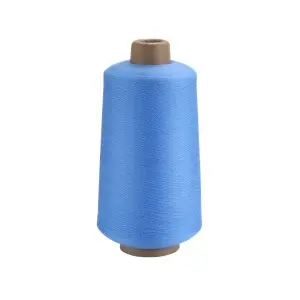
Why PA11 Needs a Different Knitting Setup
PA11 is extruded from castor-oil feedstock, which gives it a lower modulus and higher elongation at break than petroleum-based nylon 6 or nylon 66. On a single jersey or rib circular machine, that translates into a yarn that springs back more after deformation. If the feeder tension is carried over directly from a PA66 program, loops tend to close unevenly and the fabric shows vertical barre across the course. The remedy is not a single fixed number but a controlled band that matches the machine gauge, the yarn denier, and the lubricant level on the package.
Tension Control: Where to Measure and What to Hold
Measure feed tension at the feeder, not at the creel, because the path between creel and needle can add friction that the meter at the creel will never show. A practical starting band for PA11 flat or textured yarn on fine gauge machines is 3 to 6 grams per feeder, adjusted upward only when the stitch becomes unstable. Keep these checks in the mill routine:
- Verify tension meter calibration weekly; a drift of 1 gram changes loop length on lightweight gauges.
- Set the same tension on every feeder; feeder-to-feeder variation above 1.5 grams produces visible stripes.
- Pair tension with take-down force so the fabric is held evenly without over-stretching the relaxed PA11 loop.
- Watch the lubricant film; too little raises friction and spikes tension, too much causes slippage at the drive.
The goal is a consistent loop length across the full width, because PA11′s elasticity will exaggerate any small imbalance into a permanent visual defect after relaxation.
Run-Off Control and Stitch Uniformity
Run-off is the moment the held loop releases from the needle, and it is where PA11′s low friction and high spring-back matter most. If run-off is late, the stitch is tight and the fabric feels boardy; if it is early, the loop elongates and loses definition. Control it through needle timing, sinker position, and a clean yarn path with no extra guides that add micro-tension. Mills running PA11 for the first time should run a short gray-cloth trial and measure loop length at five points across the tube before committing to a full order. Keeping run-off timing uniform is the single biggest lever on first-pass yield.
Tip: Run the first PA11 lot at 10 to 15 percent lower machine speed than your PA66 baseline and re-measure loop length every 200 meters, because a stable start prevents the cumulative drift that later shows as width variation after relaxation.
PA11 vs PA6 and PA66 in the Knitting Zone
The three polyamides are not interchangeable on the same program. PA6 softens earlier and is easier to knit but loses dimensional stability in heat. PA66 holds shape under higher temperature yet is stiffer and noisier on the needles. PA11 sits between them on temperature but leads on flex life and softness, which is why it is chosen for premium seamless and next-to-skin knits. The trade-off is narrower process tolerance: PA11 rewards tight tension discipline and punishes sloppy run-off timing more than the other two, so budget extra machine time for the first qualifying run.
Procurement Specs for Knitting Mills
When sourcing PA11 yarn for circular knitting, request a spec sheet that goes beyond denier and color. Ask the supplier for:
- Linear density and filament count, matched to machine gauge and target fabric weight.
- Twist level and intermingling points per meter, which decide running stability on the feeder.
- Lubricant type and add-on percentage, since it directly affects friction and tension.
- Shrinkage in boiling water and relax shrinkage, to predict post-knit dimensional change.
- Evenness (CVm) and knot-free package claim, because knots cause stops and dropped stitches.
Confirm the package form suits your creel and that the cone taper does not trap the yarn during unwinding, as that alone can multiply breakage on a high-speed machine. A clear spec sheet signed by both sides removes most disputes before the yarn reaches the floor.
Verifying Sustainability Documentation
A bio-based claim is only as strong as the paper behind it. Before signing, ask for the renewable carbon content test and the chain-of-custody certificate, then check three things: the certificate issuer is accredited, the lot number on the document matches the shipped lot, and the bio-based percentage is stated as a measured value rather than a marketing range. Keep one archived copy per shipment so a future audit can trace the claim back to the exact order without reconstruction. Treat the chain-of-custody file as part of the product, not an afterthought.
FAQ
Can PA11 run on the same machine settings as PA66?
No. Carry tension and speed down from the PA66 baseline and tune feeder by feeder, because PA11′s elasticity makes old settings produce barre and width drift.
What is the first sign of poor run-off control?
Uneven loop length across the tube and a boardy or over-stretched feel; measure loop length at several points before scaling the lot.
Which certificate proves the bio-based claim?
A renewable carbon content test plus an accredited chain-of-custody document, with the lot number matching the shipped material.
Related Pages
- Hot Melt Yarn vs Adhesive Film
- Low Melting Yarn vs Regular Yarn
- Bulk Yarn Order Timeline Explained
- Yarn Bulk Order Planning Guide
Post time: Nov-13-2026