
Yarn Package Form and Unwinding Performance: A Sourcing and QA Guide for Textile Mills
For fabric mills and sourcing managers buying bio-based nylon yarn (PA11, PA56), low-melt yarn, or hot-melt filament in container volumes, the package the yarn arrives on is not a trivial logistics detail. The choice between a tapered cone, a straight parallel tube, or a hank directly affects unwinding speed, end-breakage rates at the knitting or warping machine, and the labor cost hidden inside every production hour. Too often, mills evaluate a supplier solely on denier consistency and price, then discover during the first production week that the supplied incoming package form forces a 15–25% reduction in machine speed or produces a steady stream of breaks that no operator adjustment can fully eliminate. This guide consolidates the practical details that purchasing, warehouse, and QA teams need to specify, verify, and receive yarn packages that actually run on their equipment.
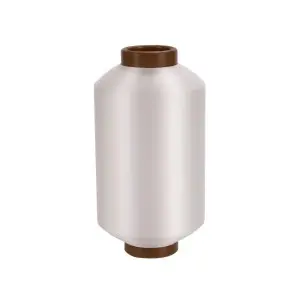
Package Types: Choosing Between Cone, Straight Tube, and Hank
For most continuous-filament nylon yarns used in warp knitting, circular knitting, and weaving, the cone (tapered package) is the default and usually the correct choice. Cones are wound on a tapered support so the outer diameter decreases from base to tip, which lets the yarn be withdrawn at a consistent angle and tension across the full build. A standard 4-degree, 20-minute cone holds roughly 1.5–5.0 kg of yarn depending on denier and winding density, with heavy cones reaching 8–10 kg for coarse deniers in loom-state weaving. The tapered geometry keeps the unwinding balloon stable and keeps the rate of tension change low as the package empties.
Cones and taper angles
Most knit and weave mills standardize on 4°20′ (commonly called 4-degree) cones for filament yarns up to about 200 dtex, and 3°30′ or 5°57′ cones for heavier or coarser counts. The taper angle matters because it determines the lift height and traverse compatibility of the creel or take-off. A cone that fits the creel holder but has the wrong taper will seat poorly, wobble at speed, and create periodic tension spikes that the knitter reads as barré or as intermittent tight spots in the fabric. Specify the cone angle, the base diameter, and the bore (tube inside diameter) in every purchase order, not just the cone weight.
Straight (parallel) tubes
Straight tubes — parallel-wound packages on a cylindrical support — are common for yarns that will be rewound in-house, for certain air-jet weaving setups, and for some twisting or cabling operations where a precise parallel wind reduces snarling during downstream processing. A parallel package is easier to label and stack, but it unwinds less cleanly than a cone at high speed because the withdrawal angle changes more across the build. For high-speed warping above roughly 800 m/min, a cone almost always outperforms a straight tube on end-breakage. Choose straight tubes when you intend to rewind onto your own cones or when your creel is built for parallel holders; otherwise prefer cones.
Hank / skein format
Hank (skein) winding is largely reserved for specialty, low-volume, or dyehouse formats where the yarn must be open to liquor circulation during dyeing or for small-batch sampling. A hank is the worst format for direct machine feeding: it must be re-wound onto a cone or tube before it can be knit or woven, adding a process step and a rewinding loss of roughly 0.5–2.0%. Avoid specifying hank for production volumes unless dyeing or finishing requires it. For a bio-based nylon that will be piece- or yarn-dyed, confirm whether your dyer requires hank or can accept cone-dyed packages, because cone dyeing (with proper package density control) removes the entire rewinding step.
Winding Density and Tension: How They Drive End-Breakage
End-breakage at the machine is the single biggest hidden cost in yarn receiving. A break interrupts production, requires operator intervention, and on warping machines can scrap an entire beam. The two winding parameters that most influence break rate are winding density (how tightly the yarn is packed onto the support) and the winding tension used during package formation at the supplier’s winding plant.
Typical winding tensions for nylon filament run between 8 cN and 25 cN, with finer deniers at the lower end and coarse or high-tenacity yarns at the upper end. If the supplier winds too tightly, the inner layers of the package are compressed; when the yarn is withdrawn, these layers spring back and can bind, producing a “package stiffness” that raises withdrawal tension by 20–60% over the outer layers. If the supplier winds too loosely, the package is unstable, edge folds and collapses, and sloughing (sudden yarn release) causes tangles and breaks.
Winding density is usually expressed as package bulk density in g/cm³. For nylon filament on cone, the practical range is about 0.45–0.75 g/cm³ package bulk density; pushing above 0.8 g/cm³ risks inter-layer fusion on low-melt or hot-melt yarns, where the bonding filament can partially activate under stored pressure and heat. For low-melt and hot-melt products, ask the supplier to keep density toward the lower end of that range and to declare the maximum package temperature during storage, because fusion defects are nearly impossible to detect at receiving and only appear as lumps during knitting.
A useful acceptance check is the slip-and-withdraw test: at the creel, run the yarn at your normal production speed for the first 200–500 meters of each sampled cone and log the tension trace. A well-wound cone shows a tension band that stays within a narrow window (often ±10–15% of the mean) from full to near-empty. A cone that shows a rising tension curve as it empties is over-wound on the core and will generate end-breaks late in the package life.
Moisture Content and Regain Control
Nylon is hygroscopic. Polyamide filament picks up moisture from the air until it reaches an equilibrium with the surrounding relative humidity, and that moisture changes both its weight and its mechanical behavior. The standard reference is the conditioned regain: for nylon 6 and nylon 66, the official conditioned regain of 4.5% applies at the standard atmosphere. Bio-based PA11 has a slightly different affinity but settles in a comparable band, typically 1.5–2.5% at 65% RH and 20°C, while PA56 behaves closer to conventional nylon at around 3.0–4.5% under the same conditions.
Why this matters to a buyer: moisture added to the yarn is moisture you are paying for by weight, and it changes how the yarn runs. A yarn received at 8% moisture instead of its conditioned 4.5% is carrying roughly 3.5 percentage points of “free water” that will leave the package during conditioning, so a 5 kg cone effectively becomes about 4.83 kg of dry-equivalent yarn — a 3.4% invisible loss against your purchase weight. On the machine, over-wet yarn is softer and more prone to snarling and linting; over-dry yarn is harsher, builds more static, and generates more end-breaks in dry winter warehouses.
Control the equilibrium by conditioning incoming yarn in a standard atmosphere (20±2°C, 65±4% RH) for at least 24–48 hours before you measure weight or run it, and before you run any color or strength comparison against an approved lot.
Tip: Always condition incoming yarn 24–48 hours at 20±2°C and 65±4% RH before weighing or running it, or you will pay for water weight and misread its running behavior.
Warehouse Conditions: Temperature and Humidity Windows
For nylon filament awaiting production, the warehouse target should hold relative humidity between 50% and 65% and temperature between 18°C and 25°C. Below 45% RH, static and brittle-handling problems rise; above 70% RH, packages absorb moisture unevenly and the outer layers can develop a surface dampness that encourages package-to-package sticking on low-melt products. Keep yarn at least 10–15 cm off concrete floors on pallets, and at least 30 cm from exterior walls, to avoid condensation wicking.
For low-melt and hot-melt yarns specifically, add a temperature ceiling: do not store above 30°C for extended periods, and never place packages near heat sources, steam lines, or direct sun through skylights. The bonding filament in these products begins to soften well below its nominal melt point when held under pressure and warmth, so a warm warehouse corner can quietly pre-activate the package. A practical rule is to keep low-melt stock under 28°C and to rotate it on a first-in-first-out basis so no lot sits more than 60–90 days before use.
Packaging Film and Moisture-Barrier Requirements
The outer package must do two jobs: protect against moisture gain or loss during transit and storage, and protect the package shape from mechanical crushing. For sea freight, specify an inner low-density polyethylene (LDPE) moisture-barrier bag with a thickness of 40–80 microns, ideally with a desiccant sachet (100–200 g of silica gel per carton for humid lanes) when shipping into tropical or high-RH destinations. The LDPE bag should be heat-sealed, not just folded, so the barrier is continuous.
For low-melt products, the inner wrap should be a non-blocking release film that will not fuse to the yarn under pressure and warmth; a thin interleaving tissue or a silicone-treated separator between package and film is a common safeguard. Cartons should be a minimum 5-ply, 120–140 g/m² kraft with edge protectors for palletized ocean loads, and stretch-wrapped with at least two full wraps plus a top sheet. Label every carton with lot number, denier, cone type, net and gross weight, and a “Do Not Crush” mark oriented so it is visible on the pallet face.
Containerized Long-Haul Shipping: What Changes
Ocean transit from an Asian supplier to a US or European mill typically runs 25–45 days, and during that time the container interior cycles through wide temperature and humidity swings. Container internal temperatures can reach 50–65°C in direct sun on a tropical deck, then drop sharply at night. Three measurable changes follow:
- Moisture migration: the yarn equilibrates toward the higher ambient RH, often gaining 1–3 percentage points of moisture versus its departure condition, with outer cartons gaining more than inner ones.
- Condensation risk: when a warm, humid container is opened in a cold destination warehouse, “container rain” can form on the cold steel and drip onto cartons; the desiccant and sealed LDPE barrier are what prevent this from reaching the yarn.
- Tension relaxation: packages held under sustained warmth and vibration can show slight winding tension relaxation at the core, which reduces the late-package tension spike but can also loosen edge windings.
On arrival, do not move yarn directly from the container into a cold, dry warehouse and start production. Instead, let cartons temper for 12–24 hours inside the receiving area so the package moisture equilibrates slowly and surface condensation, if any, evaporates. A mill that skips this step and feeds cold yarn into a warm machine room typically sees a temporary 20–40% spike in end-breaks for the first shift.
Incoming Inspection: Moisture and Package-Weight Spot Checks
A disciplined incoming inspection catches most receiving problems before they reach the machine. Build a sampling plan around two measurements: conditioned moisture/regain and net package weight.
Moisture check: take a minimum of 3 cones (or 1 carton in 10) per lot, condition them 24–48 hours at 20±2°C and 65±4% RH, then determine moisture by the oven-dry method (105–110°C for 2–4 hours for nylon) or by an approved capacitance/RF instrument calibrated to oven values. Acceptable incoming moisture for nylon filament is typically 3.5–5.5% (allowing for normal transit drift); reject or re-condition lots reading above 7% or below 2%, because both extremes predict running problems. Record the lot’s measured regain and compare it to the supplier’s declared value; a gap larger than ±1.0 percentage point warrants a supplier note.
Weight check: weigh every carton gross at receiving, and verify net yarn weight against the packing list. Use a statistical spot check — for example, weigh 10% of cones in a lot — and apply the average-deviation tolerance of ±1.5% against declared net weight. Persistent under-fill (more than 2% below declared) is a commercial claim; persistent over-moisture is a running-risk claim. Keep the conditioned-weight records per lot so you can reconcile yarn consumption against production output and spot invisible loss early.
FAQ
How do I choose between a cone and a straight tube for circular knitting?
For circular knitting at normal machine speeds, a 4°20′ cone is the safer default because its taper keeps the withdrawal balloon stable and end-breakage low; choose a straight tube only if your creel is built for parallel holders or if you plan to rewind in-house.
What winding tension should I specify for PA11 or PA56 filament?
A practical band is 8–25 cN depending on denier, with finer counts near 8–12 cN and coarse counts near 18–25 cN; ask the supplier to keep the tension trace consistent within ±10–15% across the full package build.
Why does my yarn run worse in winter?
Cold, dry warehouse air (below 45% RH) makes nylon harsher and more static-prone, raising end-breakage and linting; re-condition the warehouse to 50–65% RH or precondition incoming yarn before running.
How long can low-melt yarn be stored safely?
Keep low-melt and hot-melt stock under 28°C with first-in-first-out rotation, and avoid any single lot sitting longer than 60–90 days, because sustained warmth and pressure can pre-activate the bonding filament.
What should I check first when a container arrives?
Temper cartons 12–24 hours in the receiving area, verify gross weights against the packing list, and run a conditioned moisture check on 3 cones per lot before releasing yarn to production.
Can I reject a lot based on moisture alone?
Yes — lots reading above 7% or below 2% moisture, or showing a regain gap larger than ±1.0 point versus the declared value, should be re-conditioned or claimed, because both predict running defects and hidden weight loss.
Related Pages
- Hot Melt Yarn vs Adhesive Film
- Low Melting Yarn vs Regular Yarn
- Bulk Yarn Order Timeline Explained
- Yarn Bulk Order Planning Guide
Post time: Sep-21-2026