
Most material comparisons stop at the datasheet. Buyers deciding whether to move a program from a conventional polyamide to a castor-based one need something else: a decision path. Under what conditions does PA11 actually justify its premium, what documentation has to be in hand before a bulk order is released, and where does the substitution quietly fail? This guide sets PA6 and PA66 as the benchmark and evaluates PA11 as a substitution candidate, covering the property deltas, the carbon accounting questions, the processing consequences downstream, and a validation sequence from sample cone to bulk release. It is written for fabric mills, activewear and intimate apparel and swimwear brands, and sustainability procurement teams supplying Europe, the United States, Japan and Vietnam.
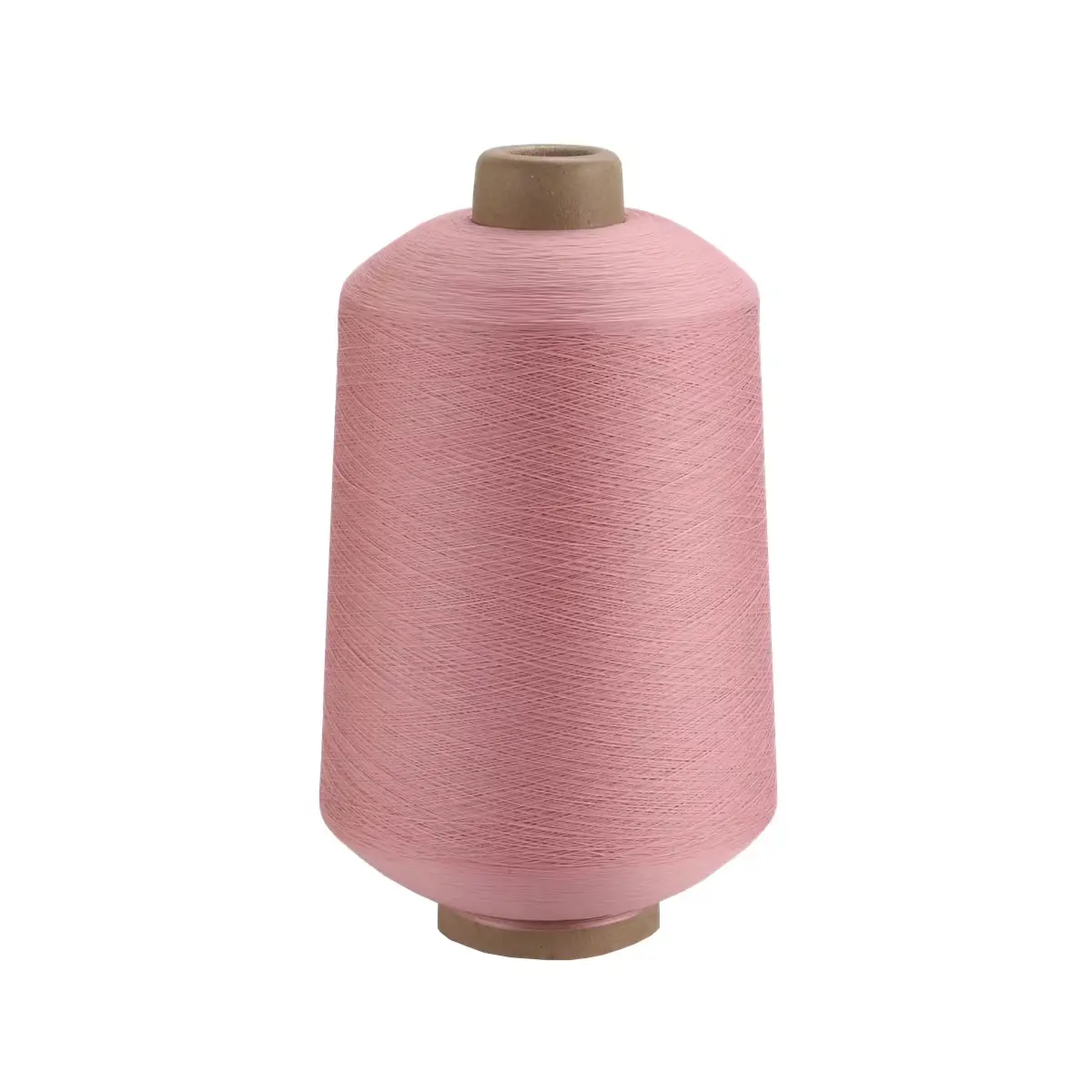
PA11 Bio-Based Nylon vs PA6 and PA66: Carbon Footprint, Properties and Application Fit
The three polyamides are often treated as interchangeable grades of “nylon”. They are not. They come from different monomers, they are made by different reaction routes, and the repeat-unit structure they end up with governs melting behaviour, moisture uptake, stiffness, dye accessibility and the emissions profile of the polymerisation step. A sourcing decision that ignores that chemistry tends to surface later as a dyehouse problem, a heat-setting problem, or a documentation problem at brand review. The sections below work through each of those in the order a buyer actually meets them: first what the material is, then how it behaves, then what the mill has to change, then what it costs, and finally what has to be verified before money moves.
1. Monomer Origin and Polymerisation Route
Everything downstream traces back to the repeat unit. PA11 carries eleven carbons per repeat unit with one amide group; PA6 carries six; PA66 carries a six-plus-six arrangement with two amide groups per repeat. The amide group is the hydrophilic, hydrogen-bonding part of the chain, so the density of amide groups along the backbone sets water uptake, melting point and stiffness. A longer methylene segment means fewer amide groups per unit length, weaker inter-chain hydrogen bonding, a lower melting point and a softer, more extensible yarn.
- PA11 is a condensation polymer built from 11-aminoundecanoic acid. In the commercial route the monomer is derived from castor oil: the ricinoleic acid in castor oil is converted to methyl ricinoleate, thermally cracked to methyl undecylenate, then converted through hydrolysis, hydrobromination and ammonolysis to 11-aminoundecanoic acid, which is polycondensed. Because the carbon skeleton originates from a plant oil, the polymer carries bio-based carbon that can be measured with radiocarbon methods. Castor is a non-food crop grown largely on marginal land, which is part of why it is used rather than a food oil, but this does not by itself settle the land-use question, which is addressed in section 5.
- PA6 is produced by hydrolytic ring-opening polymerisation of epsilon-caprolactam. The reaction is an equilibrium polymerisation, so the polymer leaving the reactor contains residual monomer and oligomers that are removed by hot-water extraction and drying before spinning. Caprolactam itself is conventionally petrochemical, produced from cyclohexanone or via butadiene routes depending on the producer. Residual extractables matter to the dyehouse because they migrate and can affect shade and effluent load.
- PA66 is produced by polycondensation of a stoichiometric salt of hexamethylenediamine and adipic acid. The salt is made first to guarantee the 1:1 balance, then heated under pressure to drive off water. Adipic acid manufacture has historically been associated with nitrous oxide formation, and many producers have installed abatement. Whether the footprint data a supplier hands you reflects abated or unabated adipic acid is a legitimate question to ask, because it changes the number materially.
Two clarifications save time later. First, a bio-based nylon designation describes the origin of the carbon, not end-of-life behaviour: PA11 is a durable engineering polyamide and is not expected to biodegrade in ordinary use or in a home composting environment, so it should not be marketed with biodegradability implications. Second, PA6 and PA66 are also available in recycled and mass-balanced variants. A bio-based PA11 and a recycled PA6 are competing answers to different briefs, and a brand that has already committed to recycled content targets may need to weigh them against each other rather than assume one replaces the other.
2. Mechanical Performance: Relative Differences and Test Method
Strength comparisons between suppliers are frequently meaningless because the numbers were generated under different conditions. Tenacity measured on a different gauge length, at a different extension rate, on a conditioned versus unconditioned sample, or on a textured yarn versus its parent filament, will not match. Before comparing anything, align the method.
Tenacity and elongation
- Single-end tensile testing is normally run to ISO 2062 or ASTM D2256. Record gauge length, extension speed, pre-tension and the number of specimens, and condition the packages before testing. Without those four parameters on the report, two tenacity figures are not comparable.
- Relative position. Regular textile PA6 filament and PA11 filament yarns are commonly reported in broadly overlapping tenacity bands, with high-tenacity PA6 and PA66 grades sitting above them. PA11 is usually reported with higher elongation at break and a noticeably lower initial modulus, which is what gives it the softer, drier hand and the greater extensibility that designers notice first.
- Implication. If a fabric was engineered around the modulus of a PA66 high-tenacity yarn, substituting a softer, more extensible yarn will change fabric power, recovery and hand, even at identical denier and identical construction. That change has to be re-balanced in knitting or weaving, not accepted as a free substitution.
Abrasion, resilience and low-temperature behaviour
Before getting into the numbers, one correction to how the comparison is usually framed. A PA6 vs PA66 choice and a PA11 substitution decision are not the same kind of question. Choosing between PA6 and PA66 is mostly a matter of thermal ceiling, abrasion target and dye route within an established petrochemical supply base. Deciding whether to bring in PA11 changes the feedstock, the documentation package and several downstream process windows at once. That is why the PA6 and PA66 figures below are treated as the reference band and PA11 as the variable being tested against it.
Abrasion is the property most often quoted and least often measured at yarn level. There is no widely accepted yarn abrasion standard that predicts fabric performance, so abrasion should be evaluated on the finished fabric, for example Martindale to ISO 12947-2 or ASTM D4966, with the end-use rub count defined by the brand’s own test protocol rather than by a generic claim. What can be said without overclaiming is directional: PA66 is generally positioned at the top for abrasion resistance and high-temperature retention, PA6 is a strong general-purpose performer, and PA11 trades some of that surface hardness for toughness, impact resistance and retained flexibility at low temperature. For a garment that sees flexing in cold conditions, that trade is often favourable; for a fabric whose selling point is rub resistance, it may not be.
3. Moisture Regain and Dimensional Stability
Water uptake is the practical dividing line between these three materials. PA6 and PA66 are hygroscopic; PA11 absorbs far less. Published figures vary by grade and by conditioning atmosphere, so treat the following as a directional guide and confirm against the supplier’s conditioned test data.
- At standard conditioning, PA6 and PA66 are commonly cited with moisture regain in the region of four per cent, while PA11 is commonly cited well below that, with saturation absorption reported at levels materially under two per cent. Confirm the conditioning atmosphere used, typically 20 degrees Celsius and 65 per cent relative humidity.
- Effect on yarn strength. Water acts as a plasticiser in polyamides. A PA6 yarn that has absorbed atmospheric moisture shows different tenacity and elongation from the same yarn tested dry. PA11, absorbing less, changes less between wet and dry states, which is one reason its wet performance is more predictable.
- Effect on dimensions. Lower uptake means less swelling and less hygral expansion, so PA11 fabrics generally hold their dimensions better across humidity changes. That is an advantage for tight-tolerance patterns and for laminated or coated constructions where differential movement between layers causes problems.
- Effect on dyeing and comfort. Lower moisture uptake has a cost: there is less water in the fibre to assist dye diffusion, and wearers perceive less moisture buffering next to skin. Both are handled in section 6, and both argue for a trial rather than a direct drop-in.
4. Thermal and Chemical Resistance
Melting point sets every downstream thermal limit, and here the three materials are far apart. PA11 is commonly reported melting in a band around the mid-to-high 180s Celsius, PA6 around 215 to 220 Celsius, and PA66 around 255 to 260 Celsius. Anyone running a stenter, a moulding step, a calendering operation or a thermal bonding process needs those bands before they plan a temperature profile, not after.
- Processing window. A lower melting point means a narrower safe margin between the temperature needed to set the fabric and the temperature at which the yarn is damaged. It also means that any co-processing with a higher-melting component, a fusible interlining or a bonding yarn requires a revised profile.
- Hydrolysis and chemicals. Fewer amide groups per unit length means fewer sites for hydrolytic attack, so PA11 is generally positioned as more resistant to hydrolysis and to a range of oils, greases, fuels and solvents. PA66 also performs well against oils and hydrocarbons; PA6 is more sensitive to hot water and steam exposure over time. For swimwear and any garment repeatedly exposed to chlorinated or heated water, hydrolytic stability is a genuine selection criterion and should be tested on the finished fabric under the brand’s own exposure protocol.
- Care labelling consequences. Lower thermal tolerance constrains ironing, tumble drying and any garment-washing step that relies on heat. This should be checked with the brand’s care-labelling team before a bulk commitment, because a care instruction that the market will not accept can kill an otherwise sound material choice.
5. Bio-Based Content and Carbon Footprint: How to Verify
This is the section where most sourcing files are weakest, and it is the one a European brand’s sustainability reviewer will read first. Bio-based content and carbon footprint are two separate measurements, reported under two separate sets of rules, and neither one implies the other.
What to request from the supplier
- Bio-based carbon content reported from radiocarbon analysis, typically to ASTM D6866, EN 16640 or the ISO 16620 series, with the test date, the laboratory and the tested article identified. Ask whether the result refers to the polymer, the yarn as shipped, or the finished fabric, because finishes and spin finishes dilute the measured share.
- Product carbon footprint declared under a recognised method, normally ISO 14067 or the GHG Protocol Product Life Cycle Accounting and Reporting Standard, with the declared unit stated as one kilogram of yarn and the system boundary stated as cradle-to-gate unless the supplier genuinely has full life-cycle data.
- The underlying LCA report, or at minimum a summary disclosing the cut-off criteria, the allocation rule applied to co-products of castor processing, whether land-use change and fertiliser emissions from cultivation are inside the boundary, and whether biogenic carbon uptake and release are reported separately rather than netted into a single figure.
- Third-party review or verification of the footprint statement, and the name of the verifier. A self-declared number and a verified number are not equivalent evidence.
- Chain of custody if any mass-balance allocation is used anywhere between the castor oil and the spun yarn, typically under a scheme such as ISCC PLUS or an equivalent. The certificate number, validity dates and the certified scope should be available.
- Claim wording support consistent with ISO 14021 for self-declared environmental claims, including a clear separation between renewable-carbon content and recyclability or biodegradability, which are different claims and should never be merged.
How to read the number honestly
A plant-derived carbon skeleton does not automatically produce a lower footprint. Cultivation carries fertiliser and nitrous oxide emissions, land-use change can dominate the result, transesterification and ammonolysis consume energy, and the polymerisation and spinning steps run on whatever grid the plant is connected to. A PA11 spun with coal-heavy electricity and a PA6 spun with low-carbon electricity can invert the intuitive ranking. When you compare nylon yarn carbon footprint figures across suppliers, check that boundaries, allocation rules and electricity assumptions are stated; if they are not, the numbers cannot be compared. Also confirm whether the reported figure includes the agricultural stage at all, since some cradle-to-gate declarations begin at the monomer or even at the polymer.
Tip: Ask for the bio-based carbon content test report and the product carbon footprint declaration as two separate documents, because a high bio-based carbon share does not by itself tell you the cradle-to-gate emissions of the yarn.
On compliance, do not assume. Requirements differ by market and are moving: European rules on substantiating environmental claims and on empowering consumers for the green transition impose discipline on how claims are worded and evidenced, product environmental footprint methods and sector rules for textiles are being developed, and deforestation-related due diligence regimes apply to specific listed commodities under specific customs codes. Whether a castor-derived yarn falls inside the scope of any given regulation depends on the current legal text, the customs classification and any delegated acts. Treat the position as: verify against the latest standard text and official publications for your target market and product code before publishing a claim.
6. Dyeing and Finishing: Process Window and Energy Profile
Shade development and colour reproducibility are their own discipline. What belongs in a sourcing comparison is the process window: the temperature and time envelope the dyehouse has to work inside, how much margin it has, and what that does to energy demand and to the risk of damaging the yarn.
Dyeing window
- Temperature band. Dyehouses running PA11 commonly work in a band below the boil, while PA6 is conventionally exhausted at or near boil and PA66 often needs more aggressive conditions or modified auxiliaries for deep shades. Because the accessible temperature band for a lower-melting polyamide is narrower, the ramp rate and hold time deserve explicit definition rather than being left to operator habit.
- Dye selection. Acid and disperse dye classes are the usual starting point for polyamides, but compatibility, levelness behaviour and build-up differ with the substrate. Run the shade on your own substrate with your own auxiliaries rather than adopting a recipe developed on a different polymer.
- Pretreatment. Residuals from polymerisation, spin finish and any sizing or coning oil have to be removed consistently before dyeing. Inconsistent scouring produces the levelness faults that are then misattributed to the polymer.
Heat-setting and finishing window
- Stenter temperature. Because PA11 melts materially lower than PA6 and PA66, the stenter window has to come down. Mills commonly run lower setting temperatures for PA11 than they would for a PA6 fabric of the same construction, with dwell time and overfeed recorded. The safe approach is to bracket the window in a trial and keep the successful combination on the route card.
- Margin management. The narrower gap between effective setting temperature and damage temperature reduces tolerance to hot spots and to stenter temperature drift. Verify chamber temperature uniformity before running bulk.
- Energy demand. Lower dyeing and setting temperatures plausibly reduce thermal energy per batch. That is a hypothesis to be metered, not a saving to be claimed. If the energy argument is part of the business case, measure steam or electricity consumption on a trial batch against the incumbent material and keep the record.
7. Cost, Lead Time and Minimum Quantities
Price position
PA11 sits in the specialty tier rather than the commodity tier. It is priced above conventional PA6 and PA66 filament yarn, because the monomer route is longer, the polymer supply base is far smaller, and the plant-oil feedstock is subject to agricultural supply conditions that commodity caprolactam is not. It is best compared with other specialty sustainable yarns rather than with bulk PA6 chip-based filament. Any specific multiple quoted in the market is period-dependent; the only reliable figure is a dated quotation against your count and volume. Buyers should also budget for the hidden costs of switching: extra trial lots, reformulated dye recipes, revised setting routes, and the internal time spent on documentation review.
Lead time and order quantities
- Polymer booking. Because PA11 polymer capacity is concentrated, booking lead time is usually longer than for commodity polyamide, and it lengthens further when the requested count, luster or cross-section is not on the standard production calendar.
- Trial quantities. Trial lots are commonly quoted from a few hundred kilograms upward per item. Plan for at least one knitting trial followed by a dyeing trial, on the actual production machines rather than on laboratory equipment, before evaluating hand and recovery.
- Bulk minimums. Minimum order quantities are typically set per combination of denier, filament count, luster and, for dope-dyed yarns, per colour. A shade palette of many colours multiplies the minimum.
- Continuity risk. Ask whether the supplier holds polymer or yarn stock dedicated to your program, and how a crop shortfall or a plant turnaround would be communicated. A single-source specialty yarn without a continuity plan is a supply risk that should be assessed before, not after, conversion.
8. Application Fit: Choosing Between the Three
The selection logic is a trade, not a ladder. No material wins on every axis, so the question is which axis the product actually sells on.
Activewear and sportswear
- Choose where the product sells on soft hand, stretch comfort and a renewable-carbon story, and where the design can tolerate a lower modulus.
- Stay with PA6 or PA66 where abrasion resistance, high fabric power or aggressive heat setting is the selling point, or where the existing dyehouse route cannot be changed.
- Watch compression and recovery behaviour after washing, because dimensional behaviour differs from the incumbent yarn.
Intimate apparel
- Fine-count fabrics benefit from the softer hand and lower stiffness.
- Lower moisture uptake means static behaviour and next-to-skin humidity perception differ; evaluate on wear trials rather than on laboratory handle alone.
- Elastic compatibility and the thermal budget of any bonding or moulding step must both be re-checked, since cups and bonded seams are heat-sensitive constructions.
Swimwear
- Hydrolytic and chemical resistance favour PA11 for repeated exposure to chlorinated or heated water.
- The counterweight is the thermal limit: lower melting point constrains heat setting and any thermal bonding used in the construction, and care instructions must stay within the material’s tolerance.
- PA6 remains a defensible choice where the existing chlorine-resistance package and setting route already perform to standard; the decision belongs at garment level, tested against the brand’s own exposure protocol.
Outdoor and workwear
- Low-temperature flexibility and chemical resistance suit layers exposed to cold flexing, oils and fuels.
- Where high-temperature exposure, high abrasion or prolonged load-bearing are the requirements, PA66′s higher melting point and stiffness usually win.
- Coating and lamination compatibility should be confirmed on the actual laminate, because adhesive cure temperature can approach the yarn’s thermal limit.
Industrial and technical textiles
- Dimensional stability across humidity changes is a genuine advantage in tight-tolerance technical constructions.
- Confirm long-term thermal ageing and any hydrolytic exposure against the service environment, using the applicable industry test method for the end product.
- Where the specification is written around a PA6 or PA66 tenacity value, the specification has to be rewritten, not merely re-sourced.
9. Product Fit: Where PA11 DTY and FDY Belong in Your Specification
Category and fit conditions
The category under consideration is PA11 nylon yarn supplied in textured and flat forms. In a buying specification it is normally positioned against a PA6 or PA66 reference yarn of the same nominal count, and it is evaluated on hand, extensibility, dye route, thermal budget and documentation, not on tenacity alone.
Typical specification windows
- Form. DTY nylon yarn for knitted applications needing bulk, cover and stretch recovery, and FDY nylon yarn where a flat, smooth filament is required for woven or warp-knitted constructions and for fine-count smooth-face fabrics.
- Count band. Fine to medium counts, commonly specified in the range of roughly 20 to 140 denier, with filament count selected against the target cover factor and surface appearance. Availability for a specific count and filament combination must be confirmed, since specialty polymer production calendars are narrower than for commodity polyamide.
- Luster and cross-section. Semi-dull, full-dull and bright options, with round or modified cross-sections where hand or wicking is specified.
- Intermingle and twist. Intermingle level specified for weaving or warp knitting without additional twisting; twist level where a twisted construction is required.
- Colour route. Raw white for package or piece dyeing, or dope-dyed where colour fastness, water savings or a fixed shade programme justify the higher minimum quantity.
Data to confirm with the mill before sampling
- Denier and filament count with tolerance, and the test method used.
- Tenacity and elongation at break, with gauge length, extension speed and conditioning stated.
- Hot-air and boiling-water shrinkage, with the measurement method recorded, since there is no single universal yarn shrinkage standard and the method must be written onto the certificate of analysis.
- Evenness and defect data from the supplier’s normal quality control regime.
- Oil pick-up level and spin finish type, relevant to scouring and to any downstream bonding or coating.
- Bio-based carbon content report, product carbon footprint declaration and, if applicable, chain-of-custody certificate number and validity dates.
- Package type, package weight and winding parameters affecting unwinding on your machines.
- Minimum order quantity per count and per colour, sampling lead time, bulk lead time, and the batch traceability system.
10. Sourcing and Validation Checklist
Stage one: sample and laboratory evaluation
- Request sample cones in the target count and luster, with the certificate of analysis for the same lot, not a generic one.
- Test tenacity, elongation and shrinkage in your own laboratory or at a nominated third-party laboratory using a named method, and keep the raw data as the baseline for later lot comparison.
- Knit or weave the sample on the production machine that will run the bulk order, at the construction intended for the product.
Stage two: small-batch trial production
- Run a full dyeing and finishing trial on production equipment, recording temperature profile, dwell time, overfeed and the full recipe.
- Evaluate the finished fabric against the incumbent material on hand, recovery, dimensional change after washing and the relevant fastness test set for the product category.
- Meter energy consumption on the trial if the lower thermal window is part of the business case.
- Have the brand’s sustainability reviewer assess the documentation package at this stage, while the trial quantities are still small enough to walk away from.
Stage three: lot consistency and bulk release
- Agree the certificate of analysis format, listing every parameter that will be tested per lot and the tolerance for each.
- Specify the sampling plan, the batch definition and the retention sample period, so a dispute can be traced to a specific lot.
- Establish the lot-to-lot comparison procedure: retain a reference swatch and reference test data from the approved trial and compare each incoming lot against it before release to cutting.
- Define the escalation path for an off-specification lot, including who is notified and what evidence is exchanged.
- Confirm continuity arrangements, including whether stock is held against the program and how feedstock disruption would be handled.
FAQ
Is PA11 a drop-in replacement for PA6 at the same denier and construction?
Technically often yes in the sense that it can be knitted or woven on the same machine, but not commercially as a direct swap. The lower modulus and higher extensibility change fabric hand, power and recovery, the dyeing and heat-setting windows move down, and the care instructions may need revision. Treat it as a re-development with a defined trial sequence rather than a substitution.
Does bio-based carbon content mean the yarn is biodegradable or recyclable?
No. These are separate claims and should be stated separately. Bio-based content describes the origin of the carbon. Biodegradability describes behaviour under specific conditions that a durable polyamide yarn is not designed for, and recyclability depends on the collection, sorting and reprocessing route available for the product. Do not combine them in a single claim.
Which carbon footprint number should be used in a supplier comparison?
Use one declared unit and one boundary across all candidates, normally one kilogram of yarn cradle-to-gate, and check that the same allocation rules and the same treatment of biogenic carbon and land-use change apply. If a supplier cannot state which boundary and allocation rule produced their figure, the figure should not be used in a comparison.
Can PA11 be used with elastane and with existing covered-yarn constructions?
Yes, subject to thermal compatibility. The constraint is that the heat-setting and bonding temperatures required by the elastane and by any adhesive or bonding yarn must stay within the lower thermal tolerance of the PA11 component. Confirm the full thermal budget for the composite yarn before running bulk.
What should a buyer ask for before the first bulk order is released?
A lot-specific certificate of analysis, an approved trial fabric with retained reference data, the bio-based content and carbon footprint documentation package with boundaries stated, agreed tolerances and sampling plan, and written confirmation of minimum quantity, lead time and continuity arrangements for the specific count and colour.
Ready to source bio-based PA11 DTY or FDY yarn? Send your specs, including denier, filament count, luster, target fabric construction and estimated annual volume, and request a quote together with sample cones for evaluation.
Related Pages
- Hot Melt Yarn vs Adhesive Film
- Low Melting Yarn vs Regular Yarn
- Bulk Yarn Order Timeline Explained
- Yarn Bulk Order Planning Guide
Post time: Oct-16-2026