
Nylon is one of the few commercial fibres that keeps trading weight with the air around it. A package of PA6 or PA66 filament shipped from a humid coastal plant and opened in a dry inland weaving shed can register a different mass on the same scale, on the same day, with nothing added and nothing removed. For a buyer paying per kilogram of yarn, that difference is not a laboratory curiosity. It decides how much actual polymer enters the invoice, how much fabric leaves the loom, and how much of the shade variation in the first dye lot is really a moisture problem rather than a dyestuff problem.
This article is written for sourcing and quality teams who buy nylon filament yarn in bulk. It separates the two moisture numbers people confuse, shows how the calculation behind a weight settlement actually works, sets out what a defensible conditioning and testing routine looks like, and turns all of it into specification and contract language that a supplier can quote against and an inspector can check.
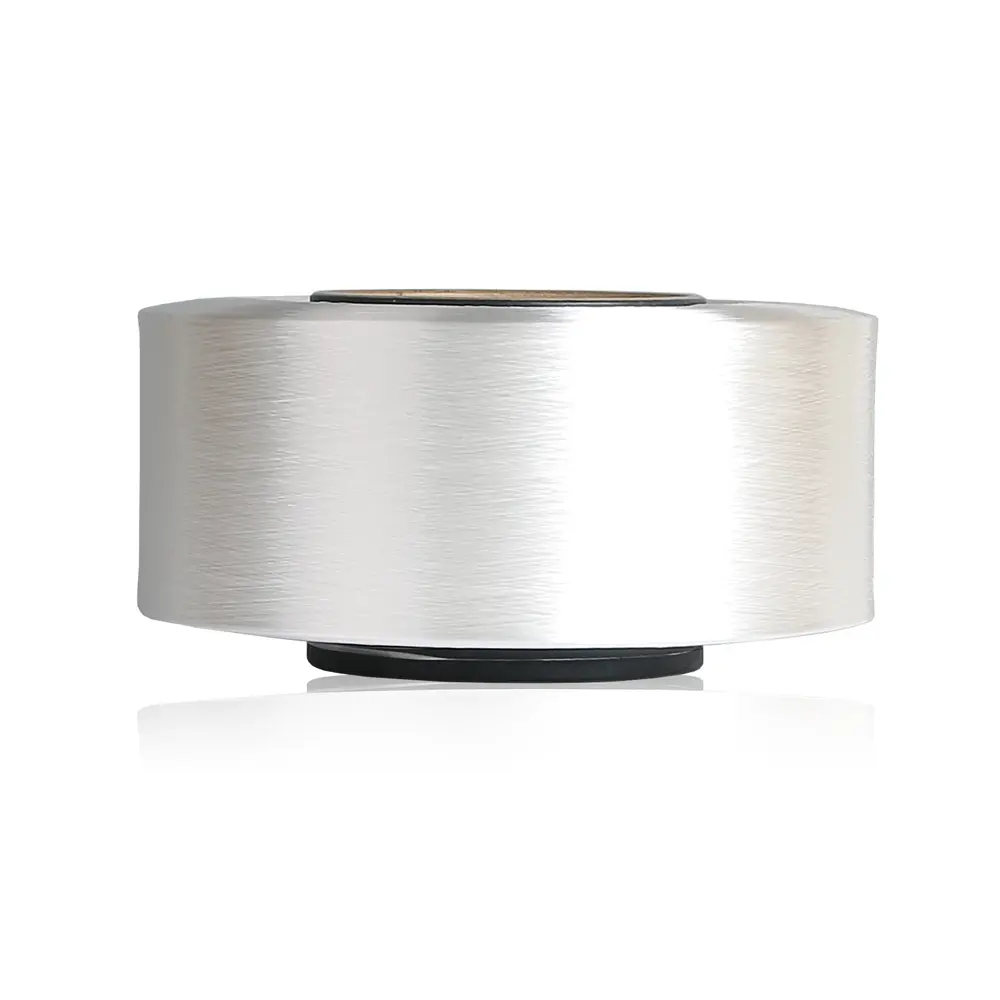
Nylon Yarn Moisture Regain and Conditioning Test Specs
Everything below starts from one practical position: moisture is not a defect in nylon, it is a property. The job of the specification is not to demand dry yarn. The job is to define which moisture state the yarn is priced in, how that state is measured, and what happens when the two sides disagree.
Regain and Moisture Content Are Not the Same Number
Two ratios are in circulation, and they differ only in the denominator. Both are built from the same two weighings: the mass of the specimen as it arrives, and the mass of the same specimen after it has been dried to constant mass.
Moisture regain expresses the water as a percentage of the dry mass. Moisture content expresses the water as a percentage of the original, undried mass. The formulas are:
- Regain R (%) = (W – D) / D x 100, where W is the as-received mass and D is the oven-dry mass.
- Content C (%) = (W – D) / W x 100, using the same two weighings.
- Conversion from content to regain: R = 100 x C / (100 – C).
- Conversion from regain to content: C = 100 x R / (100 + R).
- Because the denominators differ, content is always numerically lower than regain for the same specimen, and the gap widens as the yarn gets wetter.
The practical consequence is that a test report is meaningless unless it states which ratio it is reporting. A figure quoted as content and read as regain understates the water present, which quietly favours whoever is selling by as-received weight. Write the ratio into the test clause, not just the number.
The anchor for both ratios is the oven-dry mass of the specimen. Drying must continue until successive weighings agree within the tolerance stated in the method, and the specimen must be weighed without re-absorbing moisture on the way from the oven to the balance. In practice this means weighing in a closed vessel or cooling over an effective desiccant before the reading is taken.
Why Nylon Is Settled on a Conventional Regain
Nobody can ship yarn at a fixed moisture level. Relative humidity moves during winding, during warehouse storage, during container transit, and again in the buyer’s mill. Rather than argue about the weather, the trade agrees a conventional regain: a notional moisture level that both sides accept as the basis for calculating commercial weight. The yarn is weighed as it is, its actual regain is measured, and the invoice is settled on the calculated weight the yarn would have at the agreed figure.
The calculation is straightforward once the inputs are defined. In symbolic form:
- Step 1: Weigh the lot as received, giving gross mass G, and subtract the tare of cones, tubes, film, liners and pallets to obtain net as-received mass W.
- Step 2: Take a specimen from the same lot, condition and test it, and derive its actual regain R from the formula above.
- Step 3: Derive the dry-mass equivalent of the lot: M = W / (1 + R/100).
- Step 4: Apply the agreed conventional regain R_c to obtain the commercial or conditioned weight: W_c = M x (1 + R_c/100).
- Step 5: Compare W_c with the invoiced weight. The difference is either a credit, a debit, or an agreed tolerance band that absorbs it.
The behaviour of that calculation is worth internalising. When actual regain sits above the conventional figure, the conditioned weight is lower than the as-received weight, so the buyer is paying for water unless the clause corrects it. When the yarn arrives drier than the conventional figure, the reverse applies. On a container of fine-denier filament the absolute number of kilograms involved is not small, and on a running annual programme it becomes a real line item rather than a rounding error.
Two inputs need to be pinned down before the clause is enforceable. The first is the tare basis: whether cone, tube and film masses are declared by the supplier, measured by the buyer, or averaged from a sample of packages. The second is the conventional regain value itself, which should be named in the contract by reference to the agreed method rather than left as an understanding between salespeople. The conditioned weight convention only protects both sides when the reference value is written down.
Conditioning: Atmosphere, Pre-Conditioning and Specimen Placement
Conditioning means bringing the specimen to moisture equilibrium with a defined atmosphere before it is weighed or tested. It is not simply leaving yarn in a room. The point is reproducibility: two laboratories, or a supplier and a buyer, must be able to obtain the same answer on the same material.
- Standard atmosphere. Textile testing generally uses a standard temperate atmosphere, which in most laboratories means a temperature in the region of 20 degrees Celsius and a relative humidity in the region of 65 percent. Name the temperature, the relative humidity and the tolerance in your specification, because a control band that is stated loosely produces results that cannot be replayed.
- Pre-conditioning. Material that arrives very wet or very dry should first be brought towards the standard condition, often by holding it at a lower relative humidity before it enters the conditioning room. This step is what stops a saturated package from dragging the conditioning room humidity around and from reaching a false equilibrium.
- Equilibrium period. Hold the specimen until mass change between successive weighings falls inside the stated tolerance, or for the minimum period your method specifies. The period is a function of package density and wrapping, not a fixed number that can be guessed.
- Specimen placement. Air must reach all surfaces. Specimens should be held loose or in open form, spaced apart rather than stacked, and positioned so that air circulates freely. A hank or a skein folded on a shelf conditions at a visibly different rate from the same mass spread on a mesh tray.
- Handling discipline. Weigh with the specimen contained, minimise the time it spends outside the controlled room, and record room conditions at the moment of weighing. A result without its conditions recorded is not a result that will survive a dispute.
For packages, a useful field distinction is between surface moisture and absorbed moisture. Surface condensation from a cold container evaporates quickly once the film is opened, while moisture absorbed into the polymer moves much more slowly. Tip: open the film, let the packages stand in the conditioning room long enough for surface moisture to clear before you sample, and only then take specimens for regain, tensile and shrinkage testing; sampling straight out of a cold container is one of the most common causes of results that will not repeat.
Comparing Test Methods: Oven, Electrical Metering and Rapid Meters
Three families of method cover most situations, and they are not interchangeable. The right choice depends on whether the number is being used for settlement, for process control, or for a quick incoming check.
- Oven (gravimetric) method. The specimen is dried to constant mass and weighed. It is destructive in the sense that the specimen is consumed, it is slow, and it is the reference against which the faster methods are calibrated. Use it for settlement figures, for dispute resolution and for periodic verification of any instrument reading.
- Electrical resistance and dielectric methods. These infer moisture from an electrical property of the material. They are fast, non-destructive, and suitable for on-line monitoring during production or for scanning many packages. Their readings depend on temperature, on the spin finish and its distribution, on package density and on electrode contact, and they must be calibrated per polymer type, per denier family and per finish level. Treat them as process instruments, not as settlement instruments.
- Rapid moisture meters, including halogen, infrared and microwave types. Convenient for a receiving dock and for troubleshooting, because a result is available in minutes. Errors come from small specimen size, from surface water, from finish and oil volatilising along with water, and from overheating that starts to degrade the polymer itself.
Common error sources cut across all three. Finish level changes the mass that is not water. Specimen size that is too small stops being representative. Weighing hot introduces buoyancy error. Air that is moving across an open balance adds noise that looks like signal. And a method that has never been checked against an oven result on the same material is, for settlement purposes, an opinion.
The on-line dielectric metering fitted at a spinning or draw-texturing line is genuinely useful, but only in the way a thermometer is useful: it tells you about the moment it was taken, in that place, on that material. It does not travel with the lot.
Sampling Representativeness Across the Lot
Moisture is never uniform across a shipment, and the variation has structure. Sampling that ignores the structure produces a precise average of the wrong population.
- Within a package. The outer layers of a package exchange moisture with the room or the container atmosphere far faster than the core. A specimen pulled from the surface reads the transit environment; a specimen pulled from the core reads closer to the condition at winding. Sample at defined depths, or sample outer, middle and core and treat them as separate data points.
- Between packages. Packages at the outside of a pallet, at the top of a stack, and near the container door experience different conditions from packages in the centre. Draw packages from several positions, not from the one carton that is easiest to reach.
- Across the lot. Production spanning more than one shift, one machine, or one day of ambient weather can carry a moisture gradient from beginning to end. Sample from the first and the last production of the lot, not only from the middle.
- After transit. Container rain, a humid port, a cold night followed by a warm day, and a wet floor all create layering. Record where each specimen came from in the shipment, because the pattern is often more informative than the average.
Good representative sampling is a written plan: how many packages, from which positions, at which depths, taken by whom, and how the specimens are split between the two parties. A plan that exists on paper before the shipment is what makes a disagreement resolvable afterwards.
What Regain Does Downstream
Moisture absorbed into polyamide sits mainly in the amorphous regions and acts as a plasticiser. That single mechanism explains most of the downstream effects buyers notice.
On tensile testing, absorbed water increases chain mobility. Elongation rises, initial modulus falls, and the shape of the load-elongation curve changes, so a single-end tensile and elongation tester of the constant-rate-of-extension type, the CNG-HVCR class of instrument that many mills run, will report different tenacity and elongation behaviour on the same yarn depending on its moisture state. There is a second, purely arithmetic effect: because tenacity is normalised by linear density, and linear density includes the absorbed water, the basis of the calculation moves with the moisture as well. This is why strength specifications must always be tied to a stated conditioning state.
In dyeing, water in the fibre changes how accessible the polymer structure is to the dye liquor and shifts the practical uptake behaviour, so yarn that enters the dye house at different moisture levels can dye to different depths even when the recipe is identical. There is also a weighing effect: a recipe calculated on a moisture-affected yarn mass dispenses a slightly different amount of colour than intended. Both effects show up as shade variation between lots, and both are frequently misdiagnosed as dyestuff or machine problems.
In weaving and knitting, the dry end of the range is usually the damaging one. Low regain raises surface resistivity, so charge accumulates instead of dissipating. Charged filaments repel each other, the sheet loses cohesion, fly and hairiness increase, and the loom sees more stops and more warp breaks. On the wet end, packages can block, mould risk rises, and friction behaviour against guides changes. The practical target is therefore a controlled band, not the driest yarn obtainable.
PA6 and PA66: Different Hygroscopicity, Different Chain Effects
PA6 and PA66 are both polyamides with broadly similar amide-group density, but their crystal structure and thermal transitions differ, and so does their moisture behaviour. PA6 generally absorbs moisture faster and reaches a higher equilibrium level than PA66 under the same atmosphere, because its structure is more open and more accessible to water. The direction of every downstream effect follows from that.
- Dimensional change. Absorbed water swells the amorphous regions, which shows up as length and diameter change. PA6 tends to show the larger dimensional response, which matters for fabrics with tight dimensional tolerances and for any component where the yarn is constrained.
- Strength and stiffness. Because water plasticises the amorphous phase, the fall in modulus and the rise in elongation on wetting are generally more pronounced in the polymer that takes up more water. PA66 tends to retain more of its dry stiffness in a humid condition, which is one reason it is selected for demanding industrial applications.
- Settlement behaviour. A higher equilibrium uptake means a wider possible spread between as-received and conditioned weight, so the conventional regain clause carries more financial weight on PA6 programmes.
- Running behaviour. PA6 typically conditions back to equilibrium more quickly after a humidity excursion, which shortens the practical re-equilibration window but also means it starts taking up moisture sooner once the film is opened.
- PA11 sits at the other end. Its long methylene chain gives markedly lower moisture uptake and correspondingly better dimensional stability in humid service, which is why it appears in applications where water absorption drives the design.
The chain-level point for a buyer is that moisture behaviour is a material property, not a quality fault. Choosing between PA6, PA66 and PA11 on hygroscopicity is a legitimate design decision, and it should be made before the specification is written rather than argued about after the first shipment.
Packaging, Storage and Transit Control
Most moisture disputes start in transit, not in the laboratory. Packaging and storage decide whether the yarn arrives anywhere near the condition it left in.
- Moisture barrier. Each package or carton should be sealed inside a moisture-barrier liner, and the seal is more important than the film thickness. A thick liner with a folded, unsealed closure performs worse than a thin one that is properly closed.
- Desiccant. Where the route is long or the humidity differential is large, desiccant inside the liner buys margin. It has a finite capacity and should be sized to the journey, not added as a token.
- Pallet practice. Keep pallets off bare concrete, which wicks moisture upward, and avoid stacking against outside walls. A stretch hood over the pallet protects against splash and short-term exposure during loading.
- Container discipline. Do not load in rain, check the container floor and roof before stuffing, and leave air paths so the load can breathe. Container rain forms when warm humid air meets a cold roof, and it wets the top layer of a load first.
- Monitoring. A low-cost temperature and relative humidity logger placed in the container turns a later argument about transit conditions into a matter of recorded fact.
- Re-equilibration on arrival. Before testing, and before running the yarn on high-speed machinery, allow the packages to come back to the mill’s standard condition with the wrapping opened or loosened. Outer layers equilibrate first; cores take considerably longer, and a package that feels normal at the surface can still be off at the centre.
Writing the Specification and the Contract
The clauses below are what make the technical work above enforceable. Each one is short, testable, and quotable.
- Regain clause. State the ratio being used (regain or content), the conventional regain value by reference to the agreed method, and the tolerance band around the as-received value outside which the settlement calculation is triggered.
- Test method. Name the reference method for settlement, name any instrument method permitted for process control or incoming screening, and state the calibration and cross-check requirement that ties the fast method back to the reference method.
- Conditioning conditions. Give the temperature, the relative humidity, the tolerance, the pre-conditioning step where required, and the minimum equilibrium period or the constant-mass criterion.
- Weighing basis. State clearly whether the price applies to conditioned weight, to dry weight, or to as-received net weight, and define the tare treatment for cones, tubes, film, liners and pallets.
- Sampling plan. Define the number of packages, the positions in the shipment, the depths within each package, and how specimens are split into supplier, buyer and retained portions.
- Claim window. Set the period after receipt within which a moisture claim may be raised, measured from arrival at the buyer’s facility, together with the storage conditions the yarn must be held under during that period.
- Retained samples. Require sealed, labelled retained samples from each lot, stored under stated conditions, with an identified custodian and a defined retention period.
Dispute Handling and Third-Party Re-Test
Even with good clauses, disagreements happen. The sequence below keeps them proportionate and keeps the relationship intact.
- Hold the material. Do not process, re-pack or return the goods while a claim is open, because doing so destroys the evidence the claim depends on.
- Re-sample jointly. Take fresh specimens from the retained portion and from the shipment under the sampling plan already agreed, with both parties present or represented and with positions and depths recorded.
- Seal and label. Split each specimen, seal both halves, label with lot, package, position, depth, date and the names present, and have both sides sign the record.
- Test in parallel. Each side tests its half under the specified conditioning and method. Parallel results frequently resolve the matter without escalation, because they expose a procedural difference rather than a material difference.
- Escalate to a third party. If the parallel results still disagree, send a sealed portion to an independent laboratory agreed in advance, using the reference method named in the contract for settlement.
- Settle on the outcome. Define in advance whether the third-party result is binding, which tolerance it is judged against, and how the testing cost is allocated between the parties.
Frequently Asked Questions
- Can we simply specify dry yarn? Not usefully. Nylon re-absorbs moisture as soon as the package is opened, so a low reading at dispatch tells you nothing about the condition at use. Specify a conditioning state and a settlement basis instead of a minimum dryness.
- Why do ovens and meters disagree? They measure different things on different assumptions. Instruments infer moisture from an electrical property affected by finish, temperature, density and contact. Only a gravimetric result is a direct measurement, which is why the reference method governs settlement.
- How long should packages rest after arrival? Long enough for the core, not just the surface, to approach the mill’s standard condition. Package density and wrapping drive this, so set a period by measurement on the first lot and then hold it constant.
- Does moisture explain our shade variation? It is one of the first things to exclude, because it changes both dye accessibility and the mass the recipe is dispensed against. Test regain across the suspect lots before changing the dye formulation.
- Is PA66 always the safer choice in humid service? It generally absorbs less and retains stiffness better, but it costs more and brings its own processing requirements. The right answer depends on whether dimensional stability or cost is the binding constraint in your application.
Related Pages
Hot Melt Yarn vs Adhesive Film Low Melting Yarn vs Regular Yarn Bulk Yarn Order Timeline Explained Yarn Bulk Order Planning Guide
Post time: Oct-28-2026