
Nylon Yarn Friction and Knitting Breakage: Mill Process Specs
Friction is the yarn property that most directly decides whether a knitting shift runs smoothly or spends its hours answering stop motions. Tenacity, elongation and evenness are usually already on a buyer’s spec sheet, but friction rarely is, and it is the variable that converts a lab-acceptable yarn into either a clean fabric or a floor covered in fly and broken filaments. For mills running bio-based polyamide 11 filament yarns in DTY and FDY form, the underlying mechanics are the same as for conventional polyamide yarns: a filament bundle travels across a sequence of metal and ceramic surfaces, under tension, at speed, and every contact point either lets it slide or begins to damage it.
This article is written for process engineers, quality managers and sourcing teams who need to turn friction from an informal complaint into a written specification. It covers how friction is defined and measured, what happens at both ends of the range, which process variables move it, why different machine types tolerate different windows, how to count breakage so that two parties can agree on a number, how spin finish interacts with dyeing and heat setting, and what should be frozen inside a request for quotation before a bulk order is placed.
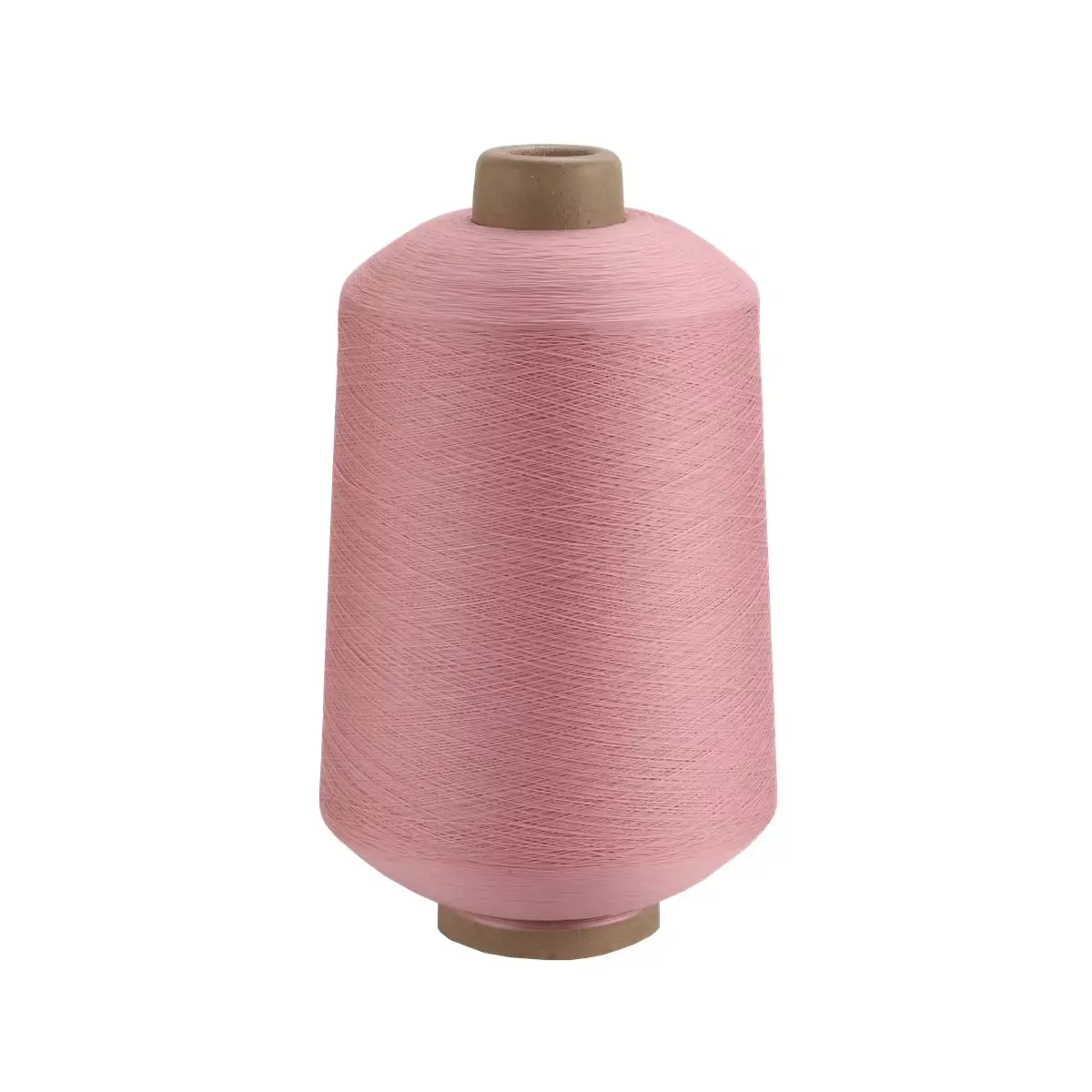
1. Defining Yarn Friction Coefficient
Friction in textile yarns is expressed as a ratio between the force resisting sliding motion and the force pressing the two surfaces together. Because a yarn does not behave like a rigid block, the measured value depends on contact geometry, wrap angle, sliding speed, surface material and the lubrication layer present on the filaments.
Yarn-to-Metal vs Yarn-to-Yarn Friction
The two families behave differently and are measured differently, and a specification that names only one of them is incomplete.
- Yarn-to-metal friction governs every guided contact: ceramic eyelets, yarn tension discs, needle hooks and latches, sinkers, feed fingers and take-down rollers. It dominates breakage, needle wear and the generation of fly.
- Yarn-to-yarn friction governs filament-to-filament and yarn-to-yarn contact inside the package, in the stitch-forming zone, and in the fabric itself. It dominates package stability, loop formation and the hand feel of the finished cloth.
Common Measurement Approaches
Several instrument families are in industrial use, and results are only comparable when method, speed, wrap angle and contact surface material are stated together with the value.
- A capstan or friction roller arrangement, in which yarn passes over a rotating or fixed pin at a defined wrap angle and the tension ratio between the incoming and outgoing leg is converted into a friction value. This is the most widely quoted configuration for yarn-to-metal work.
- A linear tribometer or friction tester, in which a yarn is drawn across a flat or curved counter-surface under controlled normal load, sliding speed and stroke length, and the tangential force is recorded continuously.
- A yarn-to-yarn arrangement, in which two lengths of the same yarn are crossed or twisted together and drawn against each other, giving a measure of internal cohesion and inter-filament slip.
- A twist-friction or cohesion test, in which the resistance of the bundle to inter-filament movement is inferred, useful for assessing intermingled or textured structures.
Whatever the instrument, the reported figure is method-specific. Where a specific test method, revision year, sample conditioning or counter-surface material is referenced in a contract, the applicable values are subject to the latest standard text and official notices, and both parties should cite the same edition in the specification.
Tip: Never accept a friction figure on a data sheet unless the method, counter-surface material, sliding speed and conditioning state are printed beside it.
2. Consequences When Friction Is Too High
Excess friction converts mechanical energy into heat and abrasion at the contact point. Because polyamide filaments are tough but not infinitely so, the damage accumulates in a recognisable pattern.
Breakage
- Filaments rupture at the needle hook or latch where the bending radius is tightest and local tension peaks during loop formation.
- Breakage concentrates in the first feeds after a stop-start cycle, when tension has not yet stabilised.
- Partial filament breakage is more damaging than a full yarn break, because the remaining filaments carry extra load and fail a few centimetres later, producing a run or a hole that is only detected at inspection.
Fuzzing and Fly
- Abraded filaments lift out of the bundle and form fuzz on the yarn surface.
- Fuzz accumulates on guides, tension discs and sinker lines, which then raises friction further and accelerates the cycle.
- Fly generated in the knitting zone contaminates the fabric surface and increases cleaning frequency, reducing effective machine hours.
Wear of Needles and Yarn Guides
- High-friction yarn polishes and eventually grooves ceramic eyelets and chrome-plated surfaces.
- Needle hooks and latches wear faster, which changes stitch dimensions and introduces variability that operators often misattribute to machine setting.
- Worn guides then damage subsequent lots, so a single high-friction delivery can have a cost tail well beyond its own running time.
Uneven Loops and Fabric Defects
- Inconsistent friction across the package width causes uneven loop length, visible as barre, streaks or course-to-course density variation.
- Tension spikes produce dropped stitches, tuck faults and press-off marks.
- In fine-gauge work the same friction level that is harmless at coarse gauge produces visible surface irregularity.
3. Consequences When Friction Is Too Low
The instinct to specify friction as low as possible is a mistake. A yarn that slides too easily loses the cohesion needed for controlled formation and stable packages.
Poor Package Formation
- Filaments fail to bond laterally, producing soft, unstable packages with poor edge definition.
- The wound package can shift during handling and transport, and layers may telescope.
Unwinding Collapse and Sloughing
- Over-lubricated or insufficiently cohesive yarn pulls off in loose loops rather than in a controlled withdrawal.
- Sloughing at the package shoulder produces sudden tension loss followed by a snap-back spike, which is itself a breakage trigger.
Unstable Tension
- Tension devices work by converting friction into resistance; if yarn-to-metal friction is too low, tension discs lose authority and the set value no longer holds.
- Positive feed systems compensate partly, but storage feeders still see variable input tension and can deliver inconsistent loop length.
- Fabric shows variable stitch length and in elastane-blended structures, variable stretch recovery across the roll.
The practical goal is therefore a window, not a minimum. Both the upper and lower bound belong in the specification.
4. Variables That Move Friction
Spin Finish Type and Oil Pick-Up (OPU)
Spin finish is the dominant lever available to the yarn producer, and the one most often left undefined in a purchase contract.
- Base chemistry: ester, polyether or mineral-oil-based lubricant systems differ in viscosity index, thermal stability and wash-removal behaviour.
- Emulsion vs neat oil application changes how the finish distributes across the filament bundle and how quickly it migrates into the package.
- Additives such as antistatic agents and cohesive promoters modify surface behaviour independently of the lubricating base.
- Oil pick-up (OPU) is normally reported as a mass percentage of finish on the yarn, determined by solvent extraction. Higher OPU generally lowers yarn-to-metal friction, but only up to the point where over-lubrication causes package instability and downstream soiling.
- Finish distribution within the package matters as much as the average level. Migration during storage can leave the outer layers depleted and the inner layers over-loaded, so a lot can test in range in bulk and still run badly on the first layers.
Cross-Section and Surface Morphology
- Round, trilobal and other profiled cross-sections present different contact areas to guides and needles at identical nominal linear density.
- Textured structures such as DTY behave differently from flat FDY because loop crimp and intermingling nodes change both contact geometry and filament mobility.
- Intermingling intensity alters cohesion: too little and the bundle opens into individual filaments, too much and stiff nodes concentrate stress and raise local friction.
Package Hardness
- Package hardness reflects winding tension and build profile, and it correlates with internal friction and filament cohesion inside the package.
- Hard packages restrict filament mobility, which can increase withdrawal tension and stress the yarn at the shoulder where the wrap angle changes.
- Soft packages allow layer displacement, which produces tangling and tension transients at high withdrawal speed.
- Hardness should be checked across the package, not only on the surface, since a hard outer shell over a soft core is a classic cause of late-stage unwinding failures.
Workshop Temperature and Humidity
- Polyamide is hygroscopic, and the moisture content of the yarn changes its stiffness, its surface behaviour and its dimensional state.
- Low humidity tends to raise static charge, which increases filament repulsion, promotes ballooning and gives erratic tension readings.
- High humidity changes finish viscosity and can alter friction in either direction depending on the chemistry in use.
- Because of this, friction results should always be reported with the conditioning state of the sample, and incoming goods should be conditioned in the knitting room before running or before testing.
5. Machine Sensitivity: Where the Window Narrows
Circular Knitting Machines
- High feed counts and short yarn paths leave little room for tension recovery between contact points, so friction spikes translate directly into stop motions.
- Fine-gauge single jersey and high-speed interlock are the most sensitive configurations.
- Ceramic guides and positive feed storage reduce but do not eliminate sensitivity.
Flat Knitting Machines
- Lower linear speeds give more tolerance, but the reciprocating carriage creates repeated acceleration and deceleration, which amplifies friction variability rather than average friction.
- Yarn carriers and tension devices on the carriage are numerous and small, so fuzz build-up has a proportionally larger effect.
- Intarsia and multi-carrier structures magnify differences between packages, since each package sees a different path length.
Seamless Knitting Machines
- Seamless production combines many feeds with tight surface quality requirements and minimal inspection opportunity before garment assembly.
- Breakage here is costly because a fault often cannot be repaired without scrapping a nearly finished garment.
- Friction consistency between packages matters more than the absolute value, because a single divergent package in a multi-feed set-up produces visible shading differences.
Warp Knitting Machines
- All ends run in parallel from a beam or creel under higher and more uniform tension, so warp knitting is generally the most tolerant of friction variation.
- The dominant risk shifts to yarn-to-yarn friction and beam build quality rather than to individual needle contacts.
- However, a persistent friction outlier across a whole beam produces uniform but out-of-spec fabric properties, which is harder to detect than isolated breaks.
The same yarn can therefore be acceptable on one machine type and marginal on another. The specification should name the target machine family and gauge, or the supplier cannot judge whether a given value is fit for purpose.
6. Breakage Rate: Statistical Method and Agreed Levels
Disputes about breakage usually come from two parties counting different things, not from disagreement about the yarn. The counting method should be agreed before shipment.
Defining the Countable Event
- Decide whether a full yarn break and a partial filament break are counted separately, since partial breaks are frequently missed on-line but dominate fabric defects.
- Decide whether breaks occurring at start-up, after cleaning, or during style change are included or excluded from the running figure.
- Classify cause where possible: yarn-related, machine-related, operator-related, or external, and record the split rather than collapsing everything into one number.
Defining the Denominator
- Breakage reported per machine-hour is easy to collect but sensitive to machine speed setting.
- Breakage reported per mass of yarn consumed is more comparable across styles and is generally preferred for supply agreements.
- Breakage reported per unit length of fabric or per number of formed loops is useful where style geometry is fixed.
Defining the Trial and the Acceptance Convention
- Run the comparison on a defined machine, gauge, structure, speed and ambient condition, with yarn from the same production lot and the same conditioning history.
- Set the observation window and the number of packages or machine-hours in advance, rather than judging from a single shift.
- Record the benchmark as an observed result for that configuration, not as a universal property of the yarn.
- State how a new acceptance level is established: a joint trial, a defined number of repeat runs, and a written revision to the specification signed by both parties.
- Specify what happens on a borderline result, including retest rules, sampling expansion and whether the lot is accepted, reconditioned or replaced.
Breakage rate should never appear in a contract as a bare threshold. It is only meaningful when the machine configuration, the counting rule and the denominator travel with it.
7. Spin Finish and Downstream Processes
The finish that makes yarn knit well can create problems later if it is not selected with the full process route in mind.
Removal Before Dyeing
- Finish residue left on the fabric produces uneven wetting, which shows as barre, streaks or resist spots in dyeing.
- Scouring parameters should be matched to the finish chemistry: a lubricant chosen for knitting performance may require different removal conditions than the mill currently runs.
- Mills should confirm with the supplier whether the finish is designed to be self-emulsifying under standard scouring conditions, and validate on a small batch before bulk.
Heat-Setting Temperature
- Heat setting drives off volatile finish components and can leave a partially degraded residue on the fibre surface.
- Setting temperature and dwell time should be considered together, because the same finish behaves differently under short high-temperature exposure and long moderate exposure.
- Inadequate extraction of degraded finish leads to poor dye uptake and to handle changes that only appear after finishing.
Finish Residue and Yellowing
- Some finish chemistries discolour under heat or on prolonged storage, producing yellowing that is visible on white and pale shades.
- Yellowing risk should be assessed by a controlled storage and heat-exposure check before committing to a large white or pastel programme.
- Where goods are stored for extended periods before dyeing, the storage condition and the expected holding time should be communicated to the yarn supplier so that a suitable finish can be selected.
8. Incoming Inspection and Sampling Plan
A practical inspection plan tests friction, finish level and actual knitting behaviour, because no single one of these predicts the other two reliably.
Friction Coefficient Testing
- Condition samples in the testing laboratory for a defined period before measurement, and record the ambient condition.
- Use one agreed instrument setting, including counter-surface material, wrap angle, sliding speed and pre-tension, and keep it fixed between lots so trend data remains comparable.
- Test from the outer, middle and inner layers of the package, since finish migration and winding tension produce layer-to-layer differences.
- Take replicate readings per sample and record the spread, not only the mean, because variability is often the better predictor of knitting behaviour.
OPU Extraction
- Determine oil pick-up by solvent extraction using a method agreed with the supplier, and record the solvent and the extraction conditions.
- Sample across the lot, not only from the first package, to detect head-to-tail variation within a single production run.
- Compare the measured value against the agreed band and against the historical average for that product code, since drift is often more informative than a single pass or fail.
Sample Knitting Verification
- Knit a small panel or a short production trial on the actual target machine and gauge, using the normal style and speed.
- Inspect the fabric for barre, dropped stitches, needle lines and surface fuzz, and inspect the machine for fly accumulation after the run.
- Keep the retained fabric and the machine setting sheet as the reference for comparison in any later claim.
Sampling Scheme
- Define the number of packages per lot, per pallet and per production batch to be sampled, and state whether sampling is random or positional.
- Define the acceptance rule in advance: how many samples may fail, whether a borderline result triggers expanded sampling, and who authorises the final decision.
- Retain reference samples from the approved lot under controlled conditions so that a later dispute can be resolved against a physical standard.
9. Freezing the Specification in the RFQ
Most friction disputes are specification disputes. The items below should be written into the request for quotation and repeated on the order confirmation and the certificate of analysis.
- Finish identification: name the permitted finish type or family, and state whether substitution requires written approval from the buyer.
- OPU range: give a lower and upper bound, and state the extraction method and solvent used to determine it.
- Friction limits: give both an upper and a lower bound, and state separately whether the value applies to yarn-to-metal, yarn-to-yarn, or both.
- Test method: name the instrument configuration, counter-surface material, wrap angle, sliding speed and pre-tension, and cite the standard edition where one is used, subject to the latest standard text and official notices.
- Environmental conditions: state the conditioning temperature and relative humidity for testing, and the conditioning time before measurement.
- Machine context: state the intended machine family, gauge and structure so the supplier can judge whether the proposed window is realistic.
- Package parameters: state package type, build, hardness range and acceptable layer-to-layer variation.
- Downstream route: state whether the yarn is dyed, heat-set, printed or bonded, and any scouring or thermal conditions the finish must survive.
- Verification: state the breakage counting rule, the denominator, the trial configuration and the retest procedure described in section six.
- Change control: require the supplier to notify the buyer in advance of any change in finish chemistry, application level, polymer source, spin pack condition or texturing parameter, since all of these can move friction.
When these items are written down, friction stops being an argument and becomes a manageable specification. When they are left out, the mill absorbs the variability as its own cost, and the supplier never learns that a change it considered minor has quietly moved a critical process parameter. For bio-based polyamide 11 filament yarns, where production volumes are smaller and process history is shorter than for conventional polyamide grades, writing the friction window into the RFQ is the most reliable way to protect both sides.
Related Pages
Hot Melt Yarn vs Adhesive Film
Low Melting Yarn vs Regular Yarn
Bulk Yarn Order Timeline Explained
Yarn Bulk Order Planning Guide
Post time: Nov-02-2026