
Nylon Yarn for Hosiery and Tights: Denier and Knitting Specs
Hosiery is one of the most demanding applications for nylon yarn. A 15-denier sheer tight leaves no room for hidden defects: every filament is visible, every break stops a circular knitting machine, and every dye lot deviation shows on the shelf. For mills and activewear brands running legwear programs, yarn specs set at sourcing determine knitting efficiency, garment quality, and return rates. This guide consolidates the denier, filament, covering, and QC specifications that matter when buying nylon yarn for hosiery and tights, including bio-based PA11 options for eco-positioned lines.
Denier Selection: Matching Yarn Weight to Legwear Category
Denier is the single most consequential spec in hosiery. It defines the linear density of the yarn — grams per 9,000 meters — and it drives the sheerness, opacity, durability, and seasonal positioning of the finished garment.
- 15D–20D: the sheer category. Ultra-sheer 15D tights are fashion pieces with limited abrasion life; 20D offers a workable balance between transparency and wearability. Filament counts are typically 1–7 filaments, so individual filament breaks translate directly into visible snags and holes. Yarn tenacity and evenness requirements are at their strictest here.
- 40D–70D: the opaque and semi-opaque workhorse range. These weights dominate everyday tights, knee-highs, and trouser socks. Abrasion life improves substantially, and the fabric tolerates more aggressive wearing and laundering cycles. Most volume programs run in this band.
- 100D and above: winter-weight and fashion-opaque tights, often knitted with covered yarns for stretch and recovery. At these weights, fabric hand and recovery matter as much as sheer appearance, and the nylon is frequently paired with elastane cores.
A practical rule: each step down in denier roughly doubles the visibility of any yarn defect. A thick spot that disappears in a 70D opaque tight becomes a visible slub in a 15D sheer. If you are extending a program from opaque into sheer, tighten your evenness and appearance acceptance criteria at the same time — do not carry the same QC spec across denier families.
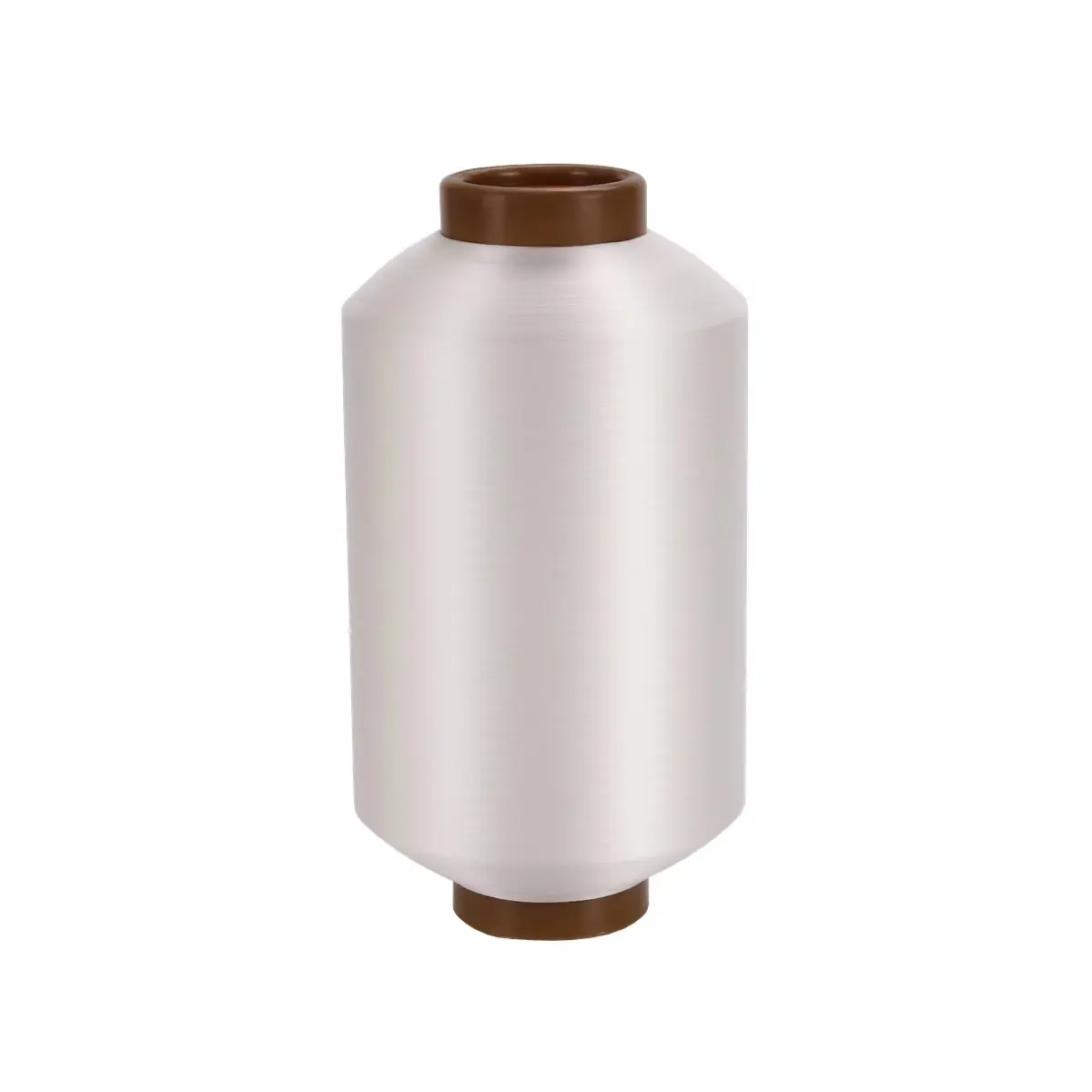
Monofilament vs Multifilament: Trade-Offs in Hosiery
Hosiery yarns come in both constructions, and the choice affects everything from sheen to snag behavior.
Monofilament yarn — a single filament at the specified denier — delivers a smooth, glassy surface and high sheen. It knits into a very uniform sheer fabric and serves some fashion legwear and technical mesh applications. The trade-off is handling brittleness: a single filament break is a hole, and bending stiffness rises with filament diameter, compromising drape at higher deniers.
Multifilament yarn — many fine filaments bundled into one thread — dominates mainstream hosiery. It offers better flex fatigue, softer hand, and superior cover per denier. When one filament breaks, the others carry the load, so a snag is often survivable rather than catastrophic. Multifilament also dyes more uniformly and supports texturing, at the cost of pilling propensity at higher filament counts and slightly lower luster unless bright-graded polymer is specified.
Most hosiery programs run multifilament for durability; monofilament is reserved for shine-critical or price-sensitive segments where snag risk is accepted.
DTY vs FDY for Hosiery Knitting
Drawn textured yarn (DTY) and fully drawn yarn (FDY) behave very differently on hosiery machines, and mis-specifying the two is a common cause of fabric defects.
FDY is smooth, flat, and high-tenacity. It knits into compact, dimensionally stable fabrics with a clean surface — the classic choice for sheer tights where clarity and uniformity are the product. Its low elongation means less bulk but better gauge definition, and the predictable yarn path suits high-speed circular knitting.
DTY carries twist-induced crimp that gives it loft, stretch, and a softer hand. In legwear it is used where volume, comfort, and a matte appearance are priorities — opaque tights, boot socks, and knitted leggings. Texturing slightly reduces tenacity versus FDY at the same denier, but the elastic behavior improves fabric fit, and the bulk spreads stitch tension, masking minor knit faults.
Match the yarn type to fabric architecture: FDY for gauge-critical sheer constructions, DTY for bulk-driven opaque and comfort-oriented programs. A single legwear line often consumes both — FDY in the leg panel and DTY or covered yarn in the panty section for stretch and recovery.
Elastane Covering: SCY and ACY for Stretch Recovery
Modern tights and many socks are not knitted from bare nylon alone. The stretch component is an elastane core covered with nylon, and the covering method determines stretch behavior and cost.
- Single-covered yarn (SCY): one layer of nylon wrapped around the elastane core. It is economical, gives firm recovery, and is the standard for socks, knee-highs, and tights where the covered yarn is knitted as the plating yarn alongside bare nylon.
- Air-covered yarn (ACY): compressed air intermingles the nylon sheath with the elastane rather than mechanically wrapping it. ACY has a softer hand, higher stretch, and no wrap twist torque — fabric spirality and skewed hems are reduced. It suits high-stretch opaque tights and seamless activewear-legwear hybrids.
Covering spec details matter in production: wrap direction (S or Z), turns per meter, and covering denier all affect recovery power. Insufficient covering tension shows up as bare-elastane exposure after dyeing; excessive covering produces a stiff, boardy fabric that fails recovery tests. For seasonal legwear that must survive repeated donning, specify covered yarn by cover ratio and elastic recovery percentage — not just denier.
Knitting Machine Compatibility: Circular Hosiery Machines and Feeders
Hosiery is produced on small-diameter circular knitting machines — single-cylinder sock machines and hosiery machines with 3.5 to 4 inch diameters, running gauges from 7N to 21N for tights and up to 200N+ for ultra-fine sheer styles. Yarn must be specified against the machine, not in isolation.
Key compatibility points to verify with your yarn supplier:
- Yarn count vs gauge: fine gauges require finer, highly uniform yarn. A 15D yarn destined for a 200-gauge machine needs CV values and fault counts far stricter than the same denier on a 36-gauge machine.
- Feeder and creel behavior: hosiery machines feed yarn at high, fluctuating speeds because each feeder alternates between pattern zones. Yarn tension peaks demand consistent elongation and proper lubrication to avoid breaks at the feeder eye.
- Package build: hosiery creels unwind over-end at fluctuating speeds. Package hardness, winding tension, and tail joints all affect stop rates; poor package build is a leading cause of mid-course breaks that operators incorrectly blame on yarn quality.
- Lubrication type and level: the spin finish must match hosiery knitting speeds. Too little friction control causes fused breaks on needles; too much causes dyeing scum and staining in downstream finishing.
Tip: Before committing to a bulk hosiery yarn order, run a supervised knitting trial on the exact machine gauge and speed you will use in production — and agree in writing on acceptable stop rates per 1,000 needles per hour. A yarn that performs acceptably on a mid-speed trial machine can fail on a high-speed production line, and the cost of that discovery belongs to whoever skipped the trial.
Snag Resistance and Abrasion Specifications
Legwear lives or dies on abrasion performance. Sheer tights are judged against ladder and hole formation; opaques against surface wear and pilling. Define measurable targets rather than adjectives:
- Tenacity: 3.5–4.5 cN/dtex is typical for hosiery-grade nylon FDY; higher tenacity improves snag survival in sheer weights.
- Abrasion cycles: Martindale or Stoll flex-abrasion testing on the finished knit, with pass thresholds set per garment category.
- Ladder resistance: assessed on the knit structure, influenced by filament count and yarn friction — multifilament with controlled intermingling ladders less than flat monofilament.
Coordinate the yarn friction spec with your knitting oil and finishing chemistry: snag behavior is a system property, not a yarn property alone.
Dye Uptake and Lot Consistency for Seasonal Color Programs
Fashion legwear runs on seasonal color cards — six to ten shades per season, across multiple knit structures and deniers. Nylon takes acid dyes fast and deep, but that sensitivity means small polymer or process variations between lots convert into visible shelf-level shade differences. For seasonal programs, require: dye-lot merging data from the supplier, spectrophotometric matching to your standard (DE under 0.8 for adjacent garment pieces), and a consistent polymer source within a season. Reserve one dye-lot for one colorway per production window — mixing lots within a colorway is the most common cause of legwear markdowns.
Bio-Based PA11 for Eco-Positioned Legwear Lines
PA11, derived from castor bean feedstock, offers hosiery brands a defensible sustainability story with performance attached: lower density than PA6 for lighter sheer constructions at equal denier, excellent flex fatigue for repeated wear cycles, and inherent softness suited to next-to-skin legwear. Bio-based content is verifiable through mass-balance documentation, supporting claims that survive scrutiny. For eco-positioned legwear lines, PA11 FDY in sheer categories and PA11-based covered yarns in stretch categories allow a line-level story rather than a single-product claim — position it where buyers pay for differentiation: premium sheer programs, certified sustainable basics, and collaborations with published carbon targets.
QC Test Items for Hosiery Yarn Acceptance
Define a written acceptance protocol for every delivery. Core items:
- Linear density (denier) and CV% — deviation directly shifts garment weight and sheer level.
- Tenacity and elongation at break — governs knitting breakage and garment strength.
- Evenness (Uster CV%) and fault classification — thick and thin places become visible defects in sheer fabric.
- Boiling water shrinkage — must be uniform across lots, or finished tights vary in length after dyeing.
- Twist, intermingling points, and lubrication level — process parameters that predict machine performance.
Frequently Asked Questions
What denier should I specify for everyday opaque tights?
40D–70D multifilament is the standard range. Within that band, choose 40D–50D for semi-opaque transitional-season products and 60D–70D for full opaque year-round programs, pairing the higher end with covered yarn if stretch recovery is a fit requirement.
Is DTY or FDY better for sheer tights?
FDY. Its smooth, high-tenacity profile knits into the clean, uniform fabric surface that sheer tights demand. DTY is better deployed in opaque and comfort-driven constructions where bulk and softness are priorities.
When should hosiery programs choose SCY over ACY?
Choose SCY for firm recovery at lower cost — socks, knee-highs, standard tights. Choose ACY when soft hand, high stretch, and low torque matter — premium opaque tights and seamless constructions where fabric spirality must be minimized.
Can bio-based PA11 replace conventional nylon in existing hosiery production?
In most cases yes, with a knitting trial. PA11 runs on the same circular hosiery machines, but its density and friction profile differ slightly from PA6, so verify feeder tension settings and dye recipes before full-scale rollout.
Related Pages
Hot Melt Yarn vs Adhesive Film
Low Melting Yarn vs Regular Yarn
Bulk Yarn Order Timeline Explained
Yarn Bulk Order Planning Guide
Post time: Nov-06-2026