
Low-Melt Yarn Bonding for Air-Layer Fabrics: A Sourcing and Process Guide for Textile Mills
For fabric mills and sourcing managers building air-layer (three-dimensional padded) textiles, the bond between the face fabric and the inner spacer layer decides whether the finished cloth feels premium or falls apart after a single wash. Mechanical interlock alone is rarely enough at commercial line speeds, which is why low-melt yarn and hot-melt yarn have become the default adhesive medium for lingerie cups, automotive headliners, medical padding, footwear reinforcements, and bonded sportswear. This guide walks through the procurement specifications, process windows, and defect-control checkpoints that a sourcing team actually needs before issuing a purchase order, and it focuses on the bonding step rather than on the face yarn itself.
A buyer who understands the melt behavior of the bonding yarn can negotiate a tighter specification, reject borderline lots earlier, and protect the production line from the most expensive failure in textiles: a stoppage caused by a missing process-critical input. The sections below translate laboratory melt data into the language a purchasing manager and a plant engineer can both act on.
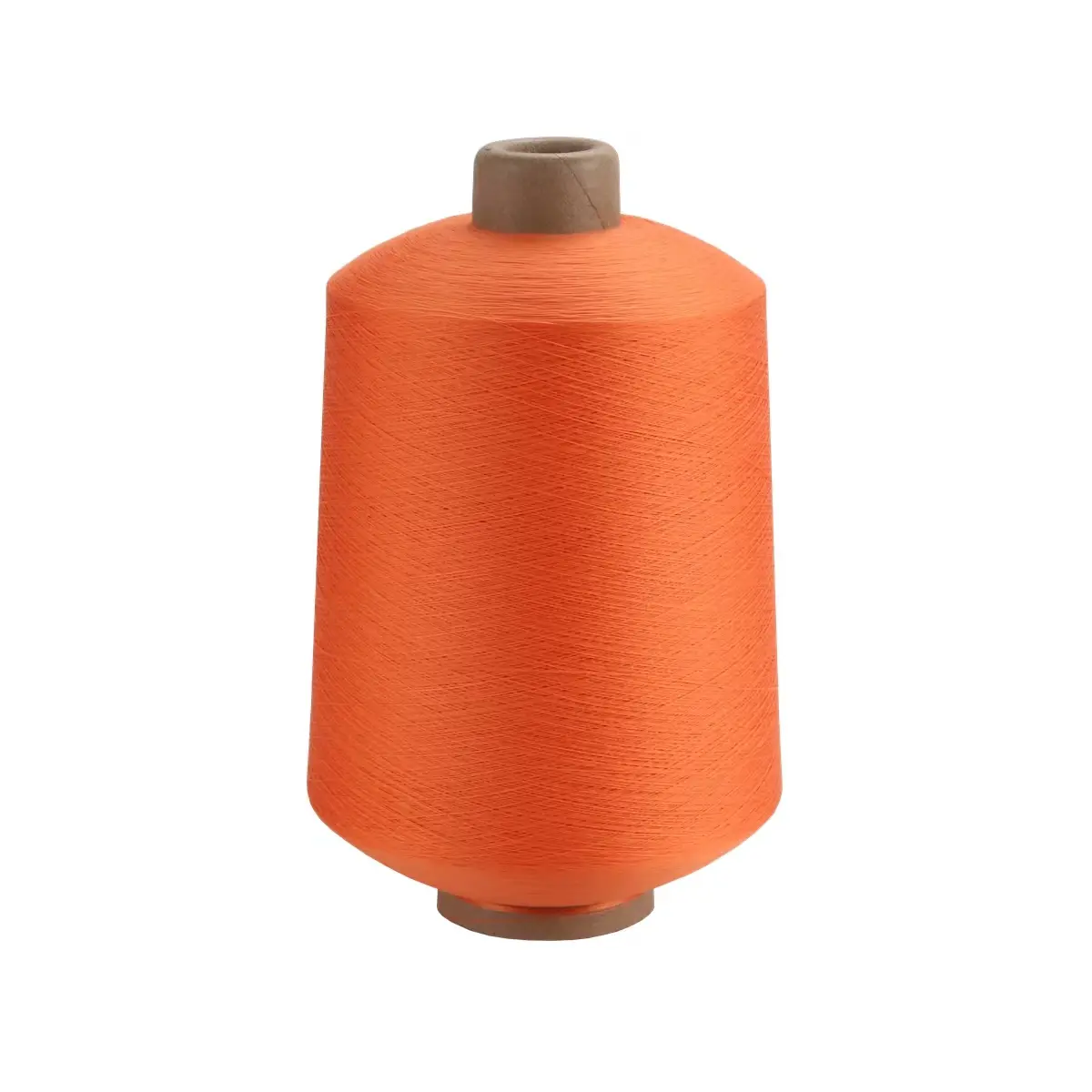
Why Air-Layer Fabrics Depend on Thermal Bonding
An air-layer fabric is essentially a sandwich: a decorative face, a lofty middle (often a spacer knit or fiber batt), and a backing, held together so the middle keeps its volume and the panel keeps its shape. Flame lamination uses solvent or open flame, which raises compliance, odor, and worker-safety concerns; adhesive film adds a separate converting step plus a third material that must be qualified, stored, and inspected. Low-melt yarn simplifies the stack because the bonding agent is already built into the yarn structure — typically as a low-melt point polyamide sheath wrapped around a higher-melt core, or as a dedicated hot-melt monofilament laid directly into the knit.
From a buyer’s seat, the appeal is consolidation. One yarn line replaces an adhesive film SKU, a laminator conversion pass, and a receiving-inspection step. For a mid-size mill running 30,000–80,000 meters of air-layer per month, removing one converting process can cut converted cost by roughly 6–12% while shrinking the supplier list and the corresponding audit workload.
- Lingerie and wired-cup structures where a soft, breathable bond beats a film lamination
- Automotive headliners and door panels needing low VOC and no solvent residue
- Medical and hygiene padding where wash stability is certified
- Footwear reinforcements and bonded activewear panels
How Low-Melt Yarn Works: The Melting Window
The single most important parameter is the melt point of the bonding component. Standard nylon face yarns sit near 215–260°C; a low-melt sheath is engineered to flow at 80–140°C depending on the copolymer chemistry. The practical rule for a stable process is a gap of at least 60–90°C between the bonding phase and the substrate, so the face fabric never deforms during fixation.
Most commercial low-melt bonding yarns operate inside a 90–130°C bonding window, with the sweet spot around 105–118°C for polyamide-based systems. Below the window the bond is tacky but not fused; above it the yarn can stiffen the fabric or bleed through a fine face. Process engineers usually set the oven 8–15°C above the measured softening point and validate on the real substrate, not on a laboratory card.
- Sheath-core PET: melt onset ~110°C, full flow ~130°C
- Co-polyamide (COPA): melt onset ~90°C, full flow ~115°C
- Co-polyester (COPE): melt onset ~100°C, full flow ~125°C
- Bio-based PA11 sheath variants: melt onset ~95°C, full flow ~120°C
Sheath-Core Versus Full Low-Melt Construction
A sheath-core bonding yarn keeps a high-melt core for strength and uses only the sheath to fuse, which protects tensile performance. A fully low-melt monofilament fuses completely and gives a flatter, more uniform bond but contributes less structural strength on its own. For air-layer face bonding, sheath-core is the safer default; for point bonding or interlining, a full low-melt monofilament is often preferred.
Specifying Low-Melt Yarn for Bonding Layers
When a sourcing manager writes the specification sheet, the following attributes should appear explicitly rather than as a generic “low-melt nylon,” because every one of them moves the process setpoint and the reject rate.
- Melting point range, stated as onset and full-flow temperatures, not a single number
- Linear density: bonding monofilaments typically run 3–8 denier monofilament, while wrapped multifilament bonding yarns sit in 20–75 denier
- Sheath chemistry (COPA versus COPE versus bio-based PA) and any regenerated content
- Shrinkage at bond temperature, usually targeted under 4% to avoid puckering
- Color and additivation — no yellowing agents if the face is white or pastel
- Recommended bond pressure, typically 0.5–2.5 bar on calender or 0–0.3 bar in through-air
Reading the Bond-Strength Curve
Ask suppliers for a bond-strength curve, not a single peak value. A credible mill will supply peel and shear data across a temperature ramp so your process team can choose the safest operating point with margin on both sides. Flag any supplier who can only quote one number at one temperature — that data cannot protect your line when the oven drifts 5°C on a humid afternoon.
Bonding Process Parameters and Equipment
Two equipment families dominate air-layer bonding. The first is the heated calender or flat-bed press, where the fabric passes between heated rolls at controlled pressure — fast, repeatable, and good for dense constructions. The second is the hot-air through-air oven, which floats the fabric on air and suits lofty, compression-sensitive air layers that would be crushed by rolls.
Calender Bonding
Calender lines run at 100–135°C across two or three zones, with line speeds of 10–25 m/min and nip pressures of 1–3 bar. They excel on thin, flat panels such as interlinings and shoe reinforcements where a dead-flat bond is required.
Through-Air Bonding
Through-air ovens float the cloth and apply 0–0.3 bar, preserving loft for apparel and automotive pads. Dwell times run 30–90 seconds, and the absence of roll pressure keeps the spacer layer visibly three-dimensional after bonding.
A well-tuned line delivers a peel strength of 8–15 N/cm on standard air-layer constructions, enough to survive garment cutting, domestic washing, and abrasion without delamination. Document the exact setpoint per style, because a 5°C shift is enough to move a bond from “excellent” to “sprung edges.”
- Oven zone temperature: 100–135°C, often in 3 separately controlled zones
- Dwell time: 20–90 seconds depending on fabric weight (heavier equals longer)
- Line speed: 8–25 m/min on continuous bonders
- Cooling: forced ambient or chilled roll to set the bond before winding
Pairing Bio-Based Nylon with Low-Melt Bonding
Many brands now request bio-based PA11 or PA56 face yarns for sustainability claims, then bond them with a conventional adhesive. The cleaner option is to keep the bonding chemistry in the same family — a PA11-sheathed low-melt yarn bonds to a PA11 face with near-native compatibility and avoids a mixed-polymer recycle stream. PA56 faces, being more hydrophilic, need a sheath with matched moisture handling or the bond can weaken after repeated laundering.
For sourcing teams, the procurement question becomes: can one supplier deliver both the bio-based face yarn and the matching low-melt bonding yarn? Consolidating onto a single qualified bonding-yarn source reduces lot-to-lot variation and simplifies the documentation required for certification audits, which is where most small mills quietly lose time.
PA11 Versus PA56 Bonding Notes
PA11 bonds cleanly with a co-polyamide sheath and tolerates the 105–118°C window without hand loss. PA56 runs slightly cooler and absorbs more moisture, so specify a sheath validated at 100–115°C and confirm wash stability on the finished panel rather than trusting the yarn datasheet alone.
Common Defects and How to Avoid Them
Even with good yarn, bonding lines generate a predictable set of rejects. The short list below is what a quality manager should brief the line on before the first bulk run, together with the usual corrective move.
- Sprung or curled edges — usually under-temperature or uneven pressure; raise zone 1 by 3–6°C
- Bond strike-through — bonding yarn bled to the face; lower temperature 5–10°C or use finer denier
- Soft-hand stiffness — over-cure; shorten dwell or drop oven 5°C
- Wash delamination — bond below spec; revalidate peel strength after 5 home launderings
- Yellowing on white goods — additive incompatibility; request a non-yellowing grade
Set acceptance at no more than 2% bonded-panel delamination after five wash cycles, and keep a retained sample from each dye lot so any field claim can be traced back to a specific production window.
Tip: Always request a bonded trial swatch on your actual face and spacer fabric before releasing a full low-melt yarn purchase order — melt behavior shifts by substrate, and a lab card will not catch it.
Inventory and Order Planning for Bonding Lines
Low-melt yarn is a process-critical input: if the bond yarn is late, the entire air-layer line stops, not just one style. Plan it like a glue you cannot substitute on the fly. For most mills, a 2–4 week raw yarn lead time is realistic for standard colors, extending to 6–10 weeks for custom melt points or bio-based grades that carry certification paperwork.
- Carry 3–4 weeks of bonding-yarn cover as safety stock for steady styles
- Place the bond-yarn PO at the same time as the face-yarn PO, not afterward
- Pre-qualify a second sheath chemistry as backup to avoid single-point stoppage
- Batch by dye lot so bond and face share the same shade tolerance window
Negotiate a fixed reorder cadence with the supplier rather than ad-hoc orders; a standing monthly release smooths both your cash cycle and the supplier’s production planning, which is reflected in steadier lead times.
FAQ
What melt point should I specify for bonding a PA11 face fabric?
For a PA11 face, target a bonding sheath with onset near 90–100°C and full flow around 115–120°C, keeping at least 90°C below the PA11 substrate melt. This preserves the face hand while giving a reliable fuse and a comfortable process margin.
Can low-melt yarn replace adhesive film entirely?
In most air-layer and interlining applications, yes — the bonding yarn is laid into the knit structure so no separate film or laminator conversion is needed. Film still wins where an ultra-thin, dead-flat bond is required on non-knit substrates such as rigid composites.
How do I test bond quality before a bulk order?
Run a 10–20 meter trial on your actual face and spacer, then measure peel strength (target 8–15 N/cm), check for strike-through under raking light, and launder five times to confirm no delamination. Keep the swatch as the approved standard for incoming inspection.
Does bonding affect the bio-based content claim?
Only if the bonding chemistry is a different polymer family. Matching a PA11 sheath to a PA11 face keeps the material stream coherent and eases recycled- or bio-content documentation during third-party audits.
What safety stock level prevents line stoppage?
Hold 3–4 weeks of steady-style bonding yarn, and always release the bond-yarn purchase order together with the face-yarn order so the two arrive as one qualified set rather than at crossed timelines.
Related Pages
- Hot Melt Yarn vs Adhesive Film
- Low Melting Yarn vs Regular Yarn
- Bulk Yarn Order Timeline Explained
- Yarn Bulk Order Planning Guide
Post time: Sep-18-2026