
Air-Covered Yarn vs Single-Covered Yarn: ACY, SCY and ITY Sourcing for Stretch Fabric Mills
Stretch fabric mills live or die by one invisible component: the covered yarn that sits inside almost every elastic knit and woven you produce. Whether you run circular knitting for leggings, double-cylinder machines for socks, seamless body-size machines for underwear, or warp knitting for swimwear, the choice between air-covered yarn (ACY), single-covered yarn (SCY) and interlaced textured yarn (ITY) decides your fabric’s rebound, surface quality, torque behavior and, ultimately, your rework rate. This guide is written for fabric mills, seamless garment factories, activewear sourcing teams and yarn traders who need a practical, numbers-backed way to specify and buy covered yarn rather than guessing from a supplier’s catalog photo.
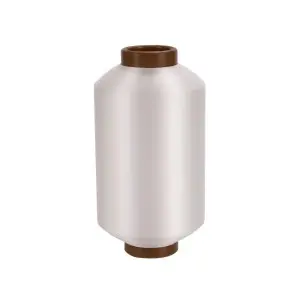
1. What Is Covered Yarn? Structure and Definition
A covered yarn is, at its simplest, a two-component structure. The bio-based nylon PA11 or polyester filament forms the outer sheath, while a bare or lightly finished elastane (spandex) filament forms the central core. The core carries the stretch; the sheath carries the abrasion resistance, the color and the hand feel. The critical manufacturing question is how the sheath is attached to the core, and this single decision splits the entire product family into two fundamentally different technologies.
Two Ways to Attach the Sheath
In air-covered yarn the outer filament is entangled onto the spandex core by a high-velocity air jet. The jet creates intermittent air-interlaced network points where the nylon loops and knots around the core without any twist. The fabric surface reads as a clean, almost single-yarn look. In single-covered yarn the outer filament is mechanically twisted around the core on a hollow-spindle machine, producing a visible spiral wrap. The twist angle, measured in turns per meter (TPM), typically runs between 900 and 1800 TPM depending on the denier combination and the target end-use.
The structural consequence is direct. Air-interlacing leaves the core loosely held but highly flexible, so the yarn has low torque and minimal residual twist. Twist-wrapping locks the core tightly but introduces directional torque that must be balanced downstream. For a mill, this difference shows up first in knitting stability and later in fabric skew.
2. ACY vs SCY: Process Differences and Cost
The production lines are different animals. An air-covering machine uses compressed air (typically 5 to 7 bar at the interlacing jet) and runs at high throughput with relatively few moving parts. A single-cover machine spins a hollow spindle at high RPM, consumes more energy per kilogram, and is slower. The cost gap is consistent across suppliers: SCY usually carries an 8% to 18% premium over an equivalent ACY construction, driven by slower line speed, higher energy, and more frequent spindle maintenance.
| Parameter | Air-Covered Yarn (ACY) | Single-Covered Yarn (SCY) |
|---|---|---|
| Sheath attachment | Air-interlaced network points | Mechanical twist (900-1800 TPM) |
| Typical torque | Low (1-3 TPM residual) | Higher (needs balancing) |
| Surface appearance | Clean, uniform, low barre | Visible spiral, finer cover |
| Core exposure risk | Moderate if network weak | Low when TPM sufficient |
| Line speed | High (400-900 m/min) | Lower (250-500 m/min) |
| Relative cost index | 100 (baseline) | 108-118 |
| Best fit | Seamless, leggings, socks | Sheer hosiery, fine gauge |
Cost is not the only lever. SCY gives you a finer, more complete cover at low denier, which is why ultra-sheer hosiery and fine-gauge circular knits still prefer it. ACY wins on torque control and productivity, which is why high-volume leggings and seamless bodies increasingly standardize on it. The emerging sweet spot for sustainability-minded brands is an ACY construction where the sheath is a bio-based nylon PA11 filament, delivering renewable-content claims without sacrificing the low-torque knitting behavior mills need.
3. Where ITY and Other Air-Textured Variants Fit
Interlaced Textured Yarn (ITY) is often confused with ACY, but it is a distinct product. ITY is usually a non-elastane or co-elastane air-textured construction where the interlacing creates a bulked, matte, drapey yarn used in woven and circular knit apparel for its soft hand and coverage. It is not a stretch core yarn in the covered-yarn sense; rather, it is a comfort textured yarn. Buyers should treat ITY as a companion product: use ACY or SCY when you need true elastic recovery, and use ITY when you need bulk, opacity and drape without high stretch.
Other air-textured variants include ATY (air-textured yarn) made from nylon or polyester flat filament for suede-like surfaces, and double-covered yarn (DCY) where two sheaths are wrapped in opposite directions to cancel torque entirely. DCY is the premium choice for high-tenacity applications like narrow elastic and premium hosiery, but it costs materially more than both ACY and SCY because it doubles the covering passes and roughly doubles the sheath material consumed per meter.
4. Fabric Performance Differences
Elastic Recovery and Power
The elastic recovery rate of a covered yarn after a 100% extension should stay above 95% at 20°C, and the residual extension after 3 stretch cycles should be under 4%. ACY and SCY perform similarly on raw recovery, but ACY holds its recovery more consistently across a long knit run because its low torque reduces uneven tension at the needle. SCY can show slightly higher initial power (firmer hold) thanks to the tight wrap, which some shapewear mills prefer for containment.
Hand Feel and Torque
Hand feel is the fastest way a buyer rejects a fabric. ACY feels rounder and softer because the air-entangled loops sit loosely; SCY feels crisper and more structured because the twist compresses the core. Torque is where they diverge sharply. ACY runs at 1 to 3 TPM residual, so fabric skew is minimal. SCY runs higher and, if the two plies or the downstream finishing are unbalanced, produces directional curl and panel twist. The classic failure is a legging leg that rotates on the body after washing, which traces back to unmanaged SCY torque or a mismatch between yarn twist and knit stitch direction.
Barre, Evenness and Coverage
Barre (horizontal stripes of shade or texture) is the covered-yarn mill’s recurring nightmare. In ACY, barre comes from inconsistent network point density; in SCY, from TPM variation between spindles. Coverage uniformity decides whether the spandex core grins through under tension. A well-covered 70D nylon over 40D spandex ACY should show zero core exposure at 30% fabric stretch; a poorly covered lot will expose the core at 15%, ruining opacity in swimwear and activewear. Evenness, measured as Uster CV% on the sheath, should stay under 1.5% to keep the cloth free of subtle shade bands.
5. Application Matching: Which Yarn for Which Product
| End use | Recommended yarn | Typical denier combination | Why |
|---|---|---|---|
| Leggings (compression) | ACY, bio-based PA11 sheath | 70D PA11 / 40D spandex | Low torque, soft hand, renewable claim |
| Socks (sport) | ACY or SCY | 70D-100D / 20D-40D | ACY for comfort, SCY for durability |
| Underwear (seamless) | ACY | 40D-70D / 20D-30D | Low torque prevents panel twist |
| Swimwear | SCY (chlorine-resistant sheath) | 40D-70D / 40D spandex | Full cover, no grin-through |
| Sheer hosiery | SCY fine gauge | 15D-30D / 10D-20D | Finer, complete cover at low denier |
| Shapewear | SCY or DCY | 70D / 40D-70D | Higher power and hold |
The rule of thumb: choose ACY when you prioritize torque-free knitting, softness and productivity; choose SCY when you need the finest cover, highest power or sheer appearance; choose DCY when torque must be zero and budget allows. For brands with sustainability targets, specifying a bio-based nylon PA11 sheath on an ACY base is the most pragmatic route to a renewable stretch claim without re-engineering the whole fabric.
6. Quality Indicators You Should Specify
- Network points per meter (n/m): for ACY, target 30 to 80 n/m depending on denier; below 25 n/m the sheath slips and core exposure appears.
- Coverage uniformity: no visible core at specified stretch; measure on a 10-meter scan under tension.
- Broken filaments: zero allowed in the outer sheath on a 1000-meter defect check.
- Spandex content: declare exact percent (typically 8% to 25%); tolerance plus or minus 0.5%.
- Linear density: final denier tolerance plus or minus 2% across the lot.
- Elongation at break: spandex core should reach 450% to 550% before failure.
- Heat setting shrinkage: sheath nylon under 4% at 180°C for 30 seconds for stable finishing.
- Color and light fastness: grade 4 minimum on the blue wool scale for apparel.
The network points per meter figure is the single most neglected spec in buyer contracts, yet it predicts core coverage better than any other number. Always write it into the purchase order.
7. Spindle-to-Spindle and Lot-to-Lot Consistency
Because covered yarn is made on many parallel spindles, spindle-to-spindle variation is the hidden source of barre. Within a single lot, network point density or TPM can drift by 10% to 15% between the first and last spindle if the machine is not periodically calibrated. Require the supplier to provide a spindle-map report showing n/m or TPM for every spindle in the lot, and reject any lot with a coefficient of variation above 5%.
Lot-to-lot consistency matters even more for repeat programs. A leggings brand re-ordering the same style six months later will see shade and power drift if the spandex batch or the air-jet pressure changed. Lock the process window in the contract: jet pressure, TPM, draw ratio and dye lot. Ask for a retained sample of the approved lot and a parallel test on every incoming shipment.
Tip: Never approve a covered yarn lot without running a 3-cycle stretch-recovery test and a 10-meter visual coverage scan, because a 2% drop in spandex core tension can turn into visible grin-through after only 20 wash cycles.
8. Procurement Specification Sheet and Incoming Acceptance Tests
Your purchase specification should leave no room for interpretation. Write the following fields explicitly:
- Construction: ACY, SCY or DCY, with sheath and core identity.
- Sheath material and origin: for example bio-based PA11, 70D, 24 filaments.
- Core: spandex denier and brand, for example 40D.
- Final covered denier and tolerance.
- Network points per meter (ACY) or TPM (SCY).
- Spandex content percentage and tolerance.
- Color, dye lot, and light fastness grade.
- Packing: cone weight, cone type, number of cones per carton.
- Certificate requirements: GRS if recycled, bio-content declaration if PA11.
On arrival, run a short incoming test plan: linear density check on three cones, n/m or TPM verification, a 3-cycle stretch-recovery on a knit swatch, a 10-meter coverage scan under 30% tension, and a shade check against the retained standard under D65 light. Any single failure above tolerance should trigger a lot hold and a supplier corrective action report. Keep the test records tied to the lot number so a future complaint can be traced back to the exact spindle map and dye lot.
9. Buying Decision Checklist
- Confirm the end-use and the torque tolerance of your knitting or weaving process.
- Choose ACY for low-torque softness, SCY for fine cover and power, DCY for zero torque.
- Decide whether a bio-based PA11 sheath supports your sustainability claim.
- Write network points per meter or TPM into the PO as a hard spec.
- Request a spindle-map report and reject lots with CV above 5%.
- Agree on a retained standard sample and parallel incoming testing.
- Define the incoming acceptance test plan before the first shipment.
- Lock the process window (jet pressure, TPM, draw ratio, dye lot) in the contract.
FAQ
Q: Can I substitute ACY for SCY in sheer hosiery?
A: Not directly. Below 30 denier the air-interlacing of ACY struggles to give complete cover, so you will see core grin-through. For sheer products, stay with fine-gauge SCY or move to a higher denier ACY only if the design tolerates lower opacity.
Q: Does a bio-based PA11 sheath change the covered yarn performance?
A: The PA11 sheath behaves close to conventional nylon 11 in tenacity and heat setting, so recovery and torque are unaffected. The difference is the renewable feedstock and a lower embedded carbon, which is valuable for brand reporting without re-qualifying the fabric.
Q: Why does my SCY fabric twist after washing?
A: Residual torque from the wrap is not balanced by stitch direction or finishing. Lower the TPM, reverse alternate courses, or switch to ACY or DCY where torque is near zero.
Q: How many network points per meter do I need for leggings?
A: For a 70D PA11 over 40D spandex ACY, target 50 to 70 n/m. Below 30 n/m the sheath slips under extension and the core exposes, ruining opacity.
Q: Is ITY a replacement for covered yarn?
A: No. ITY gives bulk and drape without true elastic recovery. Use it for comfort and coverage layers, and keep ACY or SCY where you need stretch and rebound.
Related Pages
- Hot Melt Yarn vs Adhesive Film
- Low Melting Yarn vs Regular Yarn
- Bulk Yarn Order Timeline Explained
- Yarn Bulk Order Planning Guide
Post time: Oct-12-2026