
Polyester vs Nylon Heat Resistance: A Complete Buyer’s Guide for Textile Yarn Sourcing
Introduction
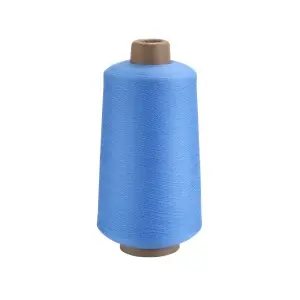
Core Thermal Parameter Comparison: Polyester vs Nylon Series
1. Melting Point & Softening Temperature
- Polyester (PET)
Melting range: 250°C–260°C; softening point around 230°C.
Polyester maintains stable molecular structure before reaching 230°C, with no obvious softening or strength loss. It supports high-temperature color fixation at 130°C–140°C under high-pressure dyeing conditions without deformation or breakage.
- Nylon 6 (PA6)
Melting range: 215°C–225°C; softens noticeably above 150°C.
Once the temperature exceeds 140°C, PA6 yarn will shrink, lose elasticity, and suffer permanent tensile strength degradation, which restricts its application in high-temperature continuous processing lines.
- Bio-based Nylon 11 (PA11)
Melting range: 183°C–188°C, the lowest melting point among common nylon varieties.
Its low melting characteristic makes it a core raw material for low-melt thermal bonding yarns, but it cannot withstand long-term exposure to temperatures above 160°C.
2. Long-Term Safe Service Temperature
- Polyester: Stable long-term use at 120°C–130°C; short-term instant heat resistance reaches 180°C–200°C. Low moisture absorption (0.4%–0.5%) ensures its thermal mechanical performance does not fluctuate in humid and hot environments, with consistent size and strength after repeated thermal cycling.
- PA6 Nylon: Safe continuous service temperature below 93°C. When humidity is high, absorbed water molecules act as plasticizers, further reducing heat resistance, leading to fabric sagging and permanent creases under sustained heat load.
- PA11 Nylon: Long-term recommended service temperature ≤110°C. Its moisture absorption rate is far lower than PA6, so thermal stability in hot and humid conditions outperforms regular nylon 6, yet still falls short of polyester.
3. Ironing & Post-Processing Temperature Limits
- Polyester: Maximum ironing temperature 180°C. After heat setting, fabrics retain excellent shape retention and anti-wrinkle properties without melting or sticking.
- PA6 Nylon: Ironing temperature strictly controlled below 140°C. High-temperature ironing will cause yarn melting adhesion, fabric hardening, and irreversible elasticity loss.
- PA11 Low-melt Nylon: Heat setting temperature limited to 100°C–130°C. It is intentionally designed for low-temperature thermal bonding; excessive heat will fully melt the bonding layer and destroy fabric structure.
Heat Performance Differences During Dyeing & Finishing
Polyester Thermal Advantages in Dyeing
Nylon Dyeing Thermal Limitations
- PA6: Sensitive to high-temperature water baths; fabrics are prone to uneven shrinkage and crease marks after high-temperature finishing.
- PA11: Exhibits superior dyeing compatibility compared to polyester under medium temperature, with lower carbon emissions during dyeing, but cannot match polyester for high-temperature continuous production efficiency.
Thermal Aging & Light-Heat Combined Stability
- Polyester: Outstanding heat-UV composite stability. After 1000 hours of light-heat aging, it retains 60%–70% of original tensile strength, with minimal yellowing. It is the preferred material for outdoor textiles, awning fabrics, and automotive upholstery exposed to sunlight.
- Nylon (PA6 & PA11): Poor light-heat aging resistance. After 500 hours of light-heat exposure, strength drops by nearly 50%, and fibers turn yellow and brittle. Nylon fabrics are unsuitable for long-term outdoor heat-sun exposure without special anti-UV coating treatment.
Application Scenario Material Selection Guide Based on Heat Resistance
Choose Polyester If Your Production Meets These Conditions
- Continuous high-temperature dyeing and heat setting processes above 130°C
- Finished products require long-term service under 100°C–130°C constant heat (automotive interiors, industrial transmission belts)
- Fabrics need anti-UV and anti-thermal aging performance (outdoor fabrics, tent cloth)
- High-temperature ironing and wrinkle-resistance finishing are standard procedures
- Products face alternating hot and humid thermal cycles with stable dimensional requirements
Choose Nylon (PA6 / PA11) If Your Production Meets These Conditions
- Medium-temperature low-melt thermal bonding applications (shoe uppers, lace, braids, sewing threads)
- Products prioritize abrasion resistance and soft hand feel over high-temperature tolerance (underwear, elastic webbing, sewing threads)
- Dyeing is completed at 100°C boiling water bath without high-temperature continuous processing
- End-use environment stays below 90°C without long-term sun exposure
- Bio-based low-carbon production targets (PA11 100% bio-based yarn cuts carbon emissions by over 50% vs polyester)
Key Sourcing Takeaways for Buyers
- Do not judge heat resistance only by melting point: Polyester has a higher melting point and far more stable thermal performance under humid heat cycling than all nylon grades.
- Distinguish nylon subtypes clearly: PA6 has higher melting point than PA11, but worse hot-humidity stability; PA11 is a low-melt specialized bonding yarn, not a substitute for high-temperature structural fibers.
- Match yarn selection to your maximum processing temperature: If your factory runs 130°C high-pressure dyeing lines, polyester is the only viable mass-production option; if low-temperature thermal bonding is core technology, PA11 low-melt nylon delivers better bonding effect.
- Balance heat resistance with auxiliary performance: Nylon surpasses polyester in abrasion resistance and softness, while polyester leads in thermal stability, light resistance, and dimensional retention. Select materials based on your product’s primary performance priority.
Final Summary
Post time: Jul-08-2026