
Polyester Low Melt Yarn Specifications: A Buyer’s Reference Guide
Table of Contents
- Understanding Polyester Low Melt Yarn Basics
- Core Technical Specifications To Evaluate
- How Key Parameters Influence End‑Product Performance
- Melting Point Selection Based On Manufacturing Processes
- Denier & Filament Count: Matching Yarn To Application
- Comparing FDY vs DTY Low Melt Polyester Yarn
- Practical Buying Considerations For Sourcing
- Common Application Scenarios
- Frequently Asked Questions
- Conclusion
Manufacturers across footwear, apparel, home textile and technical textile sectors are continuously searching for reliable thermal bonding materials. Polyester low melt yarn has grown in popularity as an alternative to liquid glue and chemical binders. It behaves like standard textile yarn during weaving and knitting, then fuses and locks fibres together under controlled heat treatment.
Even experienced procurement teams can face confusion when comparing datasheets from different suppliers. Nominal labels such as “110℃ low‑melt yarn” may not translate to identical real‑world performance. Small differences in melting range, shrinkage, tenacity and filament structure can lead to production downtime, fabric defects or finished‑product failures.
Understanding core specifications will help you short‑list suitable material, reduce trial‑and‑error sampling costs and align yarn performance with your existing thermal‑bonding equipment. Whether you are developing shoe uppers, garment interlinings, narrow woven tapes or composite technical textiles, this buyer‑focused guide walks you through critical specifications and real‑world trade‑offs.
Understanding Polyester Low Melt Yarn Basics
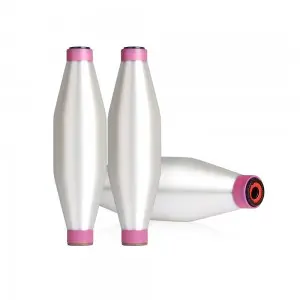
Polyester low melt yarn is a thermoplastic modified polyester filament designed for thermal bonding. Unlike conventional PET polyester with a melting point around 255‑260°C, copolyester modification lowers its softening and fusion temperature, allowing bonding at much lower oven temperatures.
Most commercial variants adopt sheath‑core bicomponent construction. The outer sheath layer is low‑melting copolyester, while the core retains standard high‑melting polyester to preserve mechanical strength before and after heat processing. Under heat activation, only the outer sheath softens and flows to bond adjacent yarns or fibres, while the core maintains structural integrity of the fabric.
A very important distinction: polyester low melt yarn is not a hot‑melt adhesive film. It can be processed on standard knitting and weaving machinery just like ordinary yarn. Bonding only happens after exposure to targeted thermal treatment. This characteristic enables sew‑free structural reinforcement without adding extra adhesive layers to final goods.
Key benefits that attract buyers include solvent‑free bonding, simplified production workflows, good wash‑resistance of bonded joints, and lighter‑weight fabric constructions. However, performance heavily depends on matching exact yarn specifications to your heat‑setting equipment and target product requirements. Generic specification labels are rarely sufficient for direct purchasing decisions.
Core Technical Specifications To Evaluate
When reviewing supplier datasheets, focus on this set of measurable technical indicators. Request certified test reports for production batches whenever possible, rather than relying only on marketing descriptions.
| Specification | Typical Commercial Range | Practical Buyer Significance |
|---|---|---|
| Nominal Melting / Fusion Point | 80°C‑150°C | Determines required oven temperature; must not exceed heat tolerance of other fibres in blend |
| Tenacity | 1.5‑3.0 cN/dtex | Ensures good runnability on looms and knitting machines, reduces breakage during fabric manufacturing |
| Elongation at Break | 20%‑50% | Influences fabric stretch behaviour and resilience of bonded textile parts |
| Thermal Shrinkage | 5‑15% | Excessive shrinkage can cause fabric distortion during heat‑bonding operations |
| Yarn Type | FDY / DTY | Impacts fabric hand‑feel, bulkiness and elasticity of finished goods |
| Denier / Filament Count | 30D‑300D; 24F‑144F | Defines fineness, coverage and softness for lightweight or heavy‑duty end‑uses |
| Finish / Oil Pick‑up | 0.10‑0.25% | Too high oil content may create smoking or staining in thermal ovens |
| Color | Raw white, black, dope‑dyed custom colours | Raw‑white for downstream dyeing; dope‑dyed for fixed‑colour finished textiles |
Many purchasing mistakes originate from overlooking thermal shrinkage. Two yarns with identical labelled melting point can produce completely different fabric dimensional stability if shrinkage values differ significantly. DSC (Differential Scanning Calorimetry) test curves are the most reliable way to verify real melting onset and peak temperatures for each lot, rather than trusting printed nominal values alone.
How Key Parameters Influence End‑Product Performance
Every specification interacts with your full production workflow. Selecting parameters in isolation often creates avoidable problems at the factory floor.
Melting point vs existing equipment limits If your thermal‑setting ovens can only reliably reach 120°C, ordering 130‑grade low‑melt polyester yarn will result in incomplete bonding and weak fabric joints. Conversely, selecting an 110°C‑grade yarn when other blended fibres are heat‑sensitive may lead to unintended shrinkage or fabric deformation. Always cross‑check yarn fusion temperature against maximum safe processing temperature of your co‑used materials.
Tenacity and processing stability Low tenacity grades can cause frequent yarn breaks on high‑speed knitting machines, raising waste rates and lowering output. For fly‑knit shoe uppers and high‑speed narrow weaving applications, higher‑tenacity variants are strongly preferred. For non‑woven padding materials, lower tenacity ranges are often acceptable.
Thermal shrinkage behaviour High thermal‑shrinkage yarn will pull fabric edges inwards during heat bonding. This can be a desired effect for locking selvedges to prevent fraying on woven tapes. The same property becomes a defect when you need flat, dimension‑stable panels for garment interlining or mattress textiles. Clarify shrinkage test conditions when comparing datasheets, as test temperature directly impacts final shrinkage figures.
Filament count and fabric hand feel Higher filament‑count yarn produces softer, smoother surfaces for apparel and intimate wear. Lower filament counts offer firmer structural reinforcement for heavy‑duty footwear components.
Melting Point Selection Based On Manufacturing Processes
Different industrial workflows call for different fusion‑temperature grades. This reference helps you narrow options at the early sampling phase.
- 105‑110°C Grade: Widely used for 3D fly‑knit shoe uppers and seamless textiles. Requires relatively low oven temperature, saves energy, suitable for blending with many common polyester textile materials. Care must be taken not to over‑heat during downstream drying or finishing steps to prevent unintended re‑fusion.
- 120‑130°C Grade: General‑purpose grade for interlining, woven tape edge locking, home‑textile lamination. Offers more thermal stability in subsequent finishing processes than 110°C variants. Works well for items that will go through repeated washing cycles.
- 140‑150°C Grade: For composite technical textiles and products requiring higher heat‑resistance in end‑use. Needs higher thermal‑bonding oven settings, best for factories with capable high‑temperature continuous ovens. Not recommended if your companion fibres cannot sustain elevated heat treatment.
Important practical note: The nominal melting temperature on datasheet represents the sheath polymer fusion peak. Actual bonding performance is also affected by oven dwell time, fabric compression pressure, and blending‑ratio between low‑melt yarn and base yarn. Successful bonding cannot be judged by temperature parameter alone. Lab or pilot‑scale sampling with your own production machine settings remains essential before mass orders.
Denier & Filament Count: Matching Yarn To Application
Denier reflects yarn thickness (weight in grams per 9000 meters yarn length). Filament count describes how many individual fine filaments make up one yarn bundle. Together these two values define texture, strength, coverage and processing suitability.
Fine denier range (30D‑75D) Well‑suited for lightweight fabrics: seamless underwear, lace reinforcement, thin garment interlining, fine narrow elastic tapes. Creates soft hand‑feel without adding bulk. Fine denier yarn demands careful attention to machine tension settings to avoid frequent breakage on high‑speed equipment.
Medium denier range (100D‑150D) This is the most widely‑specified specification. Applied heavily in knitted shoe uppers, upholstery fabrics, bag webbing, mattress quilting reinforcement. Balances mechanical strength, fabric coverage and process‑ability for mass‑volume manufacturing.
Heavy denier range (200D‑300D) For heavy‑duty technical textiles, thick composite layers and structural reinforcement applications. Produces stiffer fabric results and is less common for direct apparel contact layers.
Higher filament numbers (48F, 72F, 96F and above) deliver softer fabric surfaces. Lower filament counts create firmer, stiffer fabric structures. When sourcing custom specifications, confirm both denier and filament count, do not only reference denier value. Two 150D yarns with different filament counts will yield noticeably different fabric performance.
Comparing FDY vs DTY Low Melt Polyester Yarn
Buyers frequently choose between FDY (Fully Drawn Yarn) and DTY (Draw Textured Yarn) variants of low‑melt polyester. Each brings distinct characteristics for finished textiles.
FDY Low Melt Polyester Yarn FDY low‑melt yarn presents smooth straight filament structure. It provides good tensile strength and dimensional stability after thermal bonding. Fabrics tend to have cleaner, flatter surface appearance. FDY is the primary selection for woven tapes, shoe‑upper base fabrics and structural interlining where minimal stretch is required.
DTY Low Melt Polyester Yarn DTY receives texturing treatment to introduce bulkiness and elasticity. It creates softer, stretch‑friendly fabrics. This makes DTY suitable for elastic‑demanding applications such as seamless sportswear, elastic webbing and knit goods that need comfortable stretch‑recovery. One trade‑off: DTY typically shows higher thermal‑shrinkage variability, requiring tighter process control during heat‑bonding production.
There is no universally “better” option. The choice depends on whether your finished product prioritizes structural stability (FDY) or stretch‑and‑bulk comfort (DTY). Many factories run small‑batch sampling of both types before finalising purchasing specifications.
Practical Buying Considerations For Sourcing
Beyond technical parameters, these practical procurement points help you avoid delays and quality inconsistency in bulk production.
Request physical sample together with full test report Do not finalise orders based on datasheet alone. Test samples under your exact production conditions. Ask suppliers to provide test results for melting profile, tenacity, elongation and thermal shrinkage for the sample batch you receive.
Understand colour options Raw‑white (natural colour) low‑melt polyester yarn allows you to perform piece‑dyeing after fabric production. Dope‑dyed black or coloured yarns are pigment‑added during yarn spinning; they remove downstream dyeing steps but colour customisation usually requires minimum‑order quantities. Be mindful that some low‑melt polymer formulations have limitations for deep colour saturation.
Clarify package specifications Standard cone weight, tube inner diameter and winding density directly affect performance on your knitting or weaving machines. Confirm cone weight, tube size and packing format (carton or pallet) to fit your existing equipment and warehouse logistics.
Confirm compliance certificates For products touching human skin (apparel, underwear, bedding), ask for OEKO‑TEX Standard 100 or equivalent compliance documentation to meet destination‑market regulatory requirements. For automotive and industrial textile projects, clarify whether material meets relevant industry internal specifications.
Minimum Order Quantity and lead‑time expectations Standard‑specification yarns often have shorter lead‑times. Custom melting‑point, custom denier or special dope‑dyed colours will carry higher MOQ and longer production cycles. Align sampling timeline and mass‑production lead‑time with your product launch schedules.
Common Application Scenarios
Polyester low‑melt yarn continues expanding into diverse textile segments. Below are typical real‑world end‑uses for reference:
- Footwear (3D knitted shoe uppers) Low‑melt yarn is knitted into shoe‑upper structures. After heat‑setting treatment, yarn fuses to lock 3D knit geometry, improving upper structural stability without liquid glue. This supports lightweight shoe designs and reduces chemical‑adhesive usage on production lines.
- Apparel Interlining & Garment Components Used for suit collars, waistband reinforcement, cuff stabilisation. Thermal bonding replaces stitching or glue interlining, delivering lightweight shape retention and clean garment appearance.
- Narrow fabrics, webbing and tapes Woven bag straps, safety webbing and elastic tapes integrate low‑melt yarn at selvedge positions. Heat treatment fuses edges and stops fabric fraying during cutting‑and‑sew downstream processing, cutting rework waste.
- Home textiles & upholstery Mattress quilting layers, sofa fabric reinforcement and bedding composite structures. Thermal bonding replaces chemical adhesive, improving product safety for household end‑users.
- Technical & automotive textiles Interior textile composites, filter‑cloth reinforcement and non‑woven composite materials, where stable thermal bonding is required without solvent residues.
Frequently Asked Questions
What is the main difference between polyester low‑melt yarn and nylon low‑melt yarn? Polyester low‑melt yarn offers better dimensional stability and lower cost for most general textile bonding tasks. Nylon‑based low‑melt yarn delivers higher adhesive strength and better flexibility, but comes at higher material cost. Material selection depends on bonding‑strength targets and budget considerations.
Can I dye fabrics made with polyester low‑melt yarn? Raw‑white FDY / DTY low‑melt polyester yarn can be dyed. You must carefully manage dyeing temperature: temperatures approaching or exceeding yarn fusion point will trigger premature melting and cause fabric damage. Many buyers select dope‑dyed yarn to bypass later dyeing risks.
Will bonded joints survive repeated home laundering? Properly processed fabrics using correct‑spec low‑melt polyester yarn maintain bonding performance through standard washing cycles. However, extremely high‑temperature washing may gradually degrade bond integrity. Always perform wash‑cycling validation during your product‑development sampling phase.
What defects should I watch for during production trials? Common trial‑stage issues include incomplete bonding (insufficient oven temperature / dwell time), fabric shrinkage‑distortion (too‑high‑shrinkage yarn grade), yarn breakage (insufficient yarn tenacity or poor machine tension), and surface staining from excess spinning oil.
Is polyester low‑melt yarn recyclable? Most copolyester low‑melt polyester yarn belongs to polyester‑family polymer systems and supports mechanical recycling workflows, subject to composition of the full blended fabric.
Conclusion
Polyester low‑melt yarn delivers powerful sew‑free thermal‑bonding solutions for modern textile manufacturing. Yet its real‑world performance depends on precise specification matching rather than generic product descriptions.
As a buyer, focus your evaluation on melting profile (preferably supported by DSC test data), tenacity, thermal shrinkage, yarn form (FDY vs DTY), denier‑filament combination, plus compliance and logistical conditions. Always validate candidate yarn under your own machine settings via sampling before committing to large‑volume orders.
By systematically assessing these specifications, procurement and product‑development teams can minimise production risk, reduce sampling expense, and select yarn grades aligned with target product performance, existing factory equipment and destination‑market compliance requirements.
Post time: Aug-26-2026