
Melt Spinning of Nylon Yarn
Nylon (polyamide) yarn, with its exceptional properties such as high strength, abrasion resistance, and corrosion resistance, holds an irreplaceable position in the textile, industrial, and medical fields. The foundation of these properties stems from its core manufacturing process: melt spinning. As one of the most mature spinning technologies for synthetic fibers, melt spinning transforms solid nylon polymer into continuous filaments. The entire process is a delicate “material alchemy,” with the precise control of every parameter directly determining the quality of the final yarn. Today, we’ll delve into the melt spinning production workshop and unravel the complete transformation of nylon yarn from raw material to finished product.
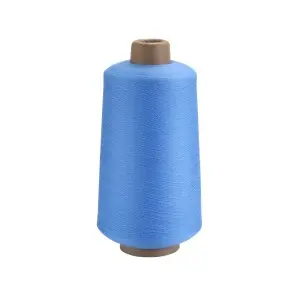
1. The Core Principle of Melt Spinning: Making the Polymer “Flow”
The essence of melt spinning is to utilize the thermoplastic properties of nylon polymer—heating to melt and cooling to solidify—to extrude the molten polymer into filaments through mechanical force. Subsequent processing forms a stable fiber structure. Its core logic can be summarized as a “three-state transformation”: solid polymer → molten fluid → solid fiber. The entire process requires three key conditions: the polymer must be meltable (no decomposition), sufficient fluidity in the molten state, and the ability to quickly set after cooling.
Compared to wet spinning and dry spinning, melt spinning is particularly well-suited for crystalline polymers like nylon. Firstly, nylon’s melting temperature (e.g., approximately 220-230°C for PA6 and 250-260°C for PA66) is well below its decomposition temperature, providing a safe range for the melting process. Secondly, the moderate viscosity of nylon melt allows for continuous extrusion without the need for solvents, simplifying the process and reducing environmental costs.
II. The Complete Melt Spinning Process: Four Steps for High-Quality Yarn
Nylon yarn melt spinning is a complex, systematic process. From raw material pretreatment to finished product winding, subtle differences in process parameters at each step can lead to significant variations in yarn strength, elasticity, and gloss. The following is an in-depth analysis of the core production process:
(I) Raw Material Pretreatment: Clearing the Way for Melting
The raw material for melt spinning is typically nylon chips (cylindrical or spherical particles with a diameter of 2-4mm). The purity and moisture content of the chips directly affect the quality of the melt. Therefore, the core of pretreatment is drying and impurity removal:
Drying: Nylon is a hygroscopic polymer. Undried chips can have a moisture content of 2%-3%. When melted at high temperatures, this moisture vaporizes, forming bubbles, which can lead to broken and fuzzy fibers. Vacuum dryers or hot air circulation dryers are commonly used in the industry, drying the chips at 80-100°C for 4-6 hours to reduce the moisture content to below 0.05%.
Screening and Impurity Removal: Vibrating screens remove powder, metal impurities, and other impurities from the chips to prevent them from clogging the spinneret or damaging the screw. (II) Melt Extrusion: Converting Solid to Fluid
The pre-treated chips enter the screw extruder, completing the critical steps of “heating and melting → mixing and homogenizing → pressurized conveying,” which is the “heart” of the spinning process:
Segmented Heating: The screw extruder is divided into a feeding section, a compression section, and a metering section. The temperature gradually rises from 180°C in the feeding section to 230-260°C in the metering section (adjusted according to the nylon type), ensuring gradual melting of the chips and avoiding localized overheating and decomposition.
Screw Mixing: The spiral structure of the screw continuously stirs the molten polymer, mixing it into a uniform melt. The screw’s propulsive force pressurizes the melt to 10-20 MPa, providing power for subsequent extrusion.
Melt Filtration: After exiting the extruder, the melt passes through multiple filters (typically 200-400 mesh stainless steel) to further remove fine impurities and gel particles, ensuring melt purity. (III) Spinning: The “Magic Moment” When Fluid Becomes Fine Filaments
Pure melt enters the spinning manifold and is extruded through the spinneret to form nascent fibers. This is the key step in determining the fiber count and fineness:
Spinneret Design: Hundreds or even thousands of spinneret holes are evenly distributed on the spinneret. The hole diameters are typically 0.1-0.3mm, and the hole shapes are mostly circular (for conventional yarns) or shaped (such as triangular or cross shapes, used to improve gloss and feel). For example, a 48-hole spinneret is required to produce 150D/48F (150 denier, 48 filaments) nylon yarn.
Melt Extrusion and Cooling: The melt is extruded from the spinneret holes under pressure, forming thin streams of melt filaments. These streams then enter the cooling air window, where clean cold air at 20-25°C cools them horizontally and vertically, rapidly solidifying them into solid nascent fibers (undrawn yarn, UDY). The cooling rate affects the fiber’s crystallinity: faster cooling results in lower crystallinity, but the fiber’s subsequent tensile properties improve.
(IV) Post-Processing: Imparting Final Fiber Properties
Naturally spun fibers have low strength, high elongation (reaching over 200%), and unstable structure. Post-processing is essential for optimizing their structure and improving their properties. This primarily involves three steps: stretching, twisting, and winding.
Stretching and shaping: This is key to improving fiber strength. Spun fibers are fed into a stretching machine where they are stretched 2-5 times over heated rollers (60-100°C). This stretching aligns the molecular chains within the fiber along the axial direction, increasing crystallinity and significantly enhancing strength (up to 4-8 cN/dtex). Elongation is reduced to 20%-30%. The stretched fibers then pass through shaping rollers (120-150°C) for heat setting, eliminating internal stresses and ensuring dimensional stability. Twisting and Winding: Depending on product requirements, the drawn filament yarn is twisted (typically 50-300 twists/meter) to strengthen interfiber cohesion and prevent loosening. Finally, the twisted yarn is wound onto paper tubes to form standard yarn packages (such as conical or cylindrical) for easy transportation and use.
III. Key Process Parameters: The “Invisible Hand” that Determines Yarn Quality
Melt spinning is an extremely parameter-sensitive process. Controlling the following three core parameters directly impacts the performance of nylon yarn:
Melt Temperature: Too low a temperature results in high melt viscosity, making extrusion difficult and prone to uneven fiber thickness. Too high a temperature causes polymer decomposition, resulting in yellowing and reduced strength. For example, the optimal melt temperature for PA6 is typically 225-235°C, while that for PA66 needs to be raised to 255-265°C. Cooling Air Speed: Too low an air speed will slow cooling and cause fibers to stick together; too high an air speed will cause fibers to vibrate violently, resulting in lint. Industrially, air speeds are generally controlled between 0.5-1.5 m/s, and air temperatures are maintained between 20-25°C.
Stretch Ratio: Insufficient stretch ratios result in low fiber strength and elasticity; excessive stretch ratios can easily cause fiber breakage. This ratio should be adjusted based on the yarn’s intended use: The stretch ratio for consumer textile yarns is typically 3-4 times, while industrial high-strength yarns can reach 4-5 times.
IV. Application Advantages and Application Scenarios of Melt-Spun Nylon Yarn
Thanks to the precise control of the melt-spinning process, nylon yarn exhibits significant performance advantages and is widely used in a variety of applications:
Textiles and Apparel: By adjusting the spinneret shape and stretch ratio, it is possible to produce soft-luster underwear yarns, wear-resistant and wrinkle-resistant outerwear yarns, and highly elastic sock yarns, achieving both comfort and durability.
Industrial: High-strength melt-spun nylon yarn can be up to five times stronger than steel, yet is lightweight and corrosion-resistant. It is used in industrial products such as conveyor belts, fishing nets, and safety ropes.
Healthcare: Yarn produced using medical-grade nylon chips and a sterile melt-spinning process offers excellent biocompatibility and can be used in surgical sutures, medical bandages, and more.
Post time: Sep-24-2025