
The Molding Capabilities of Low-Melting-Point Nylon Filaments: Adapting to Complex Shoe Upper Designs
As athletic shoes strive for both comfort and aesthetics, and casual shoes aspire to a harmonious blend of individuality and structure, shoe upper design is evolving from flat to three-dimensional, and from standardized to customized. Complex streamlined curves, precise wrapping structures, and seamless transitions are often limited by the molding bottlenecks of traditional materials. The emergence of low-melting-point nylon filaments, with their unique thermal bonding properties and excellent molding capabilities, has become a key material for solving the challenges of processing complex shoe upper designs.
Core Advantages: A Molding Revolution Enabled by Low Melting-Point Properties
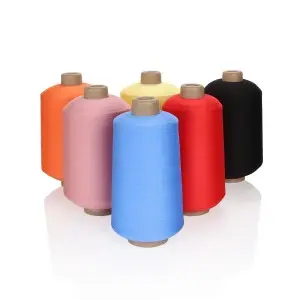
Low-melting-point nylon filaments are not simply a modification of traditional nylon, but a functional fiber produced through a special modification process. Their core competitiveness lies in the “controllable thermal melting-cooling shaping” cycle. Compared to conventional nylon, it can melt within a mild temperature range of 85℃-180℃. This temperature range ensures sufficient melting to form an adhesive effect without damaging commonly used shoe upper fibers such as TPU and polyester, providing a foundation for processing complex shapes. This characteristic brings dual advantages: Firstly, at room temperature, it possesses mechanical properties comparable to ordinary filaments, with a breaking strength of 5.0~6.4 g/d, easily integrating into conventional shoe upper weaving processes such as 3D flyknitting, warp knitting, and weft knitting, without requiring large-scale modifications to existing equipment. Secondly, upon heating, it melts rapidly and forms a strong bond with surrounding fibers, achieving its shape upon cooling, eliminating the cumbersome steps of glue bonding and stitching in traditional processes, while also avoiding VOC emissions and dust pollution from chemical adhesives.
Processing Adaptability: End-to-End Support from Design to Mass Production
1. Precise Molding Control of Complex Structures
The complex shapes of shoe uppers are often reflected in the combination of “three-dimensional curvature” and “detailed angles,” such as the toe cap protection area and arch support straps in athletic shoes, and the streamlined body of casual shoes. The melting point of low-melting-point nylon filaments can be precisely adjusted through raw material formulation, from a low-temperature type of 85℃ to a medium-temperature type of 180℃, matching the needs of different processing scenarios.
In 3D flyknit technology, low-melting-point nylon filaments are mixed with TPU fibers in a specific ratio and woven together. The resulting upper blank is then hot-pressed at approximately 110°C, causing the low-melting-point filaments to melt at the fiber interlacing points, forming a structure similar to “node reinforcement.” This structure firmly fixes the three-dimensional shape of the upper, preventing deformation and loosening even after tens of thousands of bending tests. Compared to traditional flyknit uppers that require additional adhesive reinforcement, this method not only improves molding precision by 30% but also shortens the processing cycle by more than 20%.
2. Breakthroughs in Seamless Splicing and Irregular Structures
In traditional upper processing, splicing materials in different areas often relies on needles and thread or glue, easily creating raised marks that affect aesthetics and reduce wearing comfort. The “self-adhesive” property of low-melting-point nylon filaments perfectly solves this problem—in irregular upper processing, the edges of pre-cut fabrics of different materials can be embedded with low-melting-point filaments, and localized heating melts the filaments, achieving seamless bonding of the fabrics.
For example, in customized footwear production, uppers designed for specific foot shapes often consist of multiple irregular pieces. Using low-melting-point nylon filaments with a melting point of 90℃ as an “invisible adhesive,” these pieces are tightly bonded together under heat and pressure in a humid environment, achieving a bonding strength 1.2 times that of conventional glues. The thickness at the seams only increases by 0.1mm, completely without affecting the wearing experience. This process also supports small-batch customized production, eliminating the need for specialized molds and significantly reducing the development costs of complex upper designs.
3. Dual Guarantee of Dimensional Stability and Weather Resistance
One of the core requirements for complex upper designs is maintaining shape stability under varying temperature and humidity conditions. Low-melting-point nylon filaments, especially those modified with PA12, have extremely low hygroscopicity, with a water absorption rate far lower than conventional nylons such as PA6 and PA66. Even in humid environments, they will not deform due to moisture absorption. Furthermore, TGA testing shows that the temperature at which they lose 5% of their weight exceeds 400℃, meaning that the high temperatures and friction of daily wear will not cause shape failure.
In extreme environment testing, the dimensional change rate of the upper containing low-melting-point nylon filaments was controlled within ±0.1% during temperature cycling from -20℃ to 60℃, far exceeding the industry standard of ±0.3%. This stability makes it suitable not only for everyday footwear but also for outdoor sports shoes, professional competitive shoes, and other scenarios with higher performance requirements.
Application Example: From Laboratory to Market Validation
The application of low-melting-point nylon filaments brought a significant breakthrough in the development of lightweight running shoes for a globally renowned sports brand. The shoe upper features a “gradient wrap” design, creating a smooth transition from a looser fit at the toe to a tighter fit at the arch, a subtle tension control that is difficult to achieve with traditional materials. By increasing the weaving density of the low-melting-point nylon filaments in the arch area and hot-pressing it at 100℃, the upper naturally forms a support structure that conforms to the foot shape while maintaining a 40% improvement in breathability.
Another example comes from a niche European custom shoe brand. Their 3D-printed uppers combined with flyknit fabric utilize low-melting-point nylon filaments as the connecting medium between the 3D-printed skeleton and the flyknit fabric. After the printed skeleton and flyknit fabric are combined, they are heated to 120℃, melting the filaments and bonding them firmly together. This achieves a complex structure of “hard support + soft wrapping.” Since its launch, the product’s unique design and comfortable feel have led to a 50% increase in sales compared to traditional styles.
Future Trends: Upgrades in Environmental Protection and Functionality
As the global footwear manufacturing industry increasingly demands environmental protection, the environmental advantages of low-melting-point nylon filaments are becoming increasingly prominent. Completely replacing chemical adhesives can reduce VOC emissions by 80%, and some types, such as bio-based low-melting-point nylon filaments, use renewable resources as raw materials, achieving environmental protection throughout the entire lifecycle from production to recycling. Simultaneously, the application of anti-yellowing modification technology solves the problem of nylon uppers easily yellowing, further extending the lifespan of complex-shaped footwear.
In terms of functional upgrades, low-melting-point nylon filaments are being combined with antibacterial and conductive functional fibers. Future complex shoe uppers will not only maintain their aesthetic appeal but also achieve additional functions such as deodorization and intelligent sensing. For example, blending low-melting-point filaments with conductive fibers and then hot-pressing them to form built-in circuit channels provides more flexible structural design possibilities for the development of smart shoes.
Conclusion: Redefining the Boundaries of Shoe Upper Design
The moldability advantage of low-melting-point nylon filaments is essentially a synergistic innovation of materials science and processing technology. It breaks the industry perception that “complex designs equate to high costs and low efficiency,” allowing designers to avoid compromising between creativity and mass production. From precise thermal bonding control to excellent dimensional stability, from environmentally friendly processes to functional expansion, this material is redefining the processing boundaries of complex shoe upper designs.
Post time: Dec-10-2025