
Low-Melting-Point Nylon Filament vs. Polyester Hot-Melt Yarn: Core Performance Differences and Wholesaler Selection Guide
In the field of functional hot-melt textile materials, low-melting-point nylon filament and polyester hot-melt yarn, with their respective technical characteristics, have become core choices for thermal bonding processes in footwear, apparel, home textiles, and industrial fabrics. Both can achieve fiber self-bonding through thermal melting, replacing traditional chemical adhesives and aligning with the industry’s trend towards environmental protection and high efficiency. However, significant differences exist in raw material characteristics, core performance, process compatibility, and application scenarios. For global textile wholesalers, accurately grasping the performance boundaries and selection logic of these two materials is crucial for matching downstream customer needs and enhancing supply chain competitiveness. This article will provide wholesalers with a comprehensive selection reference from three dimensions: core performance differences, process compatibility, and application scenarios.
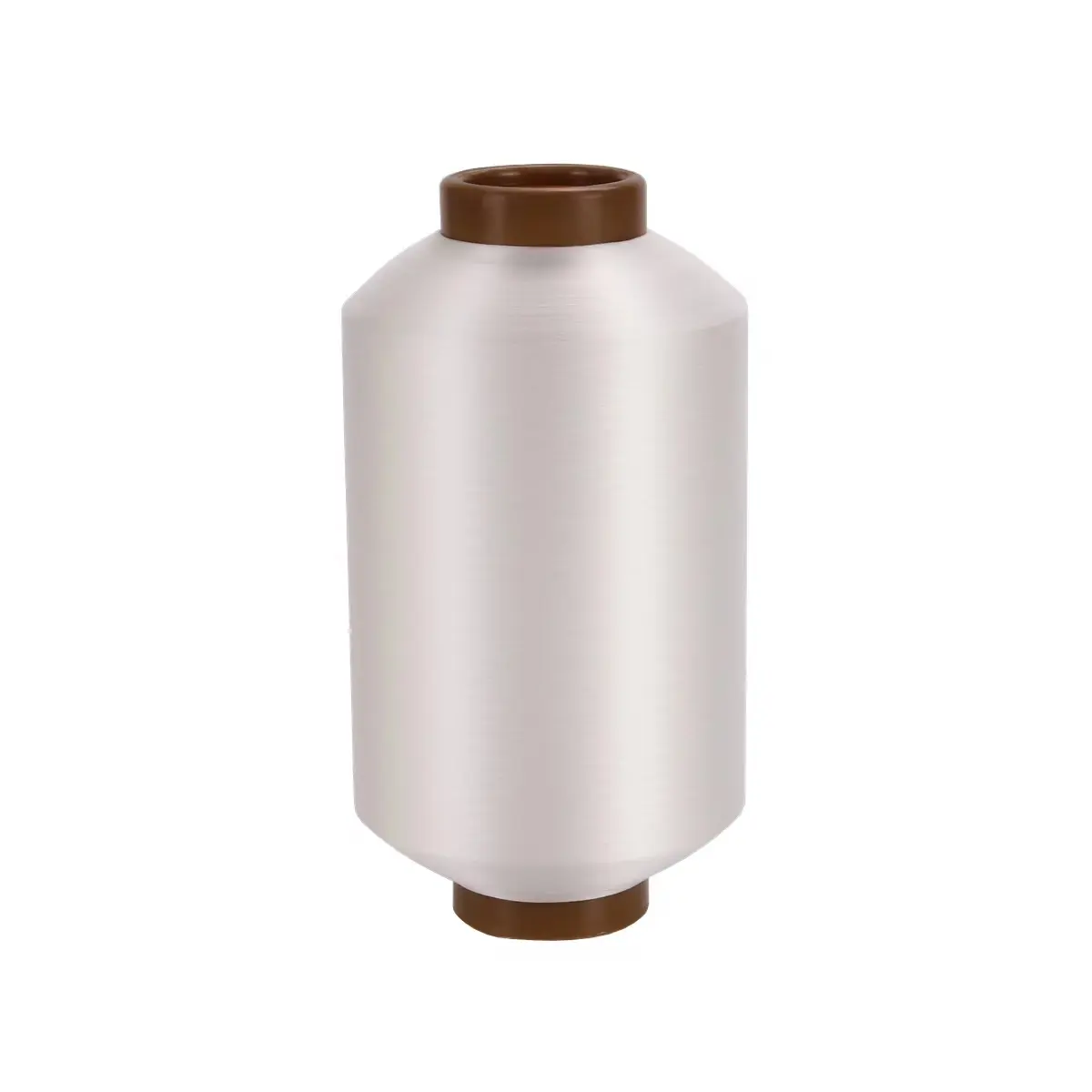
I. Core Performance: Homologous yet Heterogeneous, Each with Its Own Emphasis
Low-melting-point nylon filament (mainly modified with PA6/PA11/PA66) and polyester hot-melt yarn (modified with PET) are both thermoplastic functional fibers. They can be conventionally woven at room temperature, melted and bonded after being heated to a specific melting point, and then cooled and solidified to form a stable structure. However, due to the different molecular structures of the raw materials, their core performances exhibit fundamental differences, specifically in melting point range, physical strength, weather resistance, and environmental friendliness.
(I) Melting Point and Processing Temperature: Nylon is better suited for low-temperature processes, while polyester covers medium- and high-temperature requirements.
The melting point of low-melting-point nylon filament can be precisely controlled between 85℃ and 180℃, with mainstream commercial specifications concentrated between 85℃ and 110℃, classifying it as a low-temperature hot-melt material. Its low-temperature melting characteristics avoid damage to heat-sensitive substrates such as wool, silk, and TPU during the hot-bonding process, making it suitable for refined, low-damage processing techniques, and especially suitable for blending and bonding with high-end flexible fibers.
The melting point range of polyester hot melt yarn is 110℃-180℃, with common specifications being 130℃, 160℃, and 170℃. Special low-temperature versions can reach 85℃, with overall performance primarily at medium to high temperatures. Its higher melting point and stronger thermal stability make it suitable for high-temperature hot pressing processes. It exhibits more stable bonding in dry heat environments, reducing the likelihood of issues such as glue seepage after melting and sticking to rollers.
(II) Physical Properties: Nylon is strong and abrasion-resistant, while polyester offers dimensional stability.
Strength and Abrasion Resistance: The breaking strength of low-melting-point nylon filaments can reach 3.5-6.4 g/d. Some high-end PA11 materials combine high toughness and abrasion resistance, ranking among the top synthetic fibers in abrasion resistance. After bonding, the fabric exhibits stronger tensile and bending resistance, and is less prone to structural loosening after repeated use. Polyester hot-melt yarn exhibits similar strength in both dry and wet states, with a heat shrinkage rate as low as 5%, and some high-strength specifications achieving a dry heat shrinkage rate of <3%. This results in superior dimensional stability of the bonded fabric, making it less prone to deformation and shrinkage due to temperature and humidity changes.
Hand feel and flexibility: Low-melting-point nylon filaments retain good flexibility after melting and solidification, resulting in a soft, elastic hand feel in the bonded fabric, without any stiffness. This makes it suitable for products requiring a high level of tactile sensitivity, such as underwear, lace, and flyknit shoe uppers. Bonded polyester hot-melt yarn also provides better crispness and longer-lasting shape retention, making it suitable for applications requiring high shape retention, such as suit linings, curtains, and industrial fabrics.
(III) Weather Resistance and Chemical Stability: Nylon is adaptable to complex environments, while polyester exhibits superior washability.
Low-melting-point nylon filaments possess excellent resistance to weak acids, weak alkalis, and oils, and exhibit strong weather resistance. Their physical properties remain stable under high and low temperatures and high humidity conditions, resisting embrittlement and aging. The bonded structure maintains long-term stability even in complex environments such as outdoor settings and automotive interiors. Polyester hot-melt yarn demonstrates superior washability and dry-cleanability, with no significant decrease in bonding strength after multiple washes. It also exhibits strong UV resistance, making it suitable for home textiles, outdoor clothing, and other products requiring frequent washing or prolonged outdoor exposure.
(IV) Environmental Friendliness and Dyeability: Nylon’s bio-based properties are prominent, while polyester offers broader dyeing compatibility.
Low-melting-point nylon filaments can be made using bio-based raw materials (such as PA11), achieving 100% bio-based properties. There is no competition for food resources during production and use, resulting in lower carbon emissions and compliance with EU environmental standards. Some products have also obtained OEKO-TEX STANDARD 100 certification, meeting the demands of high-end environmentally friendly textiles. Its dyeability is good, allowing for a rich variety of colors to be achieved with acid dyes, and dyeing does not affect its hot melt bonding performance.
Although polyester hot melt yarn lacks bio-based properties, its production process is mature, with no VOC emissions, and it has higher compatibility with the dyeing processes of conventional polyester fibers. It can be dyed in the same bath as ordinary polyester, simplifying downstream processing. It also exhibits good dyeing uniformity, making it suitable for large-scale, standardized textile production. Furthermore, some low-melting-point nylon filaments (such as PA11) can reduce carbon emissions by at least 50% during the dyeing process compared to polyester hot melt yarn, making them more suitable for low-carbon production requirements.
II. Process Compatibility: Matching Structure and Process, Balancing Efficiency and Quality
The process compatibility between low-melting-point nylon filaments and polyester hot melt yarn is deeply tied to their fiber structure and melting characteristics. Differences exist between the two in spinning structure, processing technology, and blending compatibility with other fibers, directly impacting downstream production efficiency and product quality. These are key factors that wholesalers must consider when selecting materials.
(I) Fiber Structure: Nylon is mainly of the fully melt-bonded type, while polyester core-sheath type is more mainstream.
Low-melting-point nylon filaments mostly adopt a fully melt-bonded structure. The entire fiber is made of low-melting-point modified polyamide, which can be completely transformed into a bonding medium when melted. It has a large bonding area and strong adhesion, making it suitable for scenarios requiring overall bonding, such as flyknit shoe uppers and seamless underwear. Its spinning process can achieve full specification coverage of FDY/POY-DTY, supporting customized linear densities (20D-300D) to meet the needs of different weaving equipment.
Polyester hot-melt yarn has a core-sheath structure as its core (semi-melt-bonded). The sheath layer is made of low-melting-point modified PET, and the core layer is made of conventional high-strength polyester. When melted, only the sheath layer melts to achieve bonding, while the core layer maintains fiber strength. This balances adhesion and overall fabric mechanical properties, and is less prone to fabric strength reduction due to excessive melting. Its mainstream linear densities are 75D, 100D, and 150D, with imported high-end specifications reaching 20D. It is compatible with conventional textile equipment such as circular knitting machines, high-speed warp knitting machines, and weaving machines.
(II) Processing Technology: Nylon is suitable for both dry and humid environments, while polyester is superior in dry heat processes. The melt bonding of low-melting-point nylon filaments is not limited by the heating environment; stable bonding can be achieved under both dry and humid conditions. The hot-pressing temperature only needs to be slightly higher than its melting point (typically 120℃-160℃, held for 20-30 seconds), providing a wide process window. Downstream manufacturers do not need to significantly modify their equipment; only a simple heat setting process is required. Simultaneously, its rapid solidification after melting improves production efficiency, making it suitable for small-to-medium batch, multi-variety production.
Polyester hot-melt yarn is more suitable for dry heat processes. In a dry heat environment, it melts uniformly and has high bonding strength. In a humid heat environment, precise control of temperature and humidity is required; otherwise, problems such as weak bonding and glue seepage may occur. Its hot-pressing and setting temperature is typically 130℃-190℃, with more standardized process parameters, making it suitable for large-scale, continuous production processes, such as the mass production of home textiles and industrial fabrics.
(III) Blending Compatibility: Nylon is compatible with high-end flexible fibers, while polyester is compatible with conventional synthetic fibers. Low-melting-point nylon filament exhibits better blending compatibility with high-end flexible fibers such as wool, silk, TPU, and spandex. Its low-temperature melting characteristics do not damage the original properties of the substrate, preserving its softness and breathability, making it suitable for high-end textiles. Simultaneously, it blends well with conventional nylon and cotton fibers, improving the fabric’s bonding stability and abrasion resistance.
Polyester hot-melt yarn has the best blending compatibility with conventional synthetic fibers such as polyester and polypropylene, achieving seamless bonding of fibers of the same material. The resulting fabric exhibits more uniform overall performance and lower processing costs. When blending with natural fibers such as cotton and linen, careful control of the hot-pressing temperature is necessary to avoid damaging the natural fibers; its compatibility is slightly lower than that of low-melting-point nylon filament.
III. Application Scenarios: On-Demand Selection to Match Downstream Core Needs
The classification of application scenarios for low-melting-point nylon filament and polyester hot-melt yarn essentially boils down to the precise matching of their core performance with downstream product requirements. When selecting materials, wholesalers need to consider the product categories, positioning, and processing techniques of their downstream customers to choose suitable hot-melt materials, avoiding quality problems or cost waste caused by material mismatch with demand. The following are the core application scenarios and selection recommendations for both:
(I) Low-melting-point nylon filament: The preferred choice for high-end flexibility and complex environments. Low-melting-point nylon filament, with its low-temperature melting, strong toughness and wear resistance, soft feel, and strong weather resistance, is mainly suitable for high-end flexible textiles and industrial fabrics used in complex environments, specifically including:
Footwear: 3D flyknit uppers, sock shoes, and athletic shoe midsoles, especially suitable for shaping TPU flyknit uppers, improving the tensile strength and shape retention of the upper, resisting deformation after repeated bending, and maintaining the flexibility and breathability of the upper;
Apparel: Seamless underwear, lace trim, and high-end knitwear, conforming to the skin, soft to the touch without a stiff feel, and washable and resistant to delamination;
Automotive interiors: Car seat fabrics and door linings, resistant to high and low temperatures and oil, maintaining stable bonding structure in complex automotive environments;
High-end webbing/lace: High-end bag webbing and clothing lace, with strong adhesion and high wear resistance, extending product lifespan.
Wholesaler Selection Guidelines: For downstream customers producing high-end footwear materials, luxury apparel, and automotive interiors, prioritize fully melt-type low-melting-point nylon filaments with a melting point of 85℃-110℃. Pay close attention to bio-based properties (such as PA11), tensile strength, and dyeability. Also, consider suppliers that support customized linear densities to meet individual customer needs.
(II) Polyester Hot-Melt Yarn: The Mainstream Choice for Mass-Market Standardized Production Scenarios
Polyester hot-melt yarn, with its characteristics of dimensional stability, washability, standardized processing, and controllable cost, has become the core choice for mass-market standardized textiles and mass-produced industrial fabrics. Specifically, it includes:
Apparel Accessories: Suit linings, collars, and cuffs; the fabric is crisp, maintains its shape, and the processing is simple, suitable for large-scale production.
Home Textiles: Sofa fabrics, curtains, and bedding; washable and UV-resistant, maintaining its shape after repeated use and washing.
Conventional Industrial Fabrics: Filter cloth, non-woven fabrics, and carbon fiber fabrics; good dimensional stability; the fabric is crisp after bonding, suitable for industrial applications.
Conventional Footwear/Webbing: Ordinary casual shoe uppers, bag webbing, and glove edge binding yarn; lower cost, meeting the needs of mass-market products.
Wholesaler Selection Guidelines: For downstream customers producing mass-market apparel, standard home textiles, and general industrial fabrics, prioritize core-sheath polyester hot-melt yarns with a melting point of 130℃-170℃. Pay close attention to heat shrinkage, wash fastness, and dyeing compatibility with standard polyester. Choose products with mature processes and standardized specifications to reduce processing costs for downstream customers.
IV. Wholesaler’s Ultimate Selection Guide: A Three-Dimensional Decision-Making Model
Combining the core performance, process compatibility, and application scenarios of low-melting-point nylon filament and polyester hot-melt yarn, we construct a three-dimensional decision-making model for global textile wholesalers, considering demand, cost, and supply chain, to accurately match selection needs:
Dimension 1: Selection Based on Downstream Customer Product Positioning
If customers focus on the high-end market, emphasizing environmentally friendly, flexible, and wear-resistant product characteristics (such as high-end flyknit shoes, seamless underwear, and automotive interiors), low-melting-point nylon filament, especially bio-based PA11 materials, is the preferred choice, aligning with the environmental and quality requirements of high-end customers;
If customers focus on the mass market, emphasizing standardized and cost-effective products (such as regular clothing linings and home textile fabrics), polyester hot-melt yarn is the preferred choice, leveraging mature technology and controllable costs to meet the needs of large-scale, standardized production.
Dimension 2: Selection Based on Processing Technology and Equipment
If the customer’s processing equipment is general-purpose textile equipment without dedicated dry heat setting equipment, or requires adaptation to both dry and wet heat processes, low-melting-point nylon filament should be prioritized due to its wider process window and lower equipment modification costs.
If the customer has professional dry heat setting equipment and focuses on large-scale, continuous production, polyester hot-melt yarn should be prioritized, as standardized processes can improve production efficiency and reduce defect rates.
Dimension 3: Selection Based on Cost and Supply Chain Stability
Low-melting-point nylon filament (especially bio-based specifications) has relatively high raw material and production costs, but its downstream products have high added value, making it suitable for a high-margin, small-batch, multi-variety supply chain model. Wholesalers need to choose suppliers with R&D capabilities and the ability to customize production to ensure product quality and meet personalized needs.
Polyester hot-melt yarn has a mature production process, low raw material costs, and a strong supply chain stability, making it suitable for a low-profit, high-volume, standardized supply chain model. Wholesalers need to choose suppliers with large capacity, complete specifications, and short delivery cycles to ensure continuous production needs of downstream customers.
V. Conclusion Low-melting-point nylon filament and polyester hot-melt yarn are not substitutes, but rather complementary based on performance differences and stratified demand.
Together, they drive the development of hot-melt textile technology towards environmental friendliness, efficiency, and refinement. For global textile wholesalers, the focus should not be on “which material is better,” but rather on “which material best suits the needs of downstream customers.”
Low-melting-point nylon filament, with its core advantages of low-temperature melting, high strength and abrasion resistance, bio-based environmental friendliness, and soft hand feel, has become the preferred choice for high-end flexible textiles and fabrics used in complex environments. Polyester hot-melt yarn, with its dimensional stability, washability, standardized processes, and controllable costs, occupies the mainstream market for mass-market standardized textiles and large-scale production scenarios. Only by accurately grasping the performance boundaries of both materials and combining them with the product positioning, processing technology, and cost requirements of downstream customers can a precise match between material selection and market demand be achieved, thereby enhancing the core competitiveness of the supply chain.
Post time: Mar-02-2026