
Lightweight Underwear Trend: The Application of Fine Denier Polyester Hot-Melt Yarn
As the desire to “take off your bra immediately after get off work” resonates globally among women, the underwear industry is shifting from the traditional logic of “shaping and lightweight experience” to a new track of “pressure-free comfort and precise function.” Global underwear consumer trend surveys show that 72% of women with large busts suffer from shoulder and back pain, 68% complain about looking bulky in clothes, and over 60% of consumers have to endure marks from tight fabrics for support—lightweighting is the core solution to breaking the “shaping and comfort dilemma.” In this trend, the fine denier technology of polyester hot-melt yarn, with its unique material properties and technological advantages, has become a key force driving the upgrade of the underwear experience.
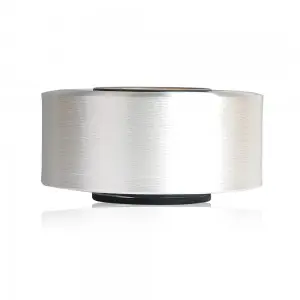
I. Lightweight Underwear: More Than Just “Light,” It’s a Reconstruction of “Precise Function”
Many people intuitively understand lightweight underwear as “thinner fabric,” but the real industry upgrade goes far beyond that. The demand for lightweight modern underwear essentially means “reducing the burden of wearing it without sacrificing core functions such as support, breathability, and seamlessness.” This can be broken down into three dimensions:
Lightweight Feel: Say goodbye to heavy underwires and padding. Fabric weight must be controlled below 130g/㎡ (especially for spring and summer styles), achieving a “virtually forget you’re wearing anything” experience, with no shoulder or back marks or chest stuffiness even after 8 hours of continuous wear.
Scene Adaptability: Compatible with diverse scenarios such as “lightweight work shirts, loungewear, and date tank tops,” eliminating the embarrassment of “underwear showing through white outerwear,” achieving “invisible integration with the skin.”
Functional Stability:Lightweight does not equate to “soft and shapeless.” Sufficient support must be maintained at a low weight to prevent breast shifting and spillage, while also being wrinkle-resistant and washable.
These three demands point precisely to a breakthrough in materials technology—traditional cotton fibers and ordinary synthetic fibers struggle to simultaneously achieve the four characteristics of “lightness, softness, stiffness, and adhesion.” Fine denier polyester hot-melt yarn, through the synergy of material form and function, has become the optimal solution to this problem.
II. Fine Denier Polyester Hot-Melt Yarn: Why Can It Become a Core Material for Lightweighting?
Polyester hot-melt yarn possesses the unique property of “hot-melt self-adhesive”: when the temperature reaches a specific range (typically 160-190℃), the low-melting-point PET in its outer layer melts, bonding the surrounding fibers together as a whole, without the need for additional stitching or adhesives. The “refined denier” (i.e., reducing the monofilament fineness to 0.3-0.6 dpf) further amplifies this advantage, perfectly matching the core requirement of lightweight underwear. The underlying logic can be summarized in three points:
1. Refined denier = “lighter weight + softer feel”
Ordinary polyester yarn has a monofilament fineness mostly above 1.0 dpf, while refined denier polyester hot-melt yarn can have a monofilament fineness as low as 0.3-0.6 dpf (equivalent to 1/20th the diameter of a human hair). Finer monofilaments mean:
More fibers but lighter total weight in the same area of fabric; fabric weight can be easily controlled at 100-130 g/㎡, reducing weight by more than 30% compared to traditional underwear fabrics;
More even contact area between the fiber and skin; the feel changes from “rough synthetic fiber feel” to “cloud-like delicate skin-friendly,” completely solving the problem of traditional hot-melt yarn being “stiff and not skin-friendly.”
2. Hot-Melt Self-Adhesive = “Wire-Free Support + Seamless Design”
Traditional bras rely on underwires and thick foam for support, while fine denier polyester hot-melt yarn can replace these heavy structures through “localized hot-melt setting”:
In areas requiring support, such as the cup edges and side panels, a high-temperature setting process of 160-190℃ melts the outer layer of the fine denier hot-melt yarn and bonds it to the surrounding fibers, forming an invisible “support skeleton”—maintaining support while avoiding the pressure of underwires;
Replacing traditional sewing: Fine denier hot-melt yarn can be directly used for fabric splicing through hot melting, eliminating the friction and protrusion of seams. Even when wearing a tight-fitting white outer layer, it will not show through, perfectly suited for “seamless scenarios.”
3. Sheath-Core Structure = “Functional Stability + Process Compatibility”
Currently, mainstream fine denier polyester hot-melt yarns adopt a “sheath-core structure”: the sheath layer is low-melting-point PET (melting point 160℃), and the core layer is ordinary PET (melting point 255-265℃). This structure brings dual advantages:
In terms of process, the hot-melt bonding temperature can be precisely controlled between 160-190℃, without damaging other fibers such as spandex and cotton in the underwear fabric, and it is compatible with the entire finishing process, including dyeing, setting, and pre-shrinking;
In terms of performance, after hot-melt bonding, multiple fine denier multifilaments will be bonded into a single filament, improving the fabric’s wrinkle resistance by more than 40%, and it will not soften even after multiple washes, solving the industry pain point of “lightweight fabrics being easily deformed.”
III. Implementation Path: Deconstruction of Underwear Application Solutions for Fine Denier Polyester Hot-Melt Yarn
The application of fine denier polyester hot-melt yarn is not a simple “material replacement,” but requires combining it with the structural design and process optimization of underwear to form a complete solution. From an industry practice perspective, three mature implementation paths have emerged:
1. Lightweight Bra Cup Fabric: Fine Denier Hot-Melt Core-Spun Yarn Solution
For spring/summer bra cups, a core-spun yarn process using “fine denier polyester hot-melt yarn as the core yarn, wrapped with cotton fiber roving” is employed (referencing ring spinning machine composite spinning technology). The specific process is as follows:
Spinning Stage: 30D/24F fine denier polyester hot-melt yarn (core-sheath structure) is used as the core yarn, with the feed tension controlled at 10-20CN. Ne51S cotton fiber roving is wrapped around it, with a twist coefficient set at 380-440, resulting in Ne40S core-spun yarn;
Setting Stage: The yarn is steam-set at 85-100℃ for 20-30 minutes to enhance fiber adhesion;
Weaving and Finishing: The core-spun yarn is woven as both warp and weft yarns, followed by high-temperature stretching and setting at 170-190℃ for 60-80 seconds. At this point, the heat-fused yarn melts, giving the fabric a “soft yet resilient” texture, with a weight as low as 100g/㎡, while retaining the moisture-wicking and breathable properties of cotton fibers.
This type of fabric is especially suitable for bra cups with large busts, providing localized support through heat fusion bonding while maintaining lightweight breathability. Real-world testing shows that the chest area remains dry even after 8 hours of continuous wear.
2. Seamless Shaping Underwear: Fine Denier Hot-Melt Yarn Composite Weaving Solution
For underwear requiring mild shaping (such as waist trainers, vests, and bras), a composite weaving process using “fine denier polyester hot-melt yarn + ultra-fine denier polyamide fiber + spandex” can be adopted:
Step 1: Fine denier polyester hot-melt yarn and ordinary polyester are hot-melted and bonded at a ratio of 1:100 to form a continuous spindle-shaped structure, serving as the fabric’s “support base”;
Step 2: Ultra-fine denier polyamide fiber (dpf below 0.5) and spandex are cross-bonded and hot-melted at a ratio of 1:50 to form a highly elastic spindle-shaped structure, responsible for the fabric’s “stretch recovery”;
Step 3: The two spindle-shaped structures are continuously cross-woven at a 1:1 ratio, resulting in a fabric that combines the three characteristics of “lightweight, elastic, and resilient”—an elastic recovery rate of over 90%, shaping without being tight, and a thickness of only 0.3mm, making it completely invisible when wearing tight clothing.
3. Invisible Bonding Technology: An Alternative to Glue Application with Fine Denier Hot-Melt Yarn
Traditional underwear often relies on glue application or sewing for joining. Glue application is prone to hardening, and sewing creates raised areas. Fine denier polyester hot-melt yarn, however, achieves “seamless bonding”: At the connection between the shoulder straps and cups, and around the underband, fine denier polyester hot-melt yarn (100D/150D specifications) with a melting point of 120℃ is used. Through localized high-temperature pressing, the yarn melts and bonds the different fabrics together.
The advantage of this bonding method is its “thinness and elasticity”: the bonded area is only 0.1mm thick, 50% thinner than traditional glue application, and it deforms synchronously with the stretching of the fabric, avoiding problems such as “cracking after washing” or “skin irritation.”
IV. Value Resonance: Two-Way Benefits for Brands and Consumers
The application of fine denier polyester hot-melt yarn not only solves consumers’ pain points in wearing underwear but also brings tangible competitiveness enhancement to lingerie brands, forming a “two-way value resonance”:
For brands:
Cost Reduction and Efficiency Improvement: Fine denier fabric reduces weight by 30%, directly reducing raw material consumption; simultaneously, the hot-melt self-adhesive process replaces sewing and gluing, increasing production efficiency by 20% and reducing the use of adhesives and other chemical additives, aligning with global sustainable consumption trends;
Differentiated Competition: In the “lightweight” market, fine denier polyester hot-melt yarn achieves the unique selling point of “support without underwire, lightweight yet washable,” differentiating itself from ordinary cotton or synthetic fiber underwear and helping brands capture the mid-to-high-end market.
For consumers: Enhanced experience: Say goodbye to the three major pain points of “bra marks, stuffiness, and seepage,” and keep your shoulders and back relaxed and your chest dry even after wearing it for 8 hours. You don’t have to worry about bra lines when wearing it as an outer layer. Suitable for various occasions: One bra can be used for commuting, home, dating, and other occasions, reducing clothing purchase costs and conforming to the concept of “minimalist consumption.”
Post time: Dec-29-2025