
Denier Selection of Polyester Hot Melt Yarn: Precise Matching of Webbing Load-Bearing Requirements and Product Specifications
In the production and manufacturing of webbing, polyester hot melt yarn, as a core raw material, its denier selection directly determines the load-bearing capacity, durability and application scenario adaptability of the webbing. For industrial-grade webbing, from light garment accessory webbing to heavy-duty cargo strapping and lifting slings, different load-bearing requirements correspond to completely different denier specifications of polyester hot melt yarn. Only by achieving precise matching between denier and load-bearing requirements can we ensure the product performance meets the standards, while taking into account production economy and use safety, allowing the webbing to exert the best efficiency in various applications.
As a core indicator characterizing the thickness of polyester hot melt yarn, denier (D) is commonly used as the measurement unit in the industry. A larger value means a thicker yarn, and its breaking strength and tensile resistance also increase accordingly. The denier selection of polyester hot melt yarn is not a one-dimensional choice, but needs to be comprehensively determined by combining multiple factors such as the weaving process, width, thickness of the webbing, and static load-bearing and dynamic tensile force in actual use. At the same time, the unique hot melt bonding characteristic of polyester hot melt yarn enables it to achieve tight bonding between yarns through heat setting after the webbing is formed, further strengthening the overall load-bearing capacity, which also makes denier selection a key prerequisite for the load-bearing design of the webbing.
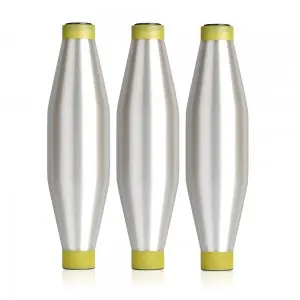
Light Load-Bearing Webbing: Adaptive Application of Low-Denier Polyester Hot Melt Yarn
Light load-bearing webbing is mainly used in scenarios such as garment accessories, luggage webbing, and daily small item strapping. The safe load-bearing capacity of such webbing is generally within 50kg. It has high requirements for the softness and weaving fineness of the yarn, and does not require excessively high breaking strength. Therefore, low-denier polyester hot melt yarn becomes the optimal choice.
For such scenarios, it is recommended to select polyester hot melt yarn in the range of 50D-150D. Among them, 50D and 70D specifications are suitable for weaving ultra-thin garment webbing, underwear shoulder strap auxiliary belts, etc. Their fine denier characteristics can keep the webbing with a soft hand feel and delicate texture, and after hot melt bonding, they can meet the load-bearing requirements of daily light pulling; 100D-150D specifications are suitable for luggage hand webbing, small gift packaging belts and other scenarios. While ensuring the webbing is formed stiffly, it can cope with static load-bearing of 0-50kg. Moreover, the yarn in this denier range has high weaving efficiency and can adapt to the production requirements of high-speed webbing machines. It is worth noting that when selecting low-denier yarn for light webbing, attention should be paid to the hot melt bonding fastness of the yarn to ensure that seamless bonding between yarns can be achieved at a conventional hot melt temperature of about 110℃, avoiding wire shedding and edge fraying during use.
Medium Load-Bearing Webbing: A Balanced Choice of Medium-Denier Polyester Hot Melt Yarn
Medium load-bearing webbing is used in scenarios such as daily logistics small cargo strapping, furniture accessory webbing, and automotive interior webbing, with a safe load-bearing range of 50kg-500kg. Such webbing needs to have a certain tensile resistance, while also taking into account the lightweight and practicality of the product. Medium-denier polyester hot melt yarn can achieve a balance between performance and practicality.
200D-600D is the core denier choice for medium load-bearing webbing. 200D-300D specifications of polyester hot melt yarn are suitable for automotive interior seat webbing, furniture decorative webbing, etc. It has moderate breaking strength, and the webbing has good flexibility and fatigue resistance after hot melt forming, which can cope with long-term repeated slight pulling; 400D-600D specifications are suitable for small and medium-sized logistics cargo strapping, industrial light tool hanging belts and other scenarios. The breaking strength of the yarn in this range can reach 80-150N. After being woven into a 20-30mm wide webbing, it can stably bear static load-bearing of 50-500kg, and its puncture and tear resistance are better than low-denier yarn, which can cope with slight friction and collision in logistics transportation. In actual production, the denier of medium webbing can be adjusted according to the width. For example, narrow webbing can use a lower denier, while wide webbing can be matched with a higher denier to achieve precise adaptation of load-bearing and specifications.
Heavy Load-Bearing Webbing: Performance Guarantee of High-Denier Polyester Hot Melt Yarn
Heavy load-bearing webbing is mainly used in core scenarios such as industrial hoisting, large cargo transportation strapping, and engineering equipment fixation, with a safe load-bearing requirement of more than 500kg. Some lifting slings even need to bear a tensile force of several tons or even ten tons. Such scenarios put extremely high requirements on the breaking strength, creep resistance and heat resistance of polyester hot melt yarn, and high-denier polyester hot melt yarn becomes the core of performance guarantee.
For heavy load-bearing requirements, it is recommended to select high-strength polyester hot melt yarn in the range of 800D-3000D. Among them, 800D-1500D specifications are suitable for medium lifting slings and large logistics strapping with a load of 500kg-2 tons. The breaking strength of the yarn in this denier can reach more than 8.2cN/dtex, with low dry heat shrinkage. After heat setting, the webbing has excellent dimensional stability and can cope with complex environments such as high temperature and bumpiness in long-distance transportation; 2000D-3000D specifications are specially designed for heavy lifting slings and engineering equipment fixing belts with a load of more than 2 tons. Its breaking strength can reach more than 182N. With multi-layer weaving technology, the load-bearing capacity of the webbing can be increased to 5 tons or even 10 tons. In addition, the corrosion resistance and aging resistance of polyester material allow the webbing to be used for a long time in harsh scenarios such as outdoor, chemical industry and construction. Furthermore, the high-denier polyester hot melt yarn selected for heavy webbing needs to meet the characteristics of high modulus and low shrinkage, and can maintain a low shrinkage rate even at a high temperature of 190℃, avoiding dimensional deformation of the webbing after heat setting and affecting the load-bearing performance.
Core Principles and Practical Points for Denier Selection of Polyester Hot Melt Yarn
- Load-bearing first, taking into account the process: The core of denier selection is to match the actual safe load-bearing requirements of the webbing, avoiding cost waste caused by “over-engineering” and eliminating potential safety hazards caused by “under-engineering”. At the same time, it is necessary to combine the process parameters of the weaving equipment to ensure that the selected denier can adapt to the needle number and rotation speed of the webbing machine, ensuring the smoothness of the weaving process.
- Adjust in conjunction with webbing specifications: For polyester hot melt yarn of the same denier, the final load-bearing capacity will vary with the different width, thickness and weaving layers of the webbing. Generally speaking, under the same denier, the wider the width and the more the layers, the stronger the load-bearing capacity of the webbing. For example, a 20mm wide webbing woven with 600D yarn has a load-bearing capacity of about 300kg, while a 50mm wide webbing of the same specification can bear more than 800kg.
- Pay attention to the comprehensive performance of the yarn: Denier is not the only indicator to judge the load-bearing capacity of the yarn. It is necessary to pay attention to the breaking strength, dry heat shrinkage, hot melt bonding strength and other parameters of polyester hot melt yarn at the same time. Even at the same denier, high-strength polyester hot melt yarn has a much higher breaking strength than ordinary yarn, which can achieve a qualitative improvement in the load-bearing performance of the webbing.
- Adapt to the environmental characteristics of the application scenario: If the webbing is used in harsh environments such as outdoor, high temperature and chemical industry, on the basis of matching the denier, it is necessary to select polyester hot melt yarn with UV resistance, acid and alkali resistance and high heat resistance to ensure that the webbing can still maintain stable load-bearing capacity in complex environments and extend its service life.
The matching between polyester hot melt yarn and webbing load-bearing requirements is a systematic project from raw material specifications to finished product applications. Precise denier selection can not only make the load-bearing performance of the webbing meet the design standards, but also optimize the production process, reduce the comprehensive cost and enhance the competitiveness of the product in the market. Whether it is light, medium or heavy load-bearing scenarios, only by comprehensively considering multiple factors such as yarn performance, weaving process and finished product specifications based on actual needs can we achieve a seamless connection between the denier of polyester hot melt yarn and the load-bearing requirements of the webbing, allowing each type of webbing to exert the best performance and value in the corresponding scenario.
Post time: Apr-08-2026