
Customized Colors for Low-Melting-Point Nylon Filaments: The Complete Process of Developing Exclusive Color Codes for Wholesalers
For wholesalers in the global textile, footwear, underwear, home textile, and sewing thread industries, stable, consistent, and scalable exclusive color codes are the core guarantee for brand recognition, product competitiveness, and consistency in end-product delivery. Due to its lower melting point, better compatibility, and suitability for thermal bonding and composite processes, low-melting-point nylon filaments require higher standards for heat resistance, color fastness, batch stability, and environmental compliance when customizing colors. This article, from an international wholesale purchasing perspective, completely breaks down the standardized development process of exclusive color codes from demand to mass production, helping wholesalers efficiently implement their exclusive color solutions.
I. Exclusive Color Code Development: Why Wholesalers Must Go Through the Customization Process
Low-melting-point nylon filaments (PA11 / bio-based PA11, etc.) are widely used in applications with stringent requirements for color accuracy and durability, such as shoe uppers, webbing, sewing thread, underwear lace, suit collars, and sofa fabrics. Universal color codes cannot meet the following requirements:
Brand-specific visual identity (brand colors, series theme colors)
High colorfastness requirements for end users, including resistance to washing, abrasion, sunlight, and perspiration
Zero color difference supply across seasons, batches, and production regions
Compliance with international environmental and safety standards such as EU REACH and OEKO-TEX
Low-temperature stable coloring with low melting point characteristics, preventing yarn clogging and breakage
Custom color code development essentially establishes a traceable, mass-producible, and long-term lock-in color standard system for wholesale customers.
II. Wholesaler-Specific Color Code Development: 7-Step Standardized Process (International Wholesale Universal Version)
1. Requirement Confirmation and Standard Locking (Globally Unified Benchmark)
Color Sources: Pantone TN Nylon-specific color codes, customer samples, brand standard color cards, international brand designated color codes
Performance Boundaries: Low melting point temperature resistance, wash/friction/sun/perspiration fastness rating, yellowing resistance, chemical resistance
Application Scenarios: Sewing thread, shoe uppers, webbing, underwear, lace, home textiles, thermal bonding composites, etc.
Compliance Requirements: REACH, RoHS, OEKO-TEX Standard 100, free of carcinogenic aromatic amines, low heavy metals
Delivery Specifications: Fineness (20D/40D/70D/150D, etc.), FDY/DTY, glossy/semi-matte/full matte, tube weight and packaging
Key Points: Double locking using spectral data + physical color cards to avoid visual bias and adapt to global supply chain communication.
2. Color Scheme and Formulation Design (Low Melting Point Dedicated System)
Targeting the characteristics of low-melting-point nylon, a dual-path approach is adopted: solution dyeing and high-temperature environmentally friendly dyeing.
Solution dyeing: Dedicated low-melting-point carrier masterbatch; inorganic/organic pigments are heat-resistant, uniformly dispersed, and suitable for stable mass production.
Environmentally friendly water-based dyeing/anhydrous dyeing: Weakly acidic system (pH 4.5–5.5), low-temperature leveling, suitable for low-melting-point nylon that does not degrade or stick.
Formulation output: Pigment/dye selection, ratio, auxiliary agent system, temperature profile, key spinning/dyeing parameters.
Core: The formulation must pass low-melting-point heat resistance simulation to ensure that it does not fade, change color, or migrate during spinning and subsequent processing.
3. Pilot Sampling and Color Difference Calibration (Wholesale-Grade Precision)
Sample Preparation: Same fineness, same process (FDY/DTY), same gloss, replicating mass production conditions.
Color Measurement: Spectrophotometer ΔE control; wholesale-grade ΔE≤1.0, high-end series ΔE≤0.8.
Correction: Fine-tuning of hue, brightness, and saturation; simultaneous verification of fastness and heat resistance.
Output: 2-3 sets of confirmed samples, signed and sealed by the customer, serving as the sole standard for mass production.
4. Pilot-Scale Scale-up and Process Consolidation (Connecting to Mass Production)
Equipment: Pilot-scale test using the same machine as the mass production line, verifying evenness, drum difference, batch difference, and overall batch stability.
Key Processes: Heating rate, holding time, pH control, screw/dyeing tank parameters, filtration accuracy.
Testing: Batch color difference, strength, breakage rate, thermal stability, and color fastness (all items).
Output: SOP process documents, dedicated color number archives, quality acceptance standards.
5. Compliance Testing and Certification Reports (International Market Access)
Bulk testing, providing commonly used reports for wholesale procurement:
Color fastness (washing, rubbing, sun exposure, perspiration)
Environmental safety (heavy metals, carcinogenic aromatic amines, REACH SVHC)
Fiber properties (linear density, breaking strength, elongation, melting point)
Available: Third-party testing reports, material certificates, COA
6. Sample Sealing and Exclusive Color Number Locking (Long-Term Stability Guarantee)
Establishing an exclusive color number library for wholesalers:
Unique color number coding (can be bound to customer brand/series/quarter)
Permanently sealing standard samples, formulas, and process parameters
Commitment: Stable color difference across batches, no arbitrary changes to formulas
Support: Quick production for repeat orders, no need for repeated sampling
7. Mass Production and Quality Control Delivery (Global Wholesale Adaptability)
Pre-production review: Standard sample comparison, equipment calibration, formula verification
Process control: Cylinder difference/Bottle difference/ Batch Difference Online Detection
Packaging and Labeling: Clearly marked color number, specifications, batch number, and net weight
Delivery: Suitable for container shipping, export documents available, long-term supply agreements supported
III. Low Melting Point Nylon Filament: Comparison of Two Technical Routes with Dedicated Color Numbers
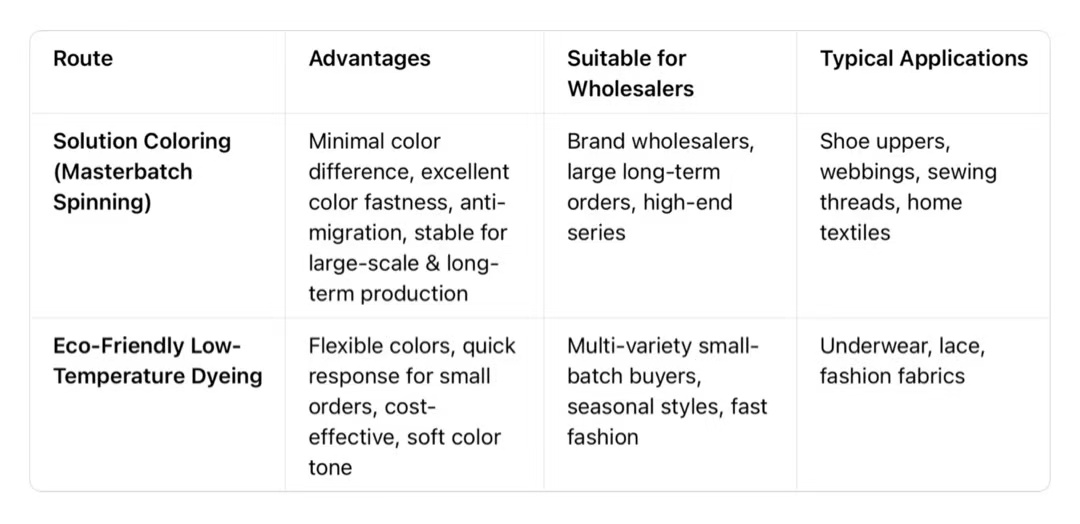
Recommendation: Wholesale customers should prioritize solution dyeing for core, proprietary colors, and use dyeing for supplementary, fast-reflecting colors, balancing stability and efficiency.
IV. Wholesaler-Specific Color Development: Key Success Factors
Low Melting Point Compatibility: Pigment/Dye Heat Resistance Matching, No Degradation, No Crosslinking, No Impact on Melting Point and Adhesion Properties
Globally Unified Standard: Based on Pantone TN Based on customer-approved samples, communication is conducted using spectral data.
Fastfastness Priority: The end-use scenario determines the fastness grade, avoiding after-sales complaints.
Environmental Compliance: Meets EU and North American market access standards, reducing customs clearance and recall risks.
Mass Production Capability: Step-by-step verification from pilot testing to intermediate testing to mass production ensures consistency in bulk orders.
Long-Term Lock-in: Exclusive color number archive management supports stable repeat orders for many years.
V. Wholesale Scenarios Suitable for Customized Color Numbers
Branded Footwear Materials: Exclusive colors for shoe upper yarns, webbing, and hot-melt threads.
Underwear and Lace: Skin-friendly, high colorfastness, environmentally friendly and safe colors.
Sewing Thread Wholesalers: Brand-specific colors, high consistency, and washable series.
Home Textiles and Sofa Fabrics: Exclusive colors that are sun-resistant, abrasion-resistant, and stain-resistant.
Industrial and Composite Fabrics: Low-melting-point heat-bonded, color-stable, and high-strength colors.
Conclusion: For international wholesale buyers, exclusive color numbers for low-melting-point nylon filaments are not simply “changing the color,” but a systematic project involving stable supply, brand recognition, and quality assurance. A standardized development process ensures accurate color, performance, and compliance, while also enabling faster reorders, lower costs, and more stable delivery.
Post time: Mar-18-2026