
Case Study of Asian Footwear Upper Wholesalers: How PA11 DTY Filament Overcame the Upper Breakage Dilemma
For Asian footwear upper wholesalers, “uppercase breakage” is a Damocles’ sword hanging over their profits. From athletic shoe factories in Jinjiang to outdoor shoe supply chains in Vietnam, returns and claims due to cracks at the flex points and broken seams erode nearly 15% of the industry’s potential revenue annually. One footwear upper wholesaler deeply rooted in the Southeast Asian market faced a fatal crisis: its running shoes supplied to European brands received over 200 breakage complaints within three months, risking the cancellation of millions of orders. Ultimately, the high-strength properties of PA11 DTY filament became the key to breaking the deadlock.
I. The Breakage Dilemma: A Common Pain Point for Asian Wholesalers
In high-stress scenarios such as athletic shoes and outdoor shoes, upper breakage often concentrates in three core areas: the toe flex area, the lace-up reinforcement area, and the heel pull tab. These parts must withstand the tensile stress of walking, the instantaneous impact of exercise, and the aging of materials due to sweat over a long period.
The predicament of the aforementioned Southeast Asian wholesaler is highly representative:
Quality Crisis: Uppers made with traditional PA6 DTY filament fabric showed microcracks after only 3,000 cycles in simulated daily wear bending tests, far below the 10,000-cycle standard required by international brands.
Cost Control Issues: The return rate due to breakage issues reached 18%, resulting in not only round-trip logistics costs but also penalties from the brand, leading to losses exceeding $800,000 in a single quarter.
Collapse of Trust: After failing two consecutive quality audits, a European brand with whom they had cooperated for five years issued an ultimatum, demanding the problem be resolved within three months or the cooperation would be terminated.
“We tried thickening the stitching and adding coatings, but these either affected breathability or only provided temporary relief,” the wholesaler’s technical manager frankly admitted in a subsequent conversation. This predicament is not an isolated case—in footwear industry clusters, approximately 60% of wholesalers have encountered similar crises due to insufficient material strength.
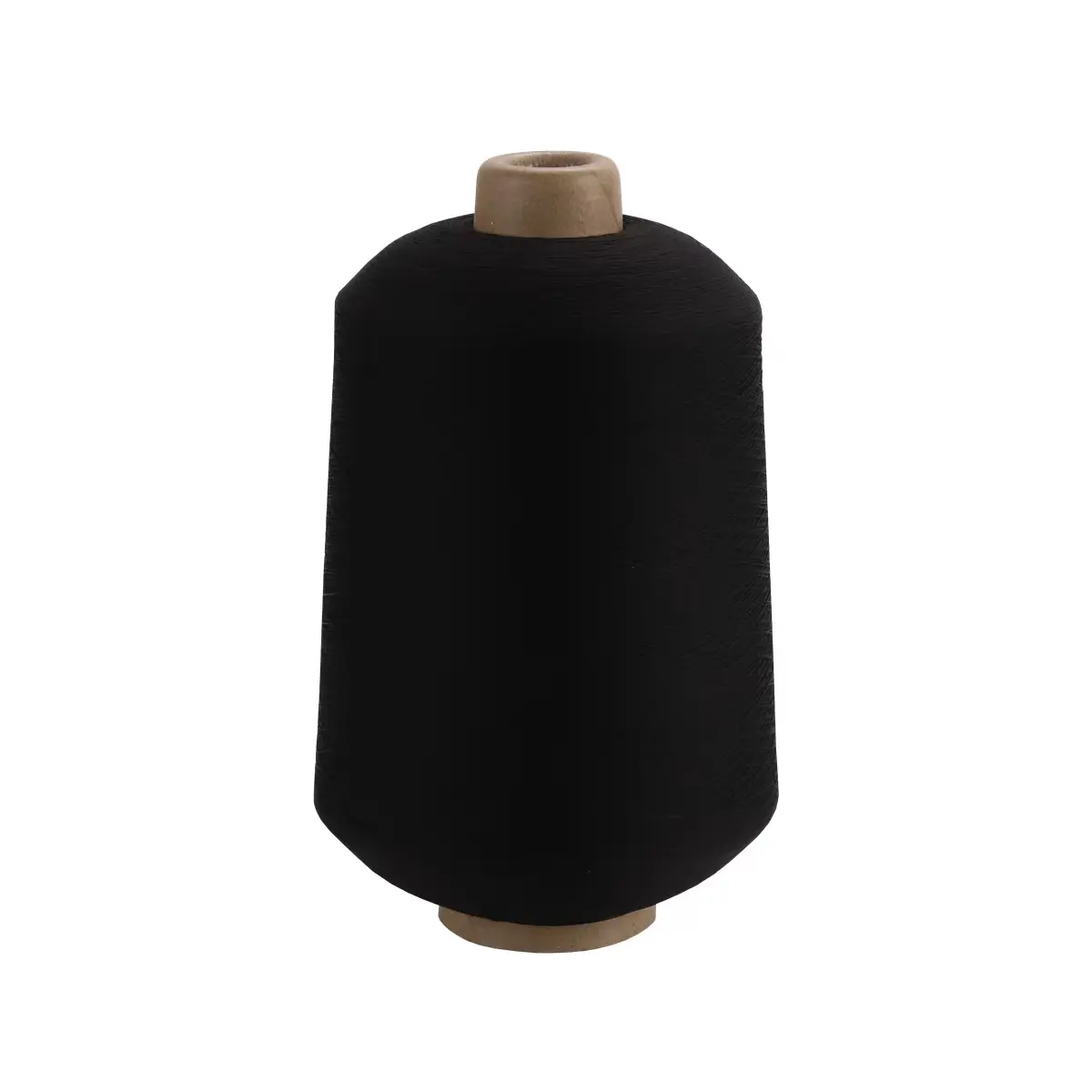
II. PA11 DTY Filament: Cracking the Strength Code to Breakage
When traditional materials are unable to overcome the limitations, the unique properties of PA11 DTY filament demonstrate targeted advantages. This bio-based filament, made from castor oil, leverages the dual advantages of its molecular structure and processing technology to construct the “breakage-resistant defense line” required for footwear uppers.
(I) Molecular-Level Advantages: The Innate Gene of Strength
The molecular chain of PA11 (polyundecylamide) consists of 11 carbon atoms. This odd-numbered carbon chain structure results in a higher density of hydrogen bonds between molecules, leading to a 5%-10% higher crystallinity than the commonly used PA6. This structure endows it with superior mechanical properties: Core strength data: Tensile strength reaches 55.1-67.0 MPa, far exceeding PA6′s 45-55 MPa, meaning that filaments of the same thickness can withstand greater tensile force.
Fatigue Resistance: In dynamic fatigue testing, PA11 DTY filaments showed no cracks after 100,000 bends, while PA6 filaments showed significant damage after approximately 20,000 bends.
Dimensional Stability: The water absorption rate in 24 hours at 23℃ is only 0.3%, far lower than PA6′s 1.5%, avoiding strength loss and deformation cracking due to moisture absorption.
(II) DTY Technology Enhancement: Practical Performance for Shoe Uppers
The DTY (Textured Yarn) technology, through texturing, gives PA11 filaments both high strength and good elasticity, perfectly meeting the needs of shoe upper weaving: The elongation at break can reach 360%, allowing it to deform with foot movement and quickly rebound to its original shape, reducing stress concentration.
The yarn has strong cohesion, making it less prone to breakage during weaving, and its excellent adhesion to the polyurethane coating further enhances the overall strength of the shoe upper.
III. Case Study: From Crisis to Benchmark
(I) Solution: Precise Material Upgrade
At the suggestion of the technical team, the wholesaler adopted Arkema BESN P20 TL PA11 DTY filament from France to optimize the upper structure in high-fracture areas:
Toe Area: A densely woven mesh fabric made of 200D/48F PA11 DTY filament was used to replace the original PA6 material, improving impact resistance.
Lace Eyelets: Reinforcing lining made of PA11 DTY filament was used, heat-pressed to form tear-resistant nodes.
Heel Area: A blend of PA11 DTY and elastic fibers was used, balancing support and flexibility.
(II) Results Verification: Data Witnesses a Leap in Quality
The first batch of 5,000 pairs of uppers after the material upgrade underwent rigorous testing and delivered outstanding results:
Bending Test: 15,000 cycles without breakage, far exceeding the brand’s standard requirement of 10,000 cycles.
On-site verification: Samples were sent to the European brand’s designated laboratory and, after simulating 6 months of daily wear accelerated aging testing, the upper’s integrity rate reached 98%.
Market feedback: Within 3 months of mass production, breakage complaints dropped from over 200 to 7, and the return rate plummeted from 18% to 2.3%.
(III) Commercial returns: Dual gains in cost and reputation
The solution to the strength issue directly translated into commercial value:
Loss mitigation: Avoided millions of order cancellations, reducing penalties and return costs by over $600,000 in a single quarter.
Price premium: Successfully increased the supply price by 5% based on stable quality performance and became a core supplier for the European brand.
Market expansion: Based on this case, successfully entered the Japanese outdoor shoe market, adding 1.2 million pairs of new annual orders.
IV. Selection Implications for Global Wholesalers
This case study demonstrates the core value of PA11 DTY filament in footwear applications and provides selection references for global buyers:
(I) Clarifying Quantitative Standards for Strength Requirements
Different scenarios have significantly different requirements for upper strength. When purchasing, it is necessary to clarify the indicators based on product positioning:
Product Type | Recommended Tensile Strength | Bending Test Standard | Applicable PA11 DTY Specifications
Professional Sports Shoes | ≥60MPa | ≥15000 cycles | 200D/48F-300D/72F
Casual Shoes | ≥55MPa | ≥10000 cycles | 150D/36F-200D/48F
Outdoor Hiking Shoes | ≥65MPa | ≥20000 cycles | 300D/72F-400D/96F
(II) Balancing Costs and Long-Term Benefits
Although the procurement cost of PA11 DTY filament is higher than that of PA6, the overall benefits are more considerable. Based on an annual supply of 1 million pairs of shoe uppers:
Material costs increase by approximately US$120,000
Return and penalty fees decrease by approximately US$800,000
Brand premium increases by approximately US$500,000
Net profit increases by approximately US$1.18 million
(III) Focus on Environmental Protection and Policy Compatibility
PA11 is derived from renewable castor oil, complying with EU carbon tariff policies and global environmental trends. Given the current preference for bio-based materials in Europe and North America, shoe uppers using PA11 DTY filaments are more likely to obtain green certification and gain market access advantages.
Post time: Nov-03-2025