
Abrasion Resistance of Polyester Hot-Melt Yarn: Controlling Wear and Tear in Long-Term Use of Woven Straps
Woven straps are critical components in industrial bundling, outdoor equipment, and everyday products. The issue of wear and tear during long-term use has always been a focus of the industry – friction, structural loosening, and breakage not only affect the user experience but can also lead to safety hazards and resource waste. Polyester hot-melt yarn, with its excellent abrasion resistance and structural stability, has become a core material choice for solving the long-term wear and tear problems of woven straps, providing a comprehensive solution from technical principles to practical applications.
I. The Core Technical Logic of Polyester Hot-Melt Yarn’s Abrasion Resistance
The abrasion resistance of polyester hot-melt yarn is not a single characteristic, but rather the result of the synergistic effect of the raw material’s inherent properties, fiber structure design, and hot-melt process. This is what distinguishes it from ordinary fibers and allows it to resist wear and tear over the long term:
1. The Abrasion-Resistant Nature of the Raw Material
Polyester itself possesses excellent mechanical strength and friction resistance. The rigid structure and high-density arrangement of its molecular chains result in a higher surface hardness, making it less prone to fiber shedding, pilling, or breakage during friction. Compared to traditional nylon and cotton fibers, polyester has a significantly higher abrasion resistance coefficient (reaching over 50,000 cycles in the Martindale abrasion test), providing basic abrasion resistance for woven straps.
2. Structural Reinforcement Effect of Hot-Melt Bonding
The core advantage of polyester hot-melt yarn lies in its “hot-melt film formation” characteristic: during the heat setting process after weaving, the low-melting-point components melt to form a uniform thin film, tightly bonding the warp and weft yarns of the woven strap into a single unit. This bonding method avoids the loosening and friction between fibers in traditional woven straps – wear and tear in ordinary woven straps often stems from repeated friction and shedding of individual fibers. After hot-melt bonding, the woven strap structure is tighter, and stress is evenly distributed under load, reducing excessive wear on local fibers and structurally preventing the source of wear and tear. 3. Optimized Fiber Morphology Design
High-quality polyester hot-melt yarn, through refined spinning processes, can achieve irregular fiber cross-sections (such as triangular or five-lobed shapes) and uniform linear density distribution. The irregular cross-section increases the cohesive force between fibers and reduces sliding friction; the uniform linear density ensures consistent wear resistance across all parts of the woven belt, preventing rapid wear caused by localized weak points and further extending the overall service life.
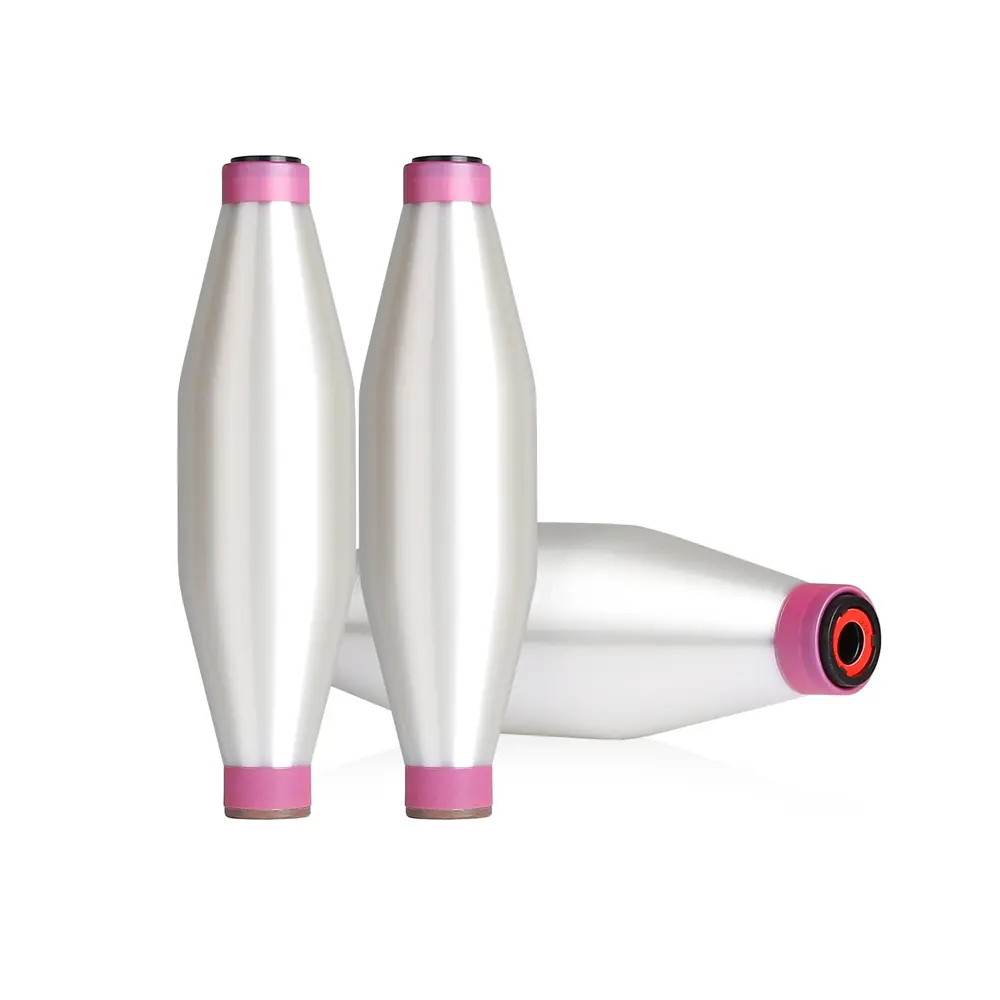
II. Three Key Roles of Polyester Hot-Melt Yarn in Controlling Woven Belt Wear
1. Resistance to Frictional Wear: Coping with High-Frequency Friction in Complex Scenarios
Woven belts are often used in scenarios involving continuous friction—friction from goods in industrial bundling, environmental friction in outdoor equipment, and friction from human contact in daily products. Polyester hot-melt yarn, with its high wear resistance, effectively withstands this high-frequency friction: in heavy-duty bundling scenarios, even with prolonged contact with rough surfaces, it is less prone to surface pilling and fiber breakage; in outdoor backpack straps and pet leashes, it maintains structural integrity under repeated bending and friction, preventing strength reduction due to wear.
2. Resistance to Structural Loosening: Reducing “Progressive Wear” During Long-Term Use
Ordinary woven belts, after prolonged stress or repeated use, are prone to yarn slippage and structural loosening, leading to narrowing width and thinning thickness, ultimately rendering them unusable. The hot-melt bonding structure of polyester hot-melt yarn creates an “irreversible” stable connection between fibers, maintaining the structural stability of the woven belt even under prolonged tension or bending. Data shows that woven belts using polyester hot-melt yarn have a structural loosening rate of only 15% compared to ordinary woven belts after 5000 repeated stretching tests, effectively slowing down the process of “progressive wear.”
3. Resistance to Environmental Aging: Extending Service Life Under Extreme Conditions
Woven belts are often used in complex and variable environments—high temperature, high humidity, and ultraviolet radiation accelerate fiber aging, reducing wear resistance and strength, and thus exacerbating wear. Polyester hot-melt yarn itself possesses excellent weather resistance: its temperature resistance range can reach -40℃ to 120℃, it does not easily soften or degrade in high-temperature environments, and it does not absorb water or mildew in humid environments. At the same time, the addition of anti-UV additives can further enhance its UV resistance, preventing the fibers from becoming brittle due to aging and reducing wear resistance. In long-term outdoor exposure scenarios, the service life of woven belts using polyester hot-melt yarn can be extended by 2-3 times, significantly reducing replacement frequency and cost.
III. Effectiveness of Loss Control in Typical Application Scenarios
1. Industrial Strapping: Reduced wear and tear under heavy load and friction
In heavy-duty strapping scenarios such as ports and logistics, traditional woven belts often show surface wear and strength degradation after only 3-6 months due to insufficient wear resistance, requiring frequent replacement. Industrial strapping made with polyester hot-melt yarn, however, boasts high wear resistance and structural stability, extending its service life to 18-24 months, reducing the wear rate by more than 70%. At the same time, its low creep characteristics ensure that long-term strapping will not loosen due to fiber stretching and deformation, further reducing indirect losses caused by product failure.
2. Outdoor Functional Belts: Enhanced durability in complex environments
Outdoor backpack straps, climbing safety belts, and other products need to withstand multiple wear factors simultaneously, including friction, bending, and UV radiation. After being woven with polyester hot-melt yarn, the products not only have a wear-resistant surface that does not fray, but also do not risk breakage due to aging during long-term outdoor use. Test data from an outdoor equipment brand shows that backpack straps using polyester hot-melt yarn, after a 1000-kilometer hiking test, showed only 20% of the wear of traditional products, fully meeting the wear control requirements for long-term outdoor use.
3. Automotive Interior Belts: Dual protection against high-frequency use and environmental aging
Automotive seat belts, seat adjustment belts, and other interior belts need to withstand high-frequency stretching and friction, while also facing the aging challenges of high temperatures and UV radiation inside the car. The high wear resistance and weather resistance of polyester hot-melt yarn effectively resist these wear factors: seat belts are less prone to wear and pilling during long-term opening and closing, and seat adjustment straps maintain structural stability under repeated stretching, extending their service life to match the entire lifespan of the vehicle, reducing losses due to repair and replacement.
IV. Sustainable Perspective: The Synergistic Value of Wear Resistance and Environmental Protection
The core of wear control is not only extending product life but also reducing resource waste and environmental burden. The high wear resistance of polyester hot-melt yarn means a lower frequency of woven belt replacement, thus reducing raw material consumption and waste generation; at the same time, high-quality polyester hot-melt yarn can be produced using recycled polyester raw materials, achieving resource recycling while maintaining wear resistance. This dual advantage of “wear resistance extending lifespan + recycling reducing consumption” allows polyester hot-melt yarn to achieve both economic value and align with the global trend of sustainable development in woven belt wear control.
Conclusion: Polyester Hot-Melt Yarn – The Technological Core of Woven Belt Wear Control
Long-term wear control of woven belts is essentially a comprehensive test of material wear resistance, structural stability, and environmental adaptability. Through raw material characteristics, process innovation, and structural optimization, polyester hot-melt yarn solves core wear problems such as friction wear, structural loosening, and environmental aging from the source, demonstrating significant wear control effectiveness in various application scenarios.
Post time: Dec-24-2025