
2025 Global Hot Melt Yarn Market Size Report: Segmented Demand Analysis of Low Melting Point Nylon and Polyester
The global hot melt yarn market entered a period of steady growth in 2025. As core supporting materials in textiles, automobiles, electronics, and other fields, low melting point nylon and polyester have become the core driving force for market growth due to their unique advantages. This article, based on authoritative industry data, provides an in-depth analysis of the global hot melt yarn market size structure, focusing on the segmented demand scenarios, regional distribution, and development trends of low melting point nylon and polyester, providing global distributors with accurate market decision-making references.
I. Global Hot Melt Yarn Market Size Overview: Growth Trends and Core Drivers
1. Overall Market Size and Growth Rate
The global hot melt yarn market size reached US$6.743 billion in 2025 and is projected to continue expanding at a CAGR of 4.5% from 2025 to 2033, with the market size expected to exceed US$9.589 billion in 2033. Low-melting-point nylon and polyester, as the mainstream categories, together account for over 72% of the global hot-melt yarn market, becoming the core driving force for market growth.
2. Core Growth Drivers
Downstream application scenarios continue to expand, with demands for automotive lightweighting, electronic packaging miniaturization, and upgraded medical protective equipment driving a surge in demand for specialty hot-melt yarns.
Environmental policies are driving industry transformation. The EU REACH regulation and China’s dual-carbon policy mandate increased use of recycled materials, highlighting the environmental compatibility advantages of low-melting-point nylon and polyester.
Technological innovation lowers application barriers. Technologies such as nanocomposite and bio-based modification improve product performance by 30%-50%, expanding application boundaries in high-end fields.
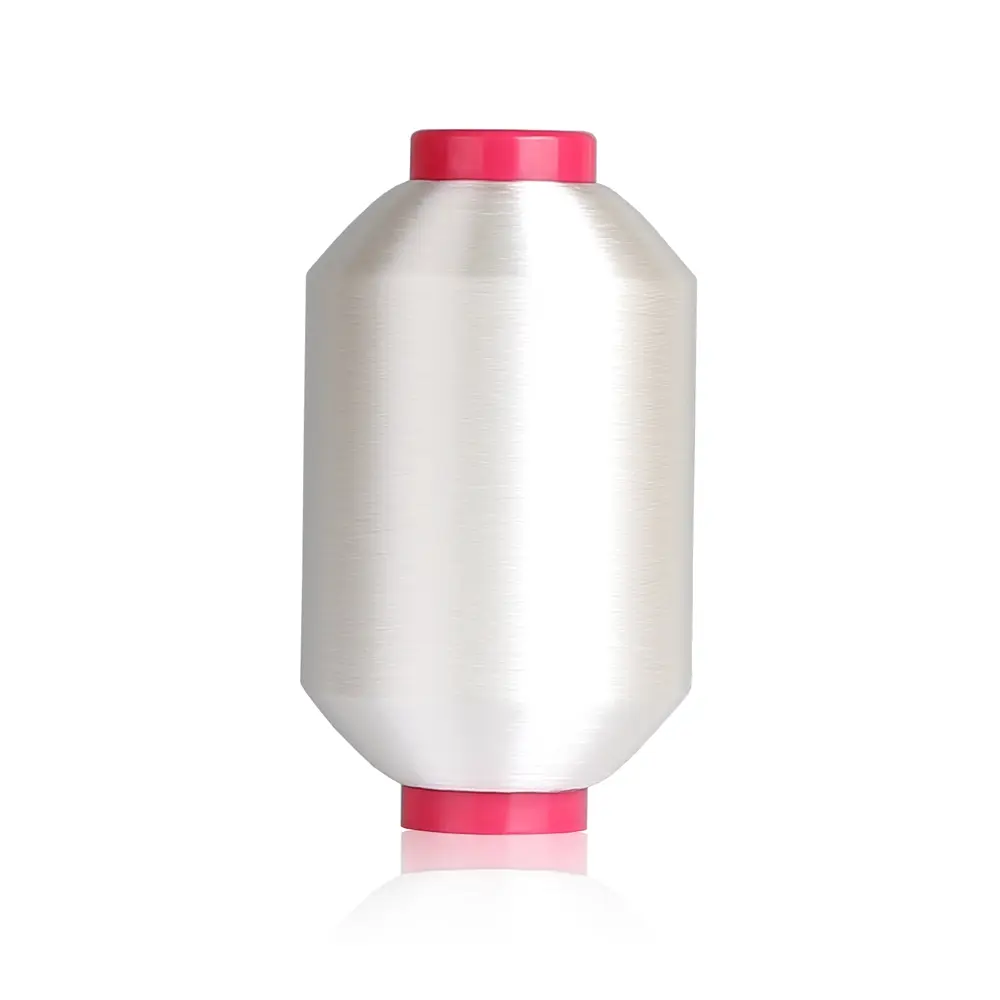
II. In-depth Analysis of Specific Demands: Application Scenarios and Advantages of Low-Melting-Point Nylon and Polyester
1. Low-Melting-Point Nylon: The Core Choice for High-End Fields
Low-melting-point nylon (melting point 90℃-150℃) has become the preferred material for high-end applications due to its excellent elastic recovery, biocompatibility, and adhesive strength.
In the healthcare sector: accounting for 35% of total demand for low-melting-point nylon, it is used in disposable medical dressings, mask ear loops, medical bandages, and other products. Its adhesive-free bonding properties ensure biocompatibility, and the global market gross margin for medical-grade low-melting-point nylon exceeds 40%.
In the high-end textile sector: accounting for 30%, it is used in seamless underwear, sportswear, and high-end footwear materials. Seamless molding is achieved through thermoforming, improving wearing comfort. One international sports brand has already achieved 80% application of low-melting-point nylon in its products.
In the electronic packaging sector: accounting for 25%, it is used in flexible printed circuit boards (FPC) and micro-connector packaging. The penetration rate of ultra-fine diameter (≤0.05mm) low-melting-point nylon in AR/VR devices is jumping from 18% to 52%.
2. Low-melting-point polyester: A cost-effective choice for large-scale applications. Low-melting-point polyester (melting point 110℃-180℃) dominates the mid-to-high-end large-scale application market due to its cost advantage, high-temperature resistance, and recyclability.
Automotive Industry: Accounting for 42% of total demand for low-melting-point polyester, focusing on insulation encapsulation for new energy vehicle battery packs and lightweight interior bonding. The global market size for automotive low-melting-point polyester is projected to reach 9.2 billion yuan by 2025, with new energy vehicles contributing 65% of the incremental growth.
Home Textiles & Furnishings: Accounting for 33%, used in the composite molding of carpets, mattresses, and curtains. Hot-melt bonding enhances product stability and durability. The global annual demand for bedding has reached hundreds of thousands of tons.
Recycled Textiles: Accounting for 18%, recycled PET-based low-melting-point polyester, thanks to chemical depolymerization and repolymerization technology, achieves performance close to 90% of virgin materials. The global application scale is expected to reach 480,000 tons by 2025, with China accounting for over 35%.
III. Regional Demand Distribution: Opportunities and Layout in the Global Market
1. Asia-Pacific Region: Largest Consumer Market and Production Base
Accounting for 45% of the global market size, China, India, and ASEAN are the core demand countries. China’s market share is projected to increase to 35% by 2025.
Demand is concentrated in the textile, electronics, and new energy vehicle sectors, with the Yangtze River Delta and Pearl River Delta industrial clusters contributing 60% of China’s hot melt yarn demand.
As a major exporter, China accounted for 40% of global hot melt yarn exports in 2024, becoming a core sourcing source for global distributors.
2. North America: A Hub for High-End Demand
The market size accounts for 28% of the global market, with the United States being the largest importer, accounting for 50% of global hot melt yarn imports.
Demand focuses on automotive electronics, medical equipment, and high-end textiles, with stringent requirements for product environmental certification and performance stability.
Policy support for intelligent manufacturing has led to an annual growth rate of 15% in demand for specialty hot melt yarns with high temperature resistance and low ionic impurities.
3. Europe: An Environmentally Driven Market
The market size accounts for 20% of the global market, with Germany, France, and Italy being the main consuming countries.
EU REACH and PPWR regulations are driving increased use of recycled materials, resulting in a surge in demand for biodegradable low-melting-point nylon.
The medical and automotive sectors favor bio-based hot-melt yarns, with product premiums reaching 25%-40%.
4. South America and the Middle East & Africa: Emerging Growth Markets
This market accounts for 7% of the global market size, with Brazil, Chile, and the Gulf Cooperation Council countries being the core growth drivers.
Demand is primarily driven by textile and apparel applications and basic industrial uses, with high acceptance of cost-effective low-melting-point polyester.
Imports are projected to increase by 400% in 2023-2024, making it a promising emerging region in the global market.
IV. Technology and Policy Drivers: Market Development Trends for the Next 5 Years
1. Technological Innovation Directions
High Performance: Low-melting-point nylon is upgrading towards even lower melting points (≤130℃) and higher adhesive strength; polyester is developing towards high-temperature resistance (above 300℃) and ultra-fine diameters.
Environmental Protection: The proportion of bio-based materials will increase from the current 15% to 30% by 2030, with biodegradable products becoming mainstream in the high-end market.
Intelligent Production: Intelligent production lines with a single-line capacity of 25,000 tons/year are becoming standard, significantly improving product customization capabilities and enabling specification switching within 12 hours.
2. Profound Policy Impact: China’s 14th Five-Year Plan lists high-end hot-melt yarn as a key strategic material, with R&D subsidies reaching 420 million yuan by 2025, driving the domestic production rate to 30%.
The EU’s plastic tax (reaching 800 euros/ton by 2025) is forcing companies to adopt recycled materials, driving demand growth for low-melting-point polyester recycled products.
Global carbon reduction policies are promoting the development of new energy vehicles, increasing demand for automotive hot-melt yarn from 1.2 kg/vehicle in 2025 to 2.5 kg/vehicle in 2030.
V. Distributor Cooperation Opportunities: Seizing the Niche Market Dividends
The structural growth of the global hot-melt yarn market provides clear market opportunities for distributors of low-melting-point nylon and polyester. The high-end medical, new energy vehicle electronics, and recycled textile sectors are experiencing the fastest demand growth, with gross profit margins significantly higher than the industry average. The mature Asia-Pacific market complements the emerging markets in South America and the Middle East and Africa, allowing for the coverage of the entire value chain through a differentiated product portfolio.
As a supplier specializing in low-melting-point nylon and polyester, we leverage our intelligent production base to provide flexible services such as customized melting points, environmental certifications, and small-batch pilot production. Our products have obtained major global certifications such as EU REACH and US FDA, adapting to the policy and application needs of different regions worldwide.
Post time: Nov-07-2025